A small business agrees to buy a payment service. The sale is celebrated. Then comes a less photogenic procession: identity checks, a form, a processor, a bank team, another form, a support call. The customer has one question - when can I start? Each participant may have an answer about its own step. Nobody can see the whole procession. It is possible to win the customer and lose the business before the first transaction.
Alfred “Chip” Kahn IV saw an early version of this problem at Boomtown, the merchant technology support company he founded in 2014. Small businesses bought new software but often failed to activate it. In a later interview, he described the commercial absurdity plainly: the provider had paid to acquire the customer, yet the customer had not gone live. Boomtown initially supplied the human help - remote support and technicians in the field. The deeper issue was the trip between signing up and using the product.
- OvationCXM coordinates onboarding and support work across banks, payment providers, software and outside partners.
- Its main product, CXMEngine, puts journey steps, tasks, cases, knowledge and communication in a shared workspace.
- KeyBank reports lower costs and higher revenue in a merchant-services case; those figures describe that engagement, not a promised return for every buyer.
- Paid journey-mapping workshops start at $3,945. The platform is priced by scope rather than by seat.
The customer did not buy your org chart
A bank may already have a CRM, ticketing system, digital portal, core platform and an impressive collection of vendors. Those systems are good at keeping their own records. They are less good at telling a customer who is waiting on whom. OvationCXM's argument is that the painful part of a journey often happens between applications and organizations. A merchant's application can be complete in one system and stalled in another, while an employee checks email for the latest status.
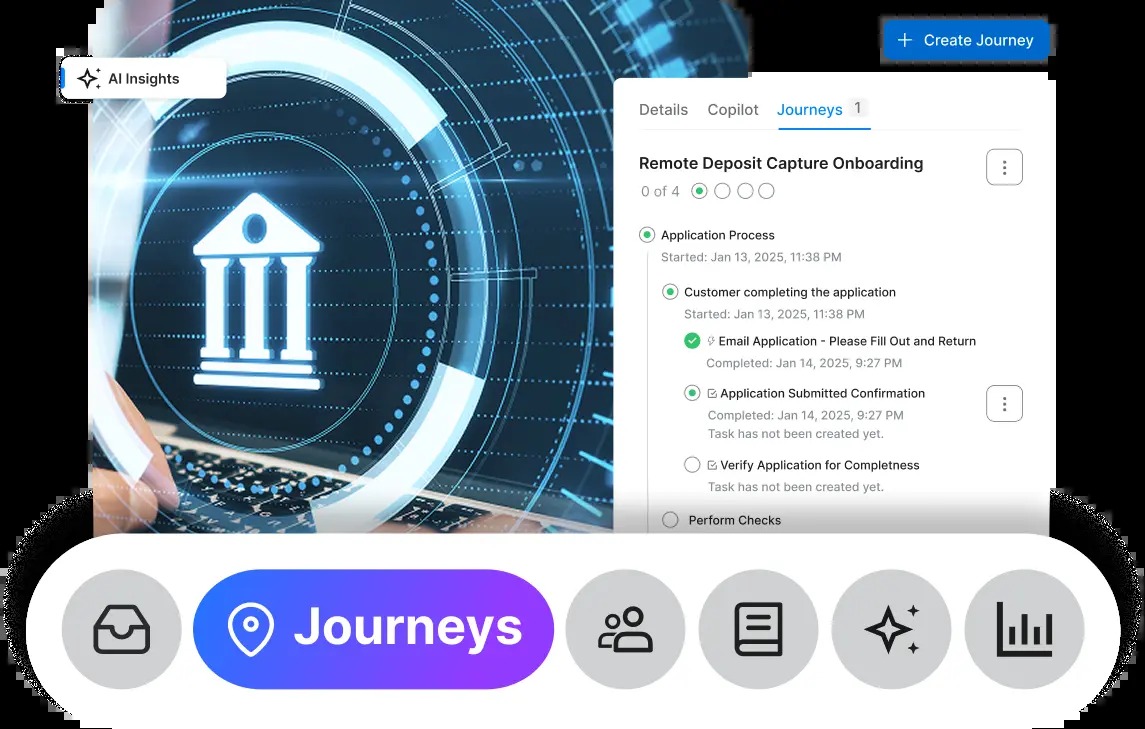
CXMEngine sits above the existing stack. Connectors pull relevant information into a common view; business teams use a no-code builder to set stages, owners, conditions and notifications. A live timeline shows where a customer is, what has happened and what comes next. Support staff can open a case with the journey context attached. Managers can find a queue of stalled applications rather than discovering the blockage from an angry call. The company also sells knowledge tools, customer communication and remote or field support services.
The distinction matters. A CRM can tell the bank who bought the service. A contact-center tool can record the complaint. A workflow app can automate a task inside one team. OvationCXM is trying to coordinate the journey across all of them, including third parties. That position depends on integration work and on persuading organizations to agree who owns each handoff. Software cannot settle a quarrel over responsibility by itself.
The case that gave the theory a number
KeyBank's merchant-services operation offered a useful test. The bank had built a network of fintech partners, but the experience for small business customers suffered at the joins. OvationCXM says it connected data across systems, organized requests and delivered the right knowledge to associates. Its case study reports that the merchant-services business became profitable 13 months after adopting the platform. It also reports a 26% reduction in operating costs, 10% higher revenue, a 60% lift in NPS and 75% greater service visibility.
KeyBank merchant-services results as reported in OvationCXM's case study; no universal outcome is implied.
The numbers are striking, but the practical lesson is smaller and more portable: start with one journey that has a measurable finish line. Merchant activation has one. Either the customer is processing payments or is still waiting. OvationCXM recommends mapping the current route with operations, compliance, support, product, IT and partner teams in the room, then finding delays that everyone has learned to tolerate. Its own example is a 14-day stretch in which nobody contacts the customer. There is little point buying a better dashboard if no one is assigned to shorten those fourteen days.
“Most of the small businesses didn't activate the product.”Alfred “Chip” Kahn IV on the problem that shaped Boomtown
A new name for an older frustration
By 2021, Boomtown had launched CXMEngine as the software expression of what its support work had taught it. In September 2022 it changed its name to OvationCXM and announced $20 million in combined Series C and debt financing, led by Telstra Ventures, with participation from KeyBank and others. The company said the round brought capital raised to more than $40 million. It also reported 600% year-over-year bookings growth for CXMEngine. Those are company figures, and bookings growth is not the same thing as revenue growth.
The rebrand made the intended buyer clearer. Today the company leads with commercial banks, credit unions, payment companies and fintechs, though it has also named customers in retail, healthcare and other sectors. Its 2022 announcement cited about 200 customers whose services reached millions of businesses. The product is enterprise software, bought by organizations trying to improve their own customers' experience. The end user usually does not know OvationCXM's name; they notice whether onboarding finishes and whether the next support agent knows the story.
What does the fix cost?
OvationCXM publishes one useful entry price. A virtual workshop producing one detailed journey map and recommendations costs $3,945; a two-map session costs $5,499. The company says it credits the workshop fee if the buyer signs a CXMEngine contract within 120 days. That is a sensible bridge from diagnosis to software sale, and a reminder that the map is itself a product: it forces a group of departments to agree what actually happens.
The platform's Basic, Pro, Enterprise and custom packages require a quote. OvationCXM says it does not charge by seat, because a journey may involve many people. Scope determines the package; optional AI has an access fee plus usage charges. A buyer can leave AI turned off. That model makes sense for cross-company work, but it also means the public cannot calculate a simple per-user comparison with a CRM or help desk subscription.
The next handoff may be to a machine
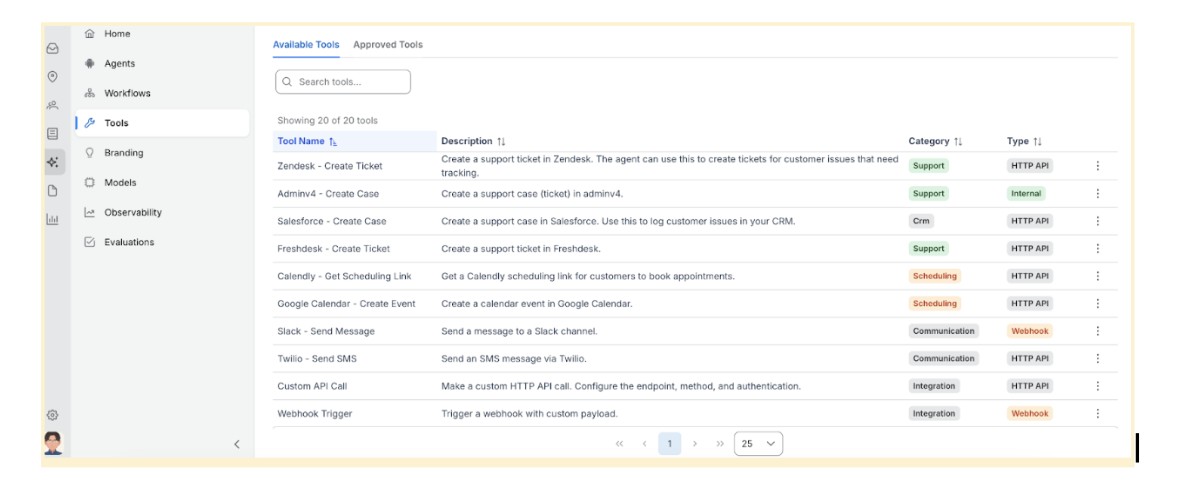
In 2024 OvationCXM joined IBM's LinuxONE Partner Network and described work on OneView, a way to assemble fragmented bank household data. In January 2026 it introduced a redesigned CXMEngine workspace and AI Studio for building and governing chat, voice and internal copilot agents. Its later AI Studio explanation emphasizes traces, tests, tool access and human review. In banking, a helpful answer is only half the job. An institution also needs to know which data an agent saw, what it was allowed to do and how to stop or audit an action.
The company has an obvious commercial reason to talk about agentic banking, and its research should be read with that in mind. Still, the question it raises is real. A June 2026 survey of 522 U.S. finance leaders found 69% would pay their bank for secure AI-agent connectivity. A September survey of 520 leaders found three-quarters were using or testing agents in at least one finance workflow. These are stated intentions and self-reported use, not proof that every bank needs the same product. They do suggest that the old customer journey - one person, one portal - is becoming a crowded room.
The copyable idea is almost embarrassingly ordinary. Pick an onboarding or service journey that matters financially. Write down every step, including the vendor's steps. Mark the owner, the expected time and the signal that a customer is stuck. Share the same status with the people who can act on it. If the process crosses few systems or partners, a simpler workflow may do. If it crosses many, the space between them can become a business of its own. OvationCXM has spent a decade trying to make that space visible.