Imagine a list of conference guests arriving as a PDF. Someone must find a name, copy the details, open a CRM, create a record, check the fields and move on. The job is too small to inspire a software project and too frequent to ignore. Adept built an agent to do precisely this kind of work. Its demonstration starts with the PDF and ends with a new HubSpot lead. Then the company shows a version for Salesforce, with modest changes to the instructions.
- Adept makes AI agents that see and operate existing business software.
- Its 2022 action model became a workflow product and, later, a more controlled agent platform.
- After raising $415 million, Adept narrowed its focus in 2024; Amazon licensed its technology and hired cofounders and some staff.
- The transferable lesson: give an agent freedom only where the task can tolerate it.
It is a rather prosaic test for a company founded to pursue general intelligence. That is its charm. The invoice, the lead record, the form nobody wants to fill: these are the places where a capable model must become a useful colleague. A dazzling answer earns applause. A correct entry in the right field earns trust.
The founding bet was on action
David Luan launched Adept in 2022 with Niki Parmar and Ashish Vaswani, two authors of the Transformer research that underpins much of modern AI. Luan had led engineering at OpenAI and large model work at Google. The founding argument was that text alone would not finish the work on a person’s computer. An assistant had to use the tools already there: browsers, spreadsheets, company applications and all their peculiar menus.
That year Adept introduced ACT-1, an Action Transformer shown clicking, typing and scrolling through browser tasks from plain language instructions. One demo compressed what the company described as more than ten Salesforce clicks into a sentence. The point was less that Salesforce had disappeared than that the user no longer had to remember its choreography. Adept’s original ambition was an interface laid over software, able to work in the same places as a human.
The market had an obvious alternative: robotic process automation, which is good at repeating known steps but can become brittle when a page changes. Another choice is to wire applications together through APIs. That can be robust, but every system pair brings integration work and permissions to maintain. Adept’s bet is visual: the agent perceives pixels and acts through the interface. If a tool has a screen, there is at least a plausible route into it.
A click is a commitment
The ease of a demo can be deceptive. A wrong sentence in a draft is fixable. A wrong click may change a customer record, send an email or produce an invoice. Adept’s 2023 Workflows experiment showed both the promise and the rough edges. Its own launch note said the public experiment sometimes needed careful prompting and that some sites worked better than others. For workflows enabled with enterprise customers, the company reported reliability above 95 percent. That is a company claim, not a universal success rate, and it describes a more carefully prepared setting.
The design kept a person close. When building or testing a workflow, actions could proceed one at a time. The agent could ask for missing information, and the user could watch the steps. That detail matters: oversight is easiest when the software exposes what it is about to do, not after it has done it.
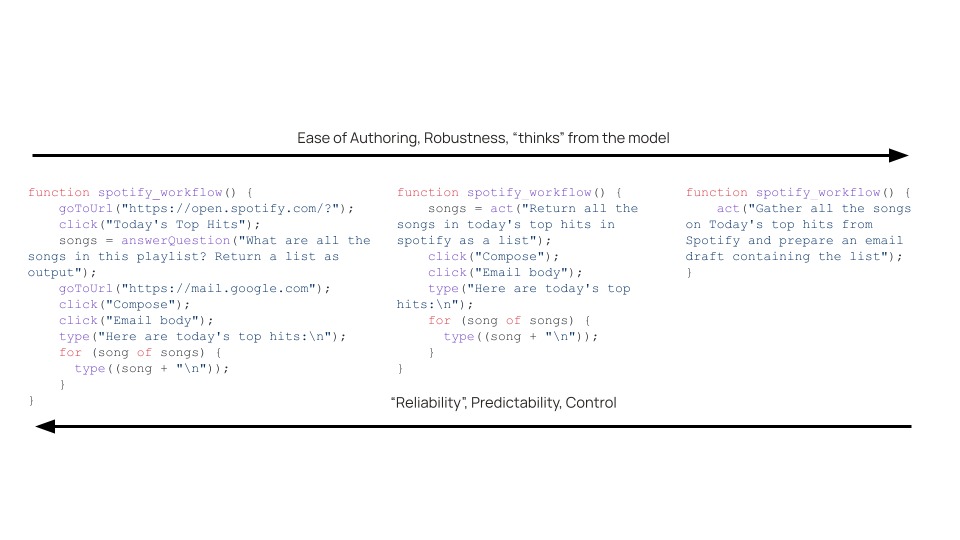
Adept’s later answer to the freedom problem was Adept Workflow Language, or AWL. It is a subset of JavaScript that can be very specific - go to this URL, click this item - or can ask the model to plan a less predictable step. The person writing a workflow can set the amount of discretion. One task may require strict commands because the consequences of a mistake are high. Another may need the agent to reason its way around a slightly altered page.
An agent needs a plan. A business needs to know which parts of that plan the agent may change.The tension behind Adept Workflow Language
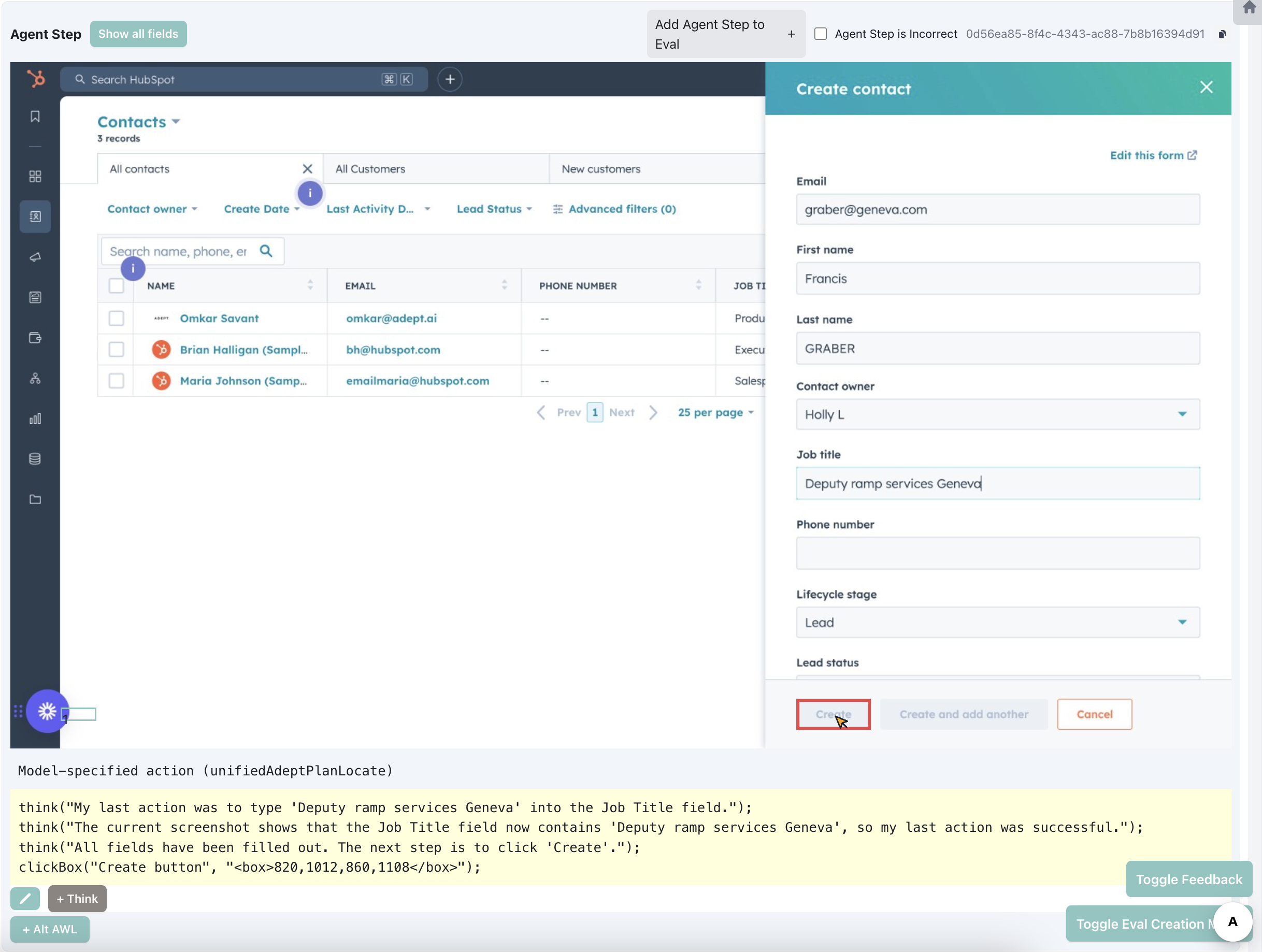
In the PDF-to-CRM demonstration, the agent reads the attendee details and creates a lead. To move from HubSpot to Salesforce, the team changed the destination and a few field instructions; Salesforce calls the record a lead and asks for a salutation. Adept says the adaptation took under five minutes. It is a tidy example of its advantage: a workflow built around understanding a screen can survive a change of destination without rebuilding every connection from scratch. It does not prove that every enterprise process will transfer so easily.
The expensive part of being general
Adept arrived with serious backing: $65 million announced at launch, then a $350 million Series B in March 2023 led by General Catalyst and Spark Capital. It built research models as well as the product: Fuyu-8B for multimodal understanding, ACT-2 for Workflows, and further work on screen perception. The company’s stated course was to train increasingly capable foundation models and turn them into agents. That meant pursuing two demanding businesses at once: model research and an enterprise product.
The model work also produced a less glamorous lesson. During a large training run, Adept’s researchers found silent hardware errors that could corrupt calculations without an obvious crash. They rebuilt the run in deterministic mode, compared machines, and removed a faulty node. A subsequent job ran for weeks without the same failure. For an agent company, this was an early reminder that reliability begins long before an agent sees a screen.
In June 2024, Adept explained the trade-off in plain terms. Continuing both tracks would require substantial attention to fundraising for foundation models. The company chose to focus on agentic AI solutions. Amazon licensed Adept’s agent technology, multimodal models and some datasets; cofounders and some staff joined Amazon’s AGI organization. Zach Brock, previously head of engineering, became Adept’s CEO, with Tim Weingarten continuing to lead product. Adept said it had already deployed workflows spanning dozens of steps in production, although it did not name those customers publicly.
This was neither a neat sale nor the original plan fulfilled. It was a revision of where the company believed it could create value. The economics of training ever larger models had pulled attention away from the awkward, valuable work of making agents operate safely inside real companies. A narrower Adept could sell the agent layer and its know-how without shouldering every future model race itself.
What an ordinary company can steal
There is a practical playbook here, even for firms that will never train a model. Start with work that has a visible beginning and end: extract the invoice number, populate the record, check the result. Write down the business rules before handing over the clicks. Make the machine’s steps inspectable. Allow natural language where judgment helps; use precise commands where a wrong action would be costly. Then measure success on the complete workflow, including exceptions, rather than on an isolated demo.
This approach has limits. Visual agents can still misread an unusual page, struggle with a changed login, or make an error that propagates across systems. A workflow that touches money, regulated records or customers needs permissions, review and a way to recover. Adept’s own 2023 caveats are a useful reminder that a good agent in a prepared environment is not the same as an agent that can be dropped into any company and trusted immediately.
Adept began with a grand question: can a model use every tool on a computer? Its more interesting question now is smaller. Can a company give a model a task, watch it cross the messy distance between applications, and know when to let it act? The future of office automation may be decided less by whether an agent can click a button than by whether the person who owns the workflow knows exactly why it did.