The most revealing sentence in enterprise procurement is not “We saved 12 percent.” It is “Where is my request?” Somewhere between an employee asking for a marketing agency and a purchase order appearing, the request has visited legal, security, finance, sourcing, supplier risk and an ERP. Everyone owns a step. Nobody owns the trip. When the work stalls, procurement gets blamed for the whole vacation.
ORO Labs was founded in 2020 by three former SAP Ariba product leaders - Sudhir Bhojwani, Lalitha Rajagopalan and Yuan Tung - who knew this peculiar maze from the inside. Their answer was not a larger suite. It was an orchestration layer: one approachable place where an employee says what they need, while workflows coordinate the systems and specialists behind the scenes.
That sounds modest. It is closer to air-traffic control. A global enterprise may have SAP for purchasing, Workday for people data, Icertis for contracts, OneTrust for privacy, ServiceNow for tickets and three homegrown databases whose original authors have changed jobs. ORO connects them, applies policy, routes tasks in parallel and shows the traveler where the request is. The systems of record stay put. The confusion becomes ORO's addressable market.
01 / The productA receptionist for the Franken-stack
ORO's “walk-up” interface is built around a consumer-software idea: users should not need procurement training. AskORO interprets an ordinary request, gathers missing facts, points to preferred suppliers and starts the correct workflow. Procurement teams use no-code builders to change rules and routes. The platform covers intake, sourcing, supplier onboarding and maintenance, contracts, risk, compliance, approvals, purchase orders and payment handoffs.
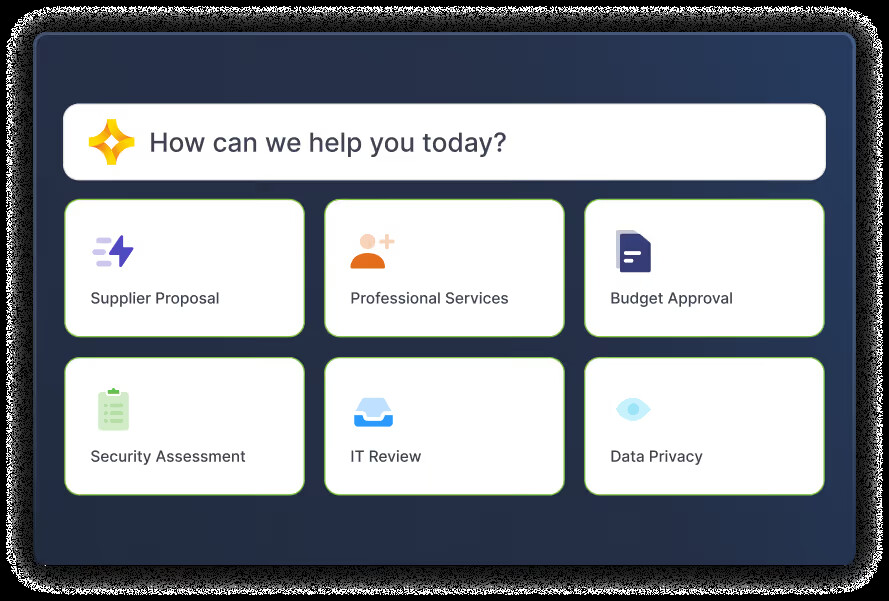
The newer layer is agentic AI. Agents can collect supplier evidence, review a purchase request, score risk or draft material. Crucially, ORO puts those agents inside a defined process, with access controls, policy checks, auditability and human review where judgment matters. Customers can use ORO's models or bring their own. That makes the pitch less “chat with your procurement bot” and more “give the bot a badge, a route and a supervisor.”
The Idea-to-Pay relay
02 / The originWhat failed first was visibility
The founding team's advantage was not a secret model. It was scar tissue. They had spent years building and operating procurement products at Ariba and SAP. They saw that adding features to a system of record did not repair the journey across systems. A request might appear to have taken two months, even when procurement touched it for five days and business approvals consumed the other 55. Without end-to-end visibility, every department defended its own queue.
The industry had tried standardization through monolithic source-to-pay suites. That works when an organization can accept a common process and move most work into one vendor. It strains when regions, categories and regulations differ, or when an acquisition arrives with another stack. The founders changed the unit of design from “the application” to “the process.” ORO could then connect the applications already there.
The same change appears in ORO's implementation advice. Its delivery leaders resist spending months documenting every exception in the current state. Reproducing a broken process in fresh software merely gives the mess a login screen. Teams begin with the outcome, find a quick win, configure working software and use playback sessions to refine the future process. One financial-services customer reached a live intake and risk workflow with integrations in three months. ORO's newer growth-enterprise package advertises typical rollouts in four to eight weeks.
03 / The proofLess waiting, fewer swivel chairs
The customer list reads like an airport departures board: Coca-Cola, Pfizer, Roche, Bayer, BASF, Danone, GSK, Novartis, Kyndryl, Liberty Global, Booking.com and others. These companies have enough scale for small workflow gains to become large numbers. They also have enough legacy software to make a clean-sheet replacement implausible.
Bristol Myers Squibb reported that Procure@BMS cut end-to-end cycle time by about 80 percent and reduced supplier onboarding to one day. More than 1,600 unique users arrived in the first month. At Novartis, a purchase-request review agent reportedly brought work that took hours or days down to an average of 16 minutes, improved accuracy by 325 percent and handled ten times the volume without new headcount. Pfizer used an agent to automate a compliance checklist with more than 20 points and implemented its front door in three weeks.
The less cinematic examples may be more instructive. Danone connected ORO with Coupa, Fairmarkit and Candex. Liberty Global linked SAP, GEP, Oracle and OneTrust, initially going live across five category trees and 10 companies in five weeks. At one customer, clearer risk rules let low-risk preferred-supplier requests go straight to a purchase requisition at a $250,000 threshold, up from roughly $25,000 to $50,000 in limited categories. The software mattered. So did the organization's willingness to decide what “low risk” actually meant.
04 / The moneyA subscription for keeping the stack
ORO sells annual enterprise SaaS subscriptions, with implementation and partner services around them. Most pricing is negotiated. One public marker exists: SAP lists ORO for SAP Fast Start at $125,000 per year, including unlimited users, suppliers and spend, core intake-to-procure workflows and pre-built SAP integrations. The full enterprise edition is price-on-request. For a multinational, the comparison is not a team credit card. It is the cost of delay, manual coordination, compliance misses and an expensive suite replacement.
Investors have funded that thesis heavily: $25 million in Series A financing in 2022, $34 million in a Felicis-led Series B in 2023, a strategic investment from Workday Ventures in 2024 and $100 million in Series C financing in March 2026. Brighton Park Capital and Growth Equity at Goldman Sachs Alternatives led the latest round, with existing backers participating. ORO said revenue had grown 300 percent in the preceding year. Its valuation remains private.
The company used 2025 to widen its moat beyond code. It acquired UK-based ProcureTech, absorbing a network and expertise in the procurement technology market. It then launched OPEN, a partner ecosystem that includes sourcing, contracting, analytics, advisory and systems players such as Fairmarkit, Globality, Keelvar, Candex, Sirion, Ironclad, SAP, Coupa, Oracle and Deloitte. Orchestration becomes more valuable when the things being orchestrated arrive ready to connect.
05 / The marketThe alternatives, and the trap
ORO competes most directly with procurement intake and orchestration products including Zip, Omnea, Tonkean, Opstream and Levelpath. It also rubs against the workflow ambitions of Coupa, SAP Ariba, Ivalua, Jaggaer and ServiceNow. Its distinction is an enterprise-first combination of procurement semantics, no-code process design, deep integrations and governed agents. The awkward competitive detail is also its best sales argument: ORO may make rival systems more usable by sitting above them.
There is no universal winner here. A smaller company with a simple process may be better served by a single procurement suite. A business that has not defined ownership, cleaned master data or secured API access will not be rescued by orchestration. AI can accelerate a bad rule as efficiently as a good one. And a new “front door” that adds questions without removing old steps simply becomes another door.
When the playbook breaks
- No executive owner can simplify policy or settle disputes between procurement, finance, legal and security.
- Supplier and contract data are unreliable, inaccessible or inconsistent across systems.
- The implementation copies every exception from the old process instead of designing the future one.
- Teams automate high-risk decisions without audit trails, thresholds or accountable humans.
06 / The stealOwn the journey, not every database
The reusable idea extends beyond procurement. Look for a job that crosses three or more entrenched systems and makes users chase status. Do not begin by replacing every database. Build the clean entrance, translate the user's intent, coordinate the handoffs and write results back to the systems that already govern the company. Start with one painful route. Measure waiting time, manual touches and adoption. Expand only after the route works.
ORO's second lesson is to put AI after process clarity, not before it. An agent needs defined permissions, trusted context, an escalation path and a visible record of what it did. The third is more human: vocabulary matters. A marketer thinks in campaigns and deliverables, not line items and requisitions. Hiding institutional jargon can be a serious productivity feature.
The company now calls the larger journey “Idea-to-Pay.” The phrase risks sounding like consultant wallpaper, but the underlying observation is sharp. Buying starts before the form, when somebody has a need. If software meets that person there and carries the context through risk, sourcing, contract and payment, procurement can stop acting like a guarded department and start behaving like infrastructure. ORO Labs did not eliminate the enterprise maze. It drew a useful path through it.