A car part has two prices. One is on the receipt. The other is paid in waiting: a missed shift, a borrowed ride, a repair bay occupied by a car that cannot leave. O’Reilly Auto Parts operates where those prices meet. Its shelves contain ordinary things - filters, brake pads, batteries. Its more interesting proposition is that the right thing can be close enough, with enough help attached, to get a job moving again.
- Home mechanics and repair shops share one parts network.
- Availability depends on warehouses, hub stores, and knowledgeable people.
- Free tests and loaner tools remove obstacles between buying a part and finishing a repair.
A retirement plan falls apart
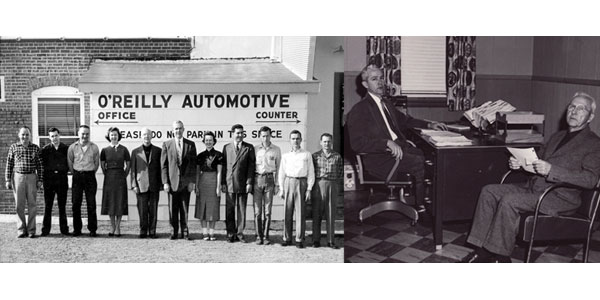
The founding story begins with an employer’s plan. In 1957, Link Motor Supply proposed a reorganization that would retire Charles F. O’Reilly, then 72, and transfer his son, Chub, to Kansas City. Neither liked the arrangement. They started their own company in Springfield, Missouri. On December 2, one store opened with 13 employee-owners. The first full year produced $700,000 in sales.
There is something useful about the pace that followed. Store number two arrived in 1965, eight years later. A warehouse and office facility followed in 1975. The company’s history dates its dual-market strategy to 1978: serve both the person fixing a car at home and the professional paid to fix somebody else’s. The distinction sounds small until you consider how differently those customers spend a Tuesday.
Two clocks at one counter
A home mechanic may need an explanation. A technician may know exactly what is wrong and need the replacement delivered. O’Reilly’s professional offering includes online ordering, on-demand delivery, shop equipment, and training. Its retail side supplies parts and practical assistance. The commercial logic is to let those different needs support the same local infrastructure.
The professional business reaches beyond passenger-car repairs. O’Reilly markets supplies for fleet and heavy-duty work, agricultural applications, hydraulics, and marine uses. It also offers technician and business training. For a shop, that makes the relationship broader than an occasional box arriving at the door: ordering, equipment, and learning can all run through one supplier.
Other sales and adjustments: $0.36B. Figures rounded.
Here is the operating logic, rather than a claim that every purchase works perfectly: two customer groups can help justify a deeper stockroom than either might support alone. That gives the counter worker more ways to say yes. It also gives the company two routes into the same repair economy, whether an owner picks up the wrench or pays someone else to hold it.
The bill for being nearby
At the end of 2025, O’Reilly operated 32 distribution centers and 399 hub stores. A hub is a store with a larger inventory that also supplies surrounding locations. Distribution centers replenished substantially all stores five nights a week. The aim is practical: a local shelf has limited space; a connected shelf has options.
Being nearby is expensive. O’Reilly spent about $1.17 billion on capital expenditures in 2025. That is company-wide annual investment, not a price tag for the entire distribution system. The business buys and resells merchandise; stores, vehicles, equipment, and inventory make the service possible. Convenience has to earn enough gross profit to carry its physical weight.
AutoZone, Advance Auto Parts, NAPA stores, independent distributors, and online sellers compete for these purchases. Free tests and loaner tools are available elsewhere too. O’Reilly’s case rests on how its pieces work together. For a planned job with flexible timing, an online price may matter more. For a stranded vehicle or occupied service bay, local availability can change the calculation.
Borrow the tool. Finish the job.
The Loaner Tool Program is a pleasingly literal answer to a household problem: why own an expensive specialty tool for one repair? O’Reilly lists more than 80 tool types. Leave a deposit, return the tool in its original condition, and receive a refund. Keep it, and the deposit is its purchase price. Availability varies by store.
The same practical thinking appears in free battery testing, selected component tests, and wiper installation. VeriScan reads vehicle trouble codes and produces a report that helps a customer investigate a warning light. A code read is a starting point for diagnosis. Battery installation has limits too: difficult access, extensive disassembly, or required resets can make a vehicle ineligible.
The person behind the counter
The company calls its staff Professional Parts People. Its stated culture favors internal promotion, a policy with a visible example at the top. Brad Beckham joined as a parts specialist in 1996, moved through store and regional operations, and became CEO in 2024. His career connects the executive office to the kind of conversation that happens over a counter.
“providing excellent customer service each and every day”Brad Beckham / 2023 succession announcement
For another business, the copyable idea is specific: find customers whose different needs can share expensive infrastructure, then remove the small obstacles that stop them completing a task. A tool deposit can do that. So can a useful explanation. The harder part is preserving the economics when deliveries become sparse, staff expertise thins, or customers can comfortably wait for a cheaper shipment.
More places. Same test.
Acquisitions helped enlarge the map. The 2008 CSK transaction was announced at roughly $1 billion, including debt. Mayasa brought entry into Mexico in 2019; Vast-Auto brought Canada in January 2024. In 2026, the company’s name also moved onto NASCAR’s secondary national series, extending a long association with racing.
The latest reported quarter available for this profile, ending June 30, 2026, showed 6,695 stores and a 6.0% increase in comparable-store sales. Those numbers describe reach and growth. The everyday test remains smaller: can someone get the correct part, understand what comes next, and put the vehicle back to work? Every additional location creates another place to answer.