At Team IMPACT’s Game Day Gala, the revealing result was a seating plan. The nonprofit’s staff usually worked on tables until noon on event day. After moving to the OneCause Fundraising Platform, they finished the day before. A thousand guests still needed seats. The work had become easier to finish.
There is a useful way to think about fundraising software hidden in that small detail. A guest sees an evening. The organizer sees a chain of dependencies. Sell a ticket. Find the guest’s name. Assign a table. Record a pledge. Collect the payment. A splendid speech cannot reconcile the accounts.
- OneCause connects event logistics with bidding, donations and payments.
- Its move from supplied devices to software changed the business.
- Published entry prices require a closer look at fees and package scope.
- Bonterra acquired it in October 2025, adding events and auctions to a broader portfolio.
A company born between the bid and the bill
OneCause’s own origin story begins with gala attendees who thought giving ought to be easier. The company dates its operating history to 2008, when it ran its first fundraising event under the BidPal name. Early coverage describes auction guests entering bids on supplied iPod Touch devices. The paper bid sheet had acquired a screen.
That was a specific intervention. In a silent auction, every return to the table competes with a conversation, a meal or another attraction. Mobile bidding lets a supporter browse items, place bids and receive an outbid notification without repeatedly crossing the room. It also leaves an electronic record for the people who must settle everything afterward.
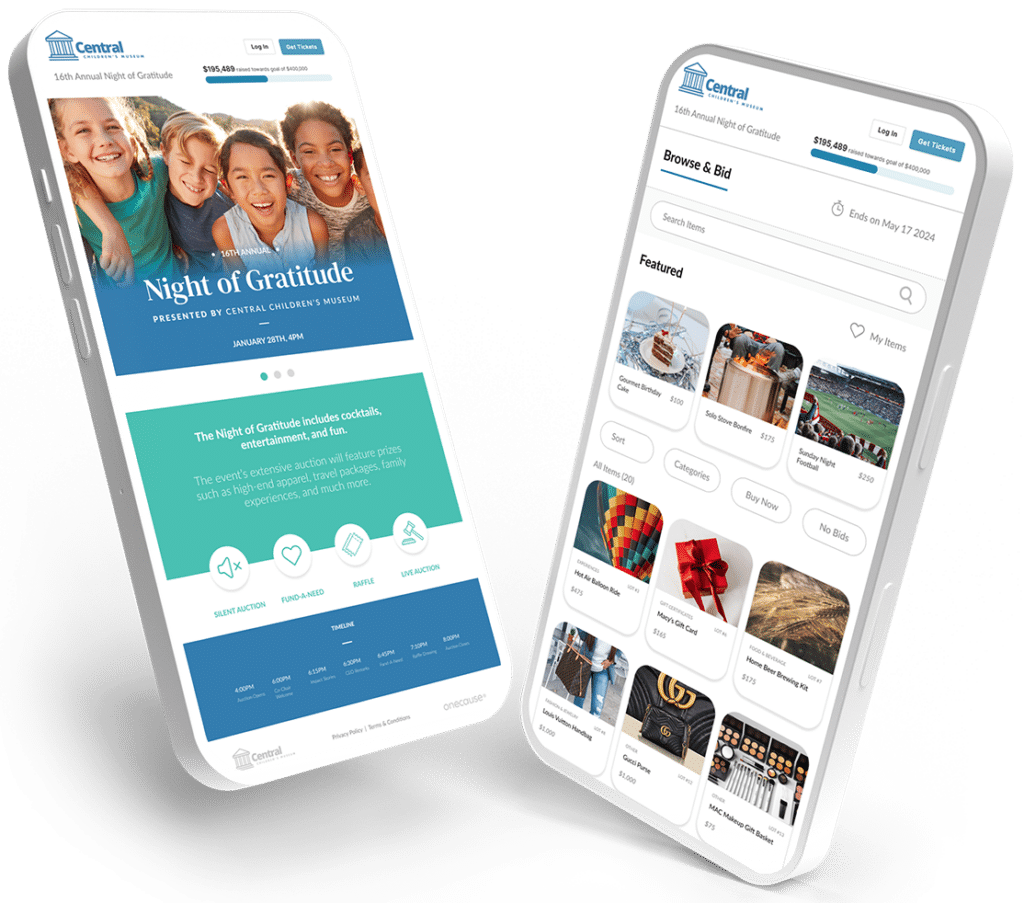
Today, OneCause’s auction tools include item filtering, favorites, maximum bids, Buy Now purchases and item-pickup scheduling. These are small conveniences viewed separately. Together, they shorten the distance between deciding to participate and actually doing it. The appeal is almost offensively practical: keep the generosity; reduce the errands.
First, the device business became too cumbersome
The route to the present platform was less tidy than a product brochure. Indianapolis Business Journal reported that BidPal cut its workforce from 113 to 84 in 2014. The company explained that simpler software reduced its need for support staff. Steve Johns arrived as CEO that year.
By 2015, the company was emphasizing annual management-software subscriptions, then roughly $1,200. The share of clients subscribing rose from about 70 percent to about 90 percent, according to Johns. A mobile app also eliminated the need to distribute bidding devices at events. Those changes altered both what customers bought and what the company had to deliver.
The business lesson is an interpretation of that reported transition: software could make the company useful between annual auctions while reducing the physical work attached to each event. A phone already in someone’s pocket is a rather convenient piece of equipment to avoid supplying.
Digital bidding at the event
App plus annual software
Events, giving, social campaigns
When bidding became too small a name
BidPal became OneCause in January 2018. The company explained the change as a broader umbrella for its growing products, while retaining BidPal as a mobile-bidding name. In April, it acquired Great Feats, an Austin peer-to-peer fundraising platform. In September, it announced $4 million in growth financing led by MK Capital, with Allos Ventures and Wintrust Ventures participating.
Peer-to-peer fundraising changes who makes the invitation. A nonprofit provides the campaign; a supporter shares a personal page with friends, relatives or colleagues. OneCause’s tools support personal stories, team participation, registration, recognition and activity-based campaigns. A run, walk or memorial appeal can reach people who never planned to buy a gala ticket.
Its present market is nonprofits and schools. The company reports having helped more than 14,000 nonprofits in the United States and Canada raise $8 billion over its history. Those are cumulative fundraising figures. They describe money raised for causes, rather than the software company’s revenue or its current subscription count.
The pandemic exposed the vulnerability of depending on a room full of people. OneCause’s 2020 survey of 1,997 nonprofit professionals found that 48 percent had cancelled an event and 62 percent had converted to a virtual fundraiser. Seventy percent of those making the virtual switch reported some degree of success. That was self-reported survey evidence, with respondents beyond OneCause customers. Going online helped many organizations; it did not produce uniform results.
The unglamorous things that add up
The new Fundraising Platform launched in October 2022 joined ticketing, QR check-in, table management, fundraising and reporting. It also provided communication tools for the periods before and after an event. The product’s organizing idea was to let supporters handle more of their own participation, while giving staff a clearer view of what was happening.
Team IMPACT used messages before its gala, auction previews and live donor analytics. It reported $3.6 million raised against a $3.25 million target, with its silent auction reaching 128 percent of goal. This is a vendor-published customer account, not an experiment establishing how much revenue the software caused.
Other customer examples help explain the product’s scope. March of Dimes reported using the platform across more than 40 markets and 90 events in 2022. Make-A-Wish Arizona’s 2025 case study describes a 30-minute reduction in total check-in time for nearly 1,000 guests. The value proposition becomes concrete when the measure is a queue, a completed task or a report that staff can actually use.
“We’re not writers, we’re fundraisers.”John Brand IV, Team IMPACT, on auction-description tools
OneCause’s AI features occupy this same operational territory. Description generators draft content; auction recommendations help surface items; Event Readiness tracks preparation; AI Guide answers software questions. The company announced additions to the suite in September 2024. Buyers can judge these tools by the task they simplify, and review the output before asking donors to act on it.
The price of a shorter queue
OneCause’s published plans advertise an entry option starting at $200, with a capped 5 percent pay-later fee on funds raised. The Professional Auction & Event annual subscription is advertised at $2,995. These are different buying arrangements whose scope deserves inspection.
Illustration: on $20,000, that formula gives $1,200 before applying any contractual cap. Payment processing is separate. This is arithmetic, not a quote.
OneCause Payments advertises credit-card rates starting at 2.0 percent and offers Stripe or Deluxe as provider options. The word “starting” matters. A useful comparison separates software charges, processing, service scope and any limits in the agreement. It also counts staff time spent operating several disconnected tools.
OneCause competes in a crowded market. GiveSmart also offers mobile bidding, ticketing, seating and year-round fundraising. Givebutter offers auctions with optional donor tips, and a different platform-fee arrangement when tips are disabled. Mobile bidding alone does not settle the choice. OneCause’s case rests on the combined workflow, its event experience and its support.
That combination earns its keep when an organization has enough operational complexity to use it. A small campaign needing only a donation form may have little reason to buy extensive event machinery. A team with an established donor database should test how records will move, who will reconcile them and whether volunteers can complete their actual jobs. The demonstration should resemble the fundraiser.
Bonterra buys the evening, and looks beyond it
Bonterra announced its acquisition of OneCause on October 15, 2025. The announcement identified events and auctions as additions to its wider fundraising suite. It described a portfolio spanning donor management, email marketing, online giving, peer-to-peer fundraising and ticketed events. The strategic attraction is continuity: the person who bids tonight remains someone the nonprofit wants to know tomorrow.
In December 2025, Bonterra launched Event Ambassador Fundraising within OneCause’s auction and event product. It connects donations, tickets, sponsorships and other event activity to the supporter who helped generate them, using configurable crediting rules. The board member who fills tables and recruits sponsors can be recognized for more than a personal gift.
The practical lesson is available even to organizations that never buy OneCause. Map the donor’s path. Rehearse the awkward handoffs. Decide who owns the follow-up before the first invitation goes out. Fundraising asks people to act on a feeling. Every avoidable administrative hurdle is another opportunity for that feeling to cool.
Take a closer look
Explore the website, product demo hub, OneCause + Bonterra recorded webinar, fundraising blog and company news.
Follow LinkedIn, X, Instagram or Facebook. Watch the OneCause YouTube channel, or listen to Raise Nation Radio.