For years, Ondrej Dobias helped run an Estonian company without going to Estonia. The arrangement sounds like the opening of a financial thriller. It was, rather more usefully, an attempt to avoid spending his working life arranging signatures. His cofounders were spread across Germany, Czechia and Slovakia. They wanted to build software together. The first product they needed was a workable company.
Dobias became an Estonian e-resident in 2017. The company was incorporated online in 2018. His first visit to Tallinn came in 2025, for the Latitude59 startup conference. In between, the team built Usetiful, software that helps people find their way through other software. There is a pleasing consistency here: a founder buying himself a simpler administrative experience, then selling a simpler digital experience to others.
“It felt almost too easy,” he said of the incorporation. Anyone who has ever been asked to print a document in order to prove that they received it electronically will understand the attraction.
A bar before the browser
Before the product tours and checklists, there was Mead House. Dobias founded the Brno business in 2009 and handled its team, business development and finances. In his career history he gives it the rather splendid description “#alcohol-as-a-service”. The software vocabulary arrived with its own refreshments.
The joke is characteristic of his public presentation. Among the languages on his professional profile, alongside English, German, Czech and Slovak, sits sarcasm. A career document can be a very solemn place. Dobias has left a small window open.
His subsequent work took him through AVG Technologies and Y Soft, then Global Fashion Group, Zalando, HomeToGo and Codility. He studied information technology, followed by management and economics. That combination offers a useful way into the Usetiful story: understanding how systems operate, and then asking whether operating them makes sense for the people involved.
At Y Soft, his remit included print management, hardware appliances, payments and a process tool that developed into employee onboarding. These are products with consequences outside a presentation slide. A confused user still has a task to finish. A printer that requires an expedition through settings has merely relocated the work.
The useful thing hiding inside another idea
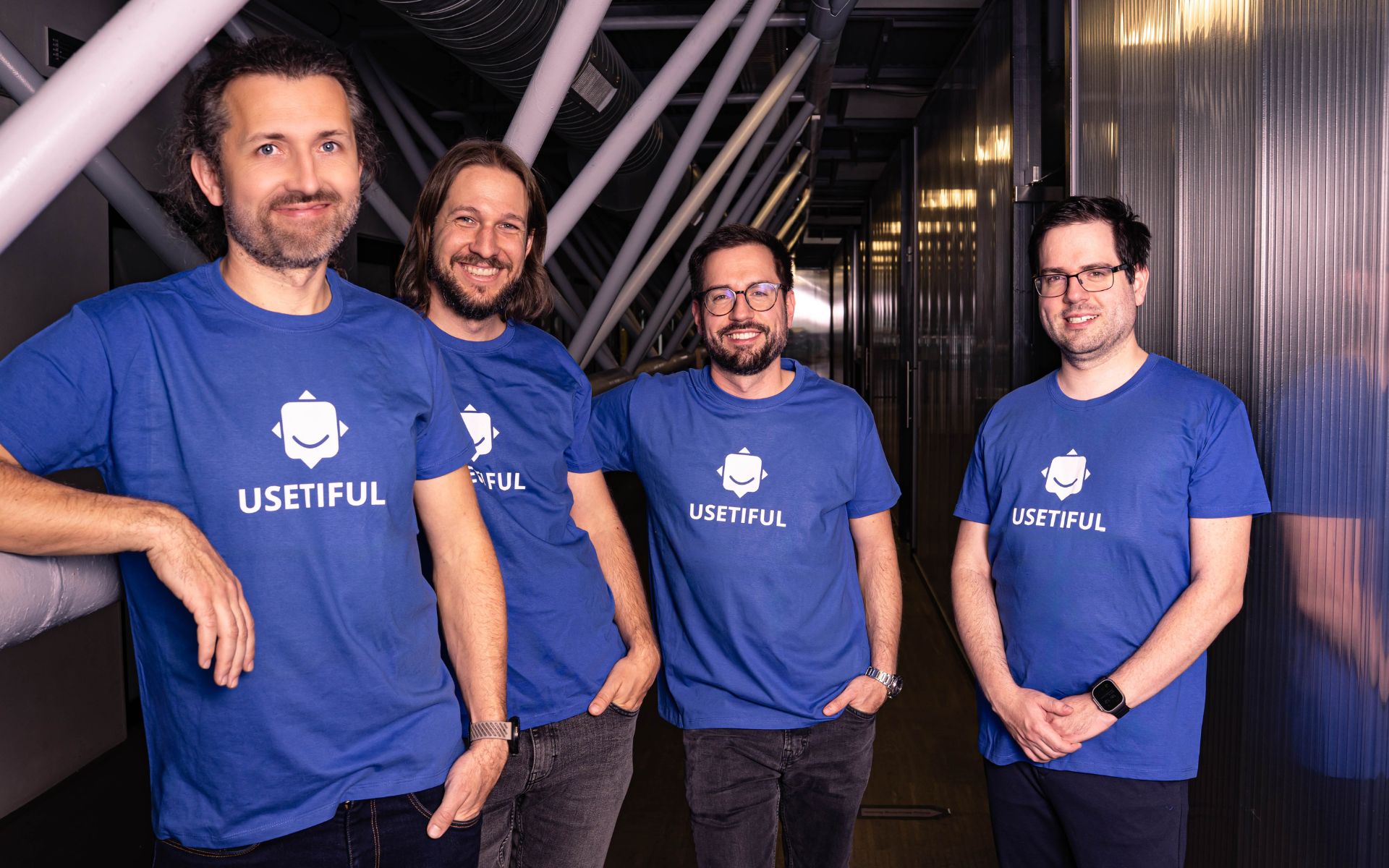
Usetiful grew out of a problem the team encountered while working on another product. Users were having trouble navigating it. Available guidance tools carried prices the founders could not justify, so they made their own. The supporting tool found a market of its own. Sometimes the thing you build to get back to work becomes the work.
Dobias and Jan Alexandr Janíček developed the project in evenings; Michal Jurzykowski and Tomáš Maxmilián Janíček joined them as cofounders. The first version launched in 2019. The origin matters because the product began with a practical inconvenience rather than a demand for another dashboard.
Its basic instruments were modest: tours, prompts, tooltips and onboarding checklists. Think of them as directions placed beside the junction where someone must choose. A guide can show a new customer the next useful action inside an application. A checklist can make a first session feel finite. The customer is trying to accomplish something; the interface should help them get there.
In a 2019 Calendify case study, Dobias appeared as that product’s manager. He described earlier attempts to activate users through email and video tutorials, followed by a guided initial setup. The reported completion rate reached 49 percent, a 25 percent increase within the first month. It was a company-published result from a particular implementation, rather than a promise about every product.
The detail that interested him was the speed of revision. The team could examine results and change the tour without a fresh round of product coding. That is a small operational advantage with a human consequence: the person who notices confusion can do something about it while the confusion is still worth fixing.
Customer questions, with the founder still answering
On January 20, 2022, Dobias introduced Usetiful to AppSumo customers. His opening included a pun about making the product useful and a family detail: the founding team included identical twins. Some cofounders knew one another through previous jobs; others were related. A distributed company can still have a very personal foundation.
Below the announcement, a prospective buyer asked about Stripe and timed emails. Dobias explained how payment links could fit into the product, then plainly said email communication was not yet supported. He invited the buyer to add their use case to the feature request. The exchange is ordinary, which is precisely its value. A founder’s philosophy becomes easier to assess when somebody asks whether a feature actually exists.
His public product work has plenty of this unglamorous texture. On Usetiful’s feedback board, his name appears beside proposals for a tour builder that would reduce window switching, more flexible step triggers, and reports that separate testing traffic. These are the little irritations that accumulate around a tool. Selling simplicity obliges you to keep noticing them.
In January 2025, he was on Indie Hackers looking for beta users for React Native support. It was a short request for feedback, complete with a smiley. The path from a browser tool to native mobile apps was being tested in public, with users invited to influence the direction.
He also went to Brno to speak with Smartsupp’s then-CMO, Nikola Kozuljevic, about how the company used Usetiful. Their conversation covered feature education, segmented campaigns and combinations of banners and tours. Dobias’s accompanying post included a question about the beer they were drinking. Customer research had acquired a drinks menu again.
Growth without a fundraising subplot
By the time of the acquisition, Usetiful had grown without external investment. November 2025 reporting put its reach above 150,000 users and annual subscription income around $500,000. Customers included DHL, Zalando, Konica Minolta and Audi. Those figures describe the company at that moment; they are not a running counter.
For a profile of a software founder, the absence of a succession of funding rounds changes the plot. The milestones are a launch, customers, recurring revenue and eventually a buyer. There is less ceremonial capital to admire and more reason to look at what people found useful enough to keep paying for.
- 2019Usetiful’s first version launches.
- 03 NOV 2025Fullstory announces the acquisition.
- 19 FEB 2026Fullstory launches Guides and Surveys.
Fullstory announced the purchase on November 3, 2025. It brought together a company that examines digital behavior and a team that builds ways to guide it. The business logic is readily understandable: seeing where a person struggles becomes more useful when you can offer relevant help inside the same experience.
In the announcement, Dobias identified the missing ingredient as understanding exactly when and why someone needed assistance. His ambition was more responsive guidance. A tour shown at the wrong moment can become another obstacle to dismiss. Timing is part of the product.
The promises after the handshake
Dobias’s own acquisition message opened cheerfully, then turned to the relationship between behavioral understanding and in-app guidance. He described the team’s exploration of session replay and the alignment it found with Fullstory. The product could develop through a combination of observation and intervention.
Below that explanation came questions about licenses, contracts and data. Existing service would continue under running agreements. The team committed to keeping customers’ data hosted in the European Union, in Germany, with access restricted to EU-residing personnel. For customers, those details belong in the same conversation as the new capabilities. A change of ownership also creates a queue of practical questions.
On February 19, 2026, Fullstory launched Guides and Surveys, explicitly connecting the release to its Usetiful acquisition. The product pairs behavioral signals with targeted guidance and contextual feedback. Dobias now lists Director of Product Management at Fullstory among his roles. The work continues inside a larger organization, close to the same problem that gave the original tool its purpose.
Europe could use a better onboarding flow
After the sale, Dobias kept talking about another difficult interface: doing business across European borders. In January 2026 he publicly supported EU-INC, the campaign for a European company structure. His interest came from operating a team that did not fit neatly inside one country.
The Estonian entity behind Usetiful was called Dobbytec, a name derived from his nickname, Dobby. The name adds a personal flourish to an otherwise administrative choice. The point of that choice was remote operation and manageable paperwork. In describing it, he emphasized that tax optimization had not been the founders’ reason for choosing a base.
“Let’s build businesses, not admin.”
Ondrej Dobias, on building across European borders
There is an argument about time running through his work. The software customer wants to complete a task. The small product team wants to improve its application. The founders want to work together without inventing a department to supervise the paperwork. Each additional obstacle spends somebody’s attention.
Dobias has built a career around those awkward intervals between wanting to do something and being able to do it. They are seldom the parts that make a demonstration exciting. They are the parts people encounter on an ordinary working day, when the novelty has worn off and there is still a job to finish. A useful product respects that day. It helps you get on with it.
Follow the thread
More from Dobias and the products he helped build.
Ondrej on LinkedIn ↗Ondrej on X ↗Indie Hackers profile ↗Usetiful ↗Watch the Smartsupp customer conversation ↗Dobias’s acquisition message ↗Fullstory’s Guides and Surveys announcement ↗The Estonia conversation ↗Dobias on building across borders (Czech) ↗