Three founders went to Barcelona for a one-hour customer onboarding meeting. The customer brought in €200 a month. Alexander Knoll knew the trip made little economic sense. He and his co-founders went anyway, because working closely with the people using their software mattered to them. On both legs of the journey they nearly missed the plane, sprinting through the airport and almost leaving their chief technology officer behind. Customer intimacy, it seems, occasionally requires comfortable shoes.
The anecdote is small enough to escape the usual founder mythology. There is no funding round, no midnight acquisition, no miraculous pivot announced from a stage. There is a modest customer, a disproportionate journey and three people trying to get to a gate. It also introduces Knoll rather well. He co-founded Condens, a Munich company making software for user research, and serves as its CEO. The work involves helping organizations listen. His own account of building the business repeatedly comes back to getting closer to people.
The Barcelona episode puts a practical question behind that aspiration. How close is close enough? A spreadsheet might have recommended a video call. The founders chose a visit. Nobody needs to turn that choice into a universal business rule; a young company can hardly send its entire leadership team abroad for every introduction. What makes the story revealing is the priority it exposes. They wanted contact with the customer badly enough to accept an inconvenient bill.
A market worth spending your days in
Knoll’s route to that company ran through business studies and product management. He studied at Mannheim and Munich, spent a period at Universidad Carlos III de Madrid, and attended the Center for Digital Technology and Management. At NavVis, working in indoor mapping and navigation, he moved into product management. That background placed him near the familiar friction between learning about users and deciding what to build.
Yet choosing a business was messier than the finished company suggests. Knoll, Maximilian Hackenschmied and Matěj Švejda explored different industries. Some investigations lasted two months before they concluded that a field was wrong for them. Looking back, Knoll described an overlooked requirement: the founders needed enthusiasm for the industry, as well as a plausible opportunity inside it. A market can look attractive in a report and feel rather less attractive as the place where you will spend your working life.
The distinction has a pleasing lack of grandeur. A founder still has to wake up and talk to somebody on Tuesday. Choosing those people is part of choosing the business. For Knoll and his partners, researchers proved enjoyable to work with. Their eventual direction gave them a professional community they wanted to remain around, rather than merely a category they could sell into.
More than 160 interviews with UX researchers helped Knoll identify obstacles in research work. There is an apt circularity here: a future supplier of research software first became a researcher of researchers. The number describes a commitment to conversation. It also gives the origin story some weight. Repeated contact offers chances to hear inconvenient details, notice recurring complaints and revise an appealing assumption before that assumption becomes expensive software.
UX researchers interviewed by Knoll while exploring problems worth solving.
The office has a memory problem
Much of Knoll’s work concerns what happens after an organization has listened. An interview produces notes, a recording, observations and eventually findings. Those findings may answer the immediate question. Their usefulness can extend much further, provided somebody can locate them when another question arrives. The difficulty is mundane and persistent: knowledge can be scattered among documents, presentations and the people who remember where everything lives.
In his writing on research repositories, Knoll describes the time consumed by looking for earlier work. He considers repositories useful across the research process, including analysis and sharing, rather than treating an archive as the final destination of a completed study. A finding should be able to travel. Otherwise, the organization can pay to learn something and then pay again because it has forgotten that it learned it.
This is also a problem of manners within a company. The person asking a question usually wants an answer, rather than an expedition through someone else’s filing system. A useful research practice must accommodate that impatience without discarding the work that makes an answer trustworthy. Knoll’s interest in ResearchOps puts him in that territory: the arrangements that allow research to function inside a team.
The subject may sound less theatrical than inventing the next consumer sensation. It has its own human stakes. When information is difficult to find, the colleague who remembers it becomes the unofficial index. When that colleague is busy, the index is closed. Knoll has chosen to work on the infrastructure behind understanding, where improvements can be felt in ordinary decisions even when nobody thinks to applaud the infrastructure.
A balance sheet with room to choose
The founders initially used savings and then received an EXIST startup grant. Knoll’s year-end account of 2021 marked a further change: Condens reached profitability early that year. He also reported fivefold growth in monthly recurring revenue and a tripling of customer numbers during 2021. Those figures belong to that year; they describe a milestone, rather than a promise about the pace of every year that followed.
His emphasis was on freedom. A business able to support itself gives its founders more choice over its direction. It is easy to talk about independence as a temperament. In a company, independence also has a monthly arithmetic. Money must come in often enough, and in sufficient amounts, for the team to keep making its own decisions.
Knoll included another choice in that reflection: returning to a physical office. The team had found value in informal conversations, working together in person and talking about things beyond work. There is a modest consistency between the airport story and this office preference. Both place a value on forms of contact that are awkward to reduce to a neat efficiency calculation. Neither requires declaring that every company should behave the same way.
Today Condens describes itself as profitable and entirely founder-owned. Its stated working practices include shared responsibility for customer support, including among its technical and product leadership. That makes closeness more than a line in a founder’s biography. It gives the organization a recurring way to encounter the people it serves. Even an elegant strategy benefits from having to answer an actual question from an actual customer.
The Game Boy moment, followed by the difficult questions
Knoll’s enthusiasm for generative AI was immediate enough to produce an unusually ordinary comparison. He described exploring ChatGPT after its 2022 release with the excitement of a child receiving a new Game Boy. The image is useful because it leaves room for delight. A person can enjoy a new technology and still examine the claims made on its behalf.
In his February 2025 account of Condens’s AI work, he described the commercial pressure to move faster. One customer left for a competitor taking a more aggressive approach to AI features. Four months later, he wrote, the research team reported disappointment. The episode makes caution a consequential choice. Restraint can lose a sale before it wins anyone’s respect.
His proposed test for AI features rests on three concerns: whether the task supplies enough context, whether the data fits the system’s constraints, and whether a person can inspect and change the result. Together, they direct attention toward the work surrounding an output. Producing a plausible answer is only one part of producing something a researcher can responsibly use.
These questions have a broader appeal because they are answerable. They ask a team to describe a particular job and examine how the tool handles it. A demonstration can be charming. The harder question is what a person must do the morning after the demonstration, when the material is untidy and the answer will affect a decision. Knoll’s approach leaves that person in view.
He continued the argument in August 2025, writing about whether AI-powered search removes the need for taxonomies. His answer preserved a role for human-applied structure: tags can carry interpretation and help researchers return to evidence. His observation about irony is particularly apt. Software can find words while missing what a speaker meant by them. Human conversation has been causing this difficulty long before anybody invented a language model.
Keeping the conversation open
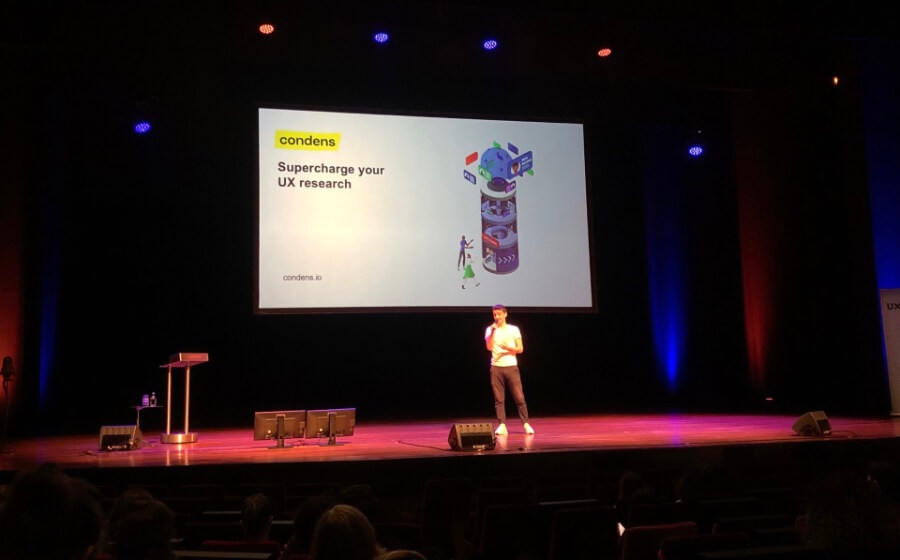
Knoll’s public work extends into the research community. He organizes UX Research Meetup events in Munich and speaks about research practice. His conversations have included Kate Moran on AI and Nikki Anderson on demonstrating research’s impact. In June 2025 he appeared on a panel with Emmanuelle Savarit about the return on investment of user research. The subjects vary, but they keep returning to how research earns a place in everyday organizational decisions.
A discussion with Anderson yielded a compact piece of advice from Knoll: “Be your own marketing team, essentially!” The line acknowledges a task that researchers may prefer to leave to their findings. Doing useful work does not automatically ensure that colleagues understand its usefulness. Visibility takes repetition, relationships and attention to what the other person needs to decide.
That advice also throws light on Knoll’s career. He has spent years working on the passage between an experience and someone else’s understanding of it. The researcher listens to a participant. The team interprets what happened. A colleague encounters the finding. At each handoff, something can be lost. His company occupies those handoffs, and his writing asks people to examine them.
The future he has described for Condens includes better ways for stakeholders to encounter research, more integrations and further AI features. Those plans fit a founder whose first substantial investment was in conversations. The interesting question for his work remains whether new capabilities make it easier to understand people, and easier to carry that understanding into a decision.
In May 2026, Knoll announced workspace-wide AI search across raw research data. His description focused on questions that arise before a new study: what has already been researched, and what earlier participants said about a topic that has become relevant again. He also emphasized filters, researcher control and access to the underlying evidence. The scope of the search had grown from a session to a project to a workspace. The concern remained recognizable: help a team recover what it knows, while keeping the person doing the research responsible for the finding.
There is a temptation to finish a founder story with a destination: an exit, a valuation, an empire pencilled into the horizon. Knoll’s story offers a different ending for now. Three colleagues chose a community, kept asking questions and built a business that supports itself. Somewhere in the account is an airport sprint that no financial model would have recommended. The meeting was only an hour. The willingness to show up has lasted considerably longer.
“Be your own marketing team, essentially!”Alexander Knoll, on making research visible