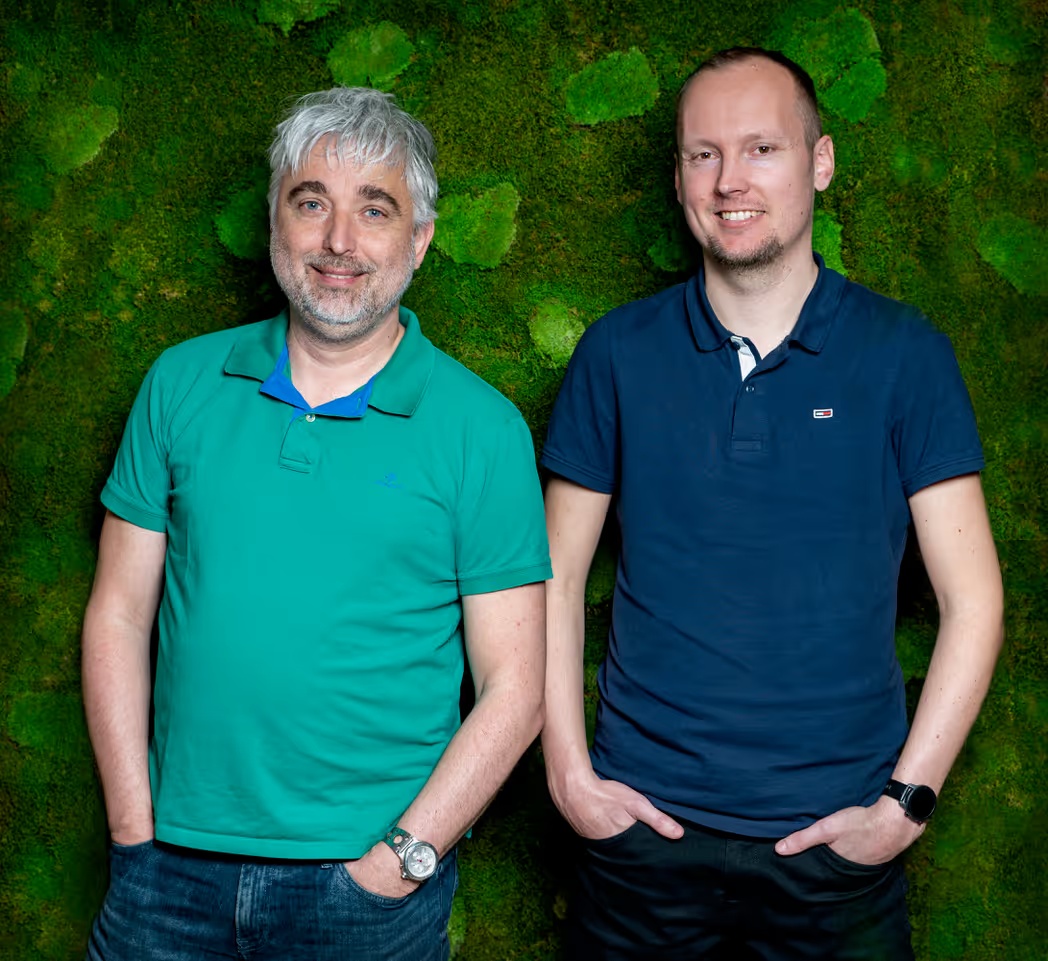
Six customers is an awkward number. Too many to call a software project imaginary; too few to let the founder stop worrying about it. That was roughly the size of Product Fruits when Karel Papík encountered Ladislav Šalom, who was working on it alone. Papík remembers a conversation lasting about ten minutes. His reaction was close to a proposal: “will you marry me?” In the less romantic language of company formation, he wanted to work together.
The anecdote has a pleasing imbalance. One founder tells the story with theatrical enthusiasm. The other had already built something people were using. Papík describes Šalom as calm and unusually good at looking a year or two ahead. He also says his partner is reluctant to go on podcasts. Some partnerships have a spokesperson and someone who would rather get on with the software. This one appears to have found its arrangement early.
Šalom’s subject was the moment after a person signs up. A product has persuaded someone to try it; now it has to make itself understandable. Anyone who has opened an unfamiliar application knows the interval. The buttons are present. The possibilities are numerous. The useful next step has somehow gone into hiding.
Before the welcome screen
By the time Product Fruits entered his working life in 2019, Šalom had spent years developing software. His career ran through Syntactic Sugar and PilsCom before a software-engineering role at Socialbakers. Alongside that, he worked independently through Devhand. Later came engineering leadership at TRIVI. These were jobs concerned with making applications work, long before his company became concerned with helping other people work inside them.
The projects occasionally leave small, revealing traces. In a 2015 interview about Tomikup, a wishlist service, its creator credited Šalom and designer-developer Tomáš Plecháč with much of the work. The premise was ordinary enough to be recognizable: remembering desired gifts and keeping wishes together across shops. Software was being asked to tidy up an everyday inconvenience. No grand declaration was necessary.
In 2018, the Pilsen Barcamp participant list identified him as TRIVI’s CTO. A conference attendee’s brief biography is a modest artifact, but it fixes him in a professional community before the founder story took over. He was an engineer with responsibilities, colleagues and projects. The later onboarding business grew out of a working career rather than arriving as a fully formed business-school case.
Software engineering
CTO
Founder
Papík brought a different kind of experience to the partnership: years of making video games. A game has little patience for an incomprehensible opening. A player who cannot work out what to do can leave without informing the developer of the decision. Business software may wear a more serious expression, but its users still have the power to close a tab.
A small team, a large market
The early commercial choices were practical. Product Fruits pursued customers abroad, with the United States central to its plans. Paid search became an acquisition channel that a small team could operate. In Papík’s account, the marketer had many responsibilities and about an hour a day for marketing. The company needed an approach that fitted the time available, rather than a strategy requiring an imaginary department.
During that growth phase, Product Fruits reached $50,000 in monthly recurring revenue within twelve months of its first investment from Lighthouse Ventures. That is a founder-reported milestone, and a useful indication of the distance traveled from the six-customer beginning. It describes a business earning repeat payments, with the corresponding obligation to keep being useful when the initial welcome is over.
By 2023, an investment announcement described customers in countries including Brazil, Germany, Taiwan, Singapore, Australia and Mexico. Šalom said the company had opened a California branch. The same announcement reported a €1.6 million investment involving LEVERAGE and Venture to Future Fund. A project concerned with the first few minutes of using software had acquired an international working life.
There is a quiet logic to that reach. Confusion travels well. A team does not have to share a founder’s country to need a checklist, an explanation or help finding a feature. The company’s job was to put those things where the user was already working. Getting someone through the front door was only the beginning of the sale.
When the guide needed a guide
Then Product Fruits encountered an irony it was professionally qualified to appreciate. As the platform grew more capable, people had a harder time discovering everything it could do. The business that helped explain software needed more help explaining its own software.
Papík described growth stalling around $1.7 million to $2 million in annual recurring revenue. Trial conversion fell from the earlier 24-25 percent range to around 15 percent. His diagnosis was increasing product complexity. Prospects needed help assembling their use case, so the company expanded its sales function, including implementation engineers. Access to the product alone was leaving possibilities unexplored.
The distinction matters. A person can understand a button without understanding what a collection of buttons might accomplish for their business. A tour solves one kind of problem. A discussion with someone who can build a use case solves another. For Šalom, a company organized around user understanding had reached a stage where understanding needed more than one form.
It is tempting to make a growth chart the judge of a founder’s judgment. But this episode asks a more interesting question: what happens when the successful method becomes too small for the product it helped create? Continuing to optimize a familiar process can feel reassuring. Recognizing that the customer needs a different process takes more attention.
Rebuilding the instructions
The rise of AI brought another decision. Papík’s account describes the founders pausing development of the existing platform to rebuild around AI, telling investors that revenue might fall. The backers supported the move. The old product continued earning revenue while the replacement was built. It was a choice made with a functioning business underneath them, which gave the decision both resources and something to lose.
A May 2024 funding announcement supplied a concrete figure: $1.6 million from Reflex Capital, intended for AI development and team expansion. Šalom described the AI work as something that “isn’t just for show.” It is a short phrase, but it sets a useful standard. A demonstration can end on applause. Help inside a product has to end with the user knowing what to do.
His argument for onboarding is equally practical. In a public discussion of product tours, he acknowledged the appeal of an interface so clear that additional help becomes unnecessary. He then pointed to the reality of smaller SaaS teams, occupied with shipping, bugs and support. Guidance, in his view, lets those teams help users while the larger work of improving the interface continues.
That position makes room for imperfect products and finite teams. It also puts a responsibility on the guidance itself. Another pop-up can become another thing to dismiss. A useful explanation has to respect what someone is trying to accomplish. The person opening an application has brought a task, not an unlimited afternoon for admiring its feature list.
“By 2028 most onboarding flows will be history.”
Ladislav Šalom, on the future he expects
The bet with a date on it
Šalom has attached a date to his expectation: 2028. His prediction is that conversations will replace much of the guidance now written as fixed sequences. He makes an exception for steps that need to remain strict, such as required setup or compliance. The distinction is useful. Some journeys need a prescribed order. Others need someone to listen before offering directions.
In a demonstration of Elvin Vision, he described a long-running pursuit of personalized onboarding and showed guidance that could respond to what a user was doing on screen. The ambition is easy to grasp: help with the task in front of the person, using the product’s actual context. Delivering that reliably is the work behind the appealing picture.
- Understand the goalAsk what the user wants to accomplish.
- Read the contextUse product knowledge and the current task.
- Offer the next stepRespond as the user makes progress.
A conceptual view of conversational onboarding, rather than a performance claim.
His thinking about AI also includes a claim about what might endure when models are widely available. After reading an article shared by Maja Voje, he argued for learning from consent-based signals inside real workflows. The value, as he describes it, comes from accumulating useful product memory. That puts the emphasis back on what users do and what helps them finish.
The company’s recent releases give that direction a practical shape. A May 2026 explanation of Flows describes onboarding that can begin with an AI-guided conversation about a user’s goals and branch accordingly. In July, Product Fruits introduced a read-only connection for AI assistants to examine onboarding and support data. Both put questions closer to the information needed to answer them.
Šalom’s story began with working software and a small customer list. The partnership gave that project more ways to reach people; growth gave it new problems to solve. The thread through those changes is the user arriving at a screen with something to get done. A founder can spend years increasing the possibilities behind that screen. The person in front of it may still need only one good next step.