Oliver Gunasekara had sold his company. Travel and a partial retirement were on the itinerary. Then the itinerary collapsed, and the sky above the San Francisco Bay Area turned orange. For someone deciding how to spend the next portion of his life, California supplied a rather forceful visual aid.
He had spent decades in semiconductors, helping build businesses around the small pieces of technology that make other things possible. Phones. Graphics. Streaming video. After the 2020 wildfires, he wanted his next company to help move the world away from fossil fuels. The question was where his particular experience might be useful.
The answer he settled on lay several kilometres underwater: dark, potato-sized rocks containing nickel, cobalt, copper and manganese. These polymetallic nodules offered a route into the materials behind electrification. They also presented an awkward proposition for a climate-minded founder. Collecting resources from an ecosystem is a consequential way to announce that you would like to protect the planet.
Gunasekara's response was to make the method of collection the business. Impossible Metals, which he founded in 2020, would develop hovering underwater robots that could inspect individual nodules, pick them up and pass over visible marine life. The machine needed discretion. A good day at work would include deciding to leave valuable material where it was.
Before the ocean, the phone
His earlier career helps explain why he thought that was a tractable problem. Gunasekara joined Arm in 1994, when the British company had about 60 employees. He led mobile business development as processors were finding their way into a vast new market. The job involved understanding where a technology could go and getting other businesses to commit to it.
He spent two and a half years living and working in Japan. Later, as vice president of corporate business development and mergers and acquisitions, he championed Arm's 2006 purchase of Falanx. Its graphics technology became Mali. He had experience on both sides of a useful entrepreneurial question: what can we build ourselves, and whose expertise should we bring inside?
He had studied electrical and electronic engineering at the University of Greenwich, earning an honours bachelor's degree. Executive study followed, including the AeA/Executive Institute programme at Stanford's business school. His credential there was a Mini-MBA. The distinction matters in a career where the attraction was learning something usable and getting back to work.
Entrepreneurship itself arrived late in his vocabulary. He has described growing up without entrepreneurial role models and discovering the possibility later. Away from work, he enjoys photography, movies and science fiction. There is something fitting about a photographer becoming preoccupied with what a camera can distinguish, although a leisure interest alone explains very little about an underwater vision system.
Mobile processors
Cloud video
Ocean robotics
Two years of no
In 2012, Gunasekara co-founded NGCodec, a video-compression business. Its first proposition centred on licensing semiconductor intellectual property around the H.265/HEVC standard. Investors were unmoved. His later account of the experience is admirably economical: two years of venture-capital rejections and no salary.
The company changed direction, moving toward cloud video encoding on programmable hardware. A chance meeting with an angel investor preceded a $3 million seed round in November 2014. The altered business gave customers a service they could use in data centres, rather than asking them to buy into the original licensing model.
The milestones became more concrete. Haivision licensed an FPGA encoder in 2015. Xilinx invested in 2016. NGCodec demonstrated its technology on Amazon's cloud hardware, and Twitch became a customer in 2018. An office in Waterloo, Ontario, extended the company beyond Silicon Valley. Each step supplied a more persuasive answer than the original pitch alone.
Xilinx acquired NGCodec in July 2019. Financial terms were not disclosed in the transaction announcement. Gunasekara later described a fivefold return for early investors. For him, the experience produced advice with little decorative packaging: share ideas, expect rejection, cultivate mentors, and make clear what the next funding round is supposed to accomplish. He also recommended celebrating successes. Champagne appeared in his presentation. Even a compression engineer may favour expansion on the appropriate occasion.
“Ideas are easy, execution is hard.”
Oliver Gunasekara · 2020 founder presentation
A robot with permission to pass
By the time he began investigating seabed minerals, Gunasekara had learnt to reconsider an architecture rather than merely improve its sales pitch. He looked at collection systems involving large seabed machines and riser pipes to surface vessels. He wondered what batteries, computer vision and autonomous robotics could change.
He recruited people with experience he lacked. Co-founder Jason Gillham brought underwater robotics expertise. Gunasekara has been quite direct about his own starting point: his background was principally semiconductors, with no previous job at a robotics or mining company. That admission makes the team-building more interesting than a story about a founder arriving with every answer.
The Eureka design uses buoyancy to hover above the seafloor. Cameras inspect the area below. Robotic arms collect nodules individually and store them onboard. The intended fleet operates without the continuous tether and riser arrangement of a conventional collection system. Avoiding nodules carrying detected life is part of the design, alongside leaving some other nodules in place.
Those qualifications carry weight. Computer vision sees what its cameras and algorithms can resolve. It cannot certify the absence of microscopic life. An individual nodule is also habitat, not simply inventory. The useful question is how much ecological disturbance selective collection causes over time, including the consequences of taking the rocks away. Gunasekara's proposal makes that question more specific; it does not make it disappear.
The distance between a tank and an ocean
The first Eureka vehicle completed a proof-of-concept trial in December 2022. In May 2023 it demonstrated autonomous nodule pickup. Those were early steps in an unusually physical development process: software had to give instructions that an arm could carry out underwater, beside a real rock.
Eureka II went deeper. On April 8, 2024, while a solar eclipse attracted attention above the surface, the vehicle reached 1,800 metres off Florida. The coincidence gave the team two directions to look at once. The dive returned data for the next stage of development.
Some of the progress was less photogenic and just as necessary. The company reported reducing arm cycle times from more than four seconds to less than two. A few seconds saved on a repeated movement can change the economics of an entire fleet. Efficiency, the old semiconductor preoccupation, had followed Gunasekara into the water.
The ocean supplies constraints that a software demo can politely ignore. Radio communications and GPS do not work underwater in their familiar terrestrial form. Acoustic systems help, with limitations. Tests require vessels, crews and workable weather. A robot that performs beautifully in a tank still has to find its way through an environment that has declined to install Wi-Fi.
Eureka II’s April 2024 dive off Florida. A development milestone, with further testing ahead.
An engineer’s argument meets a public question
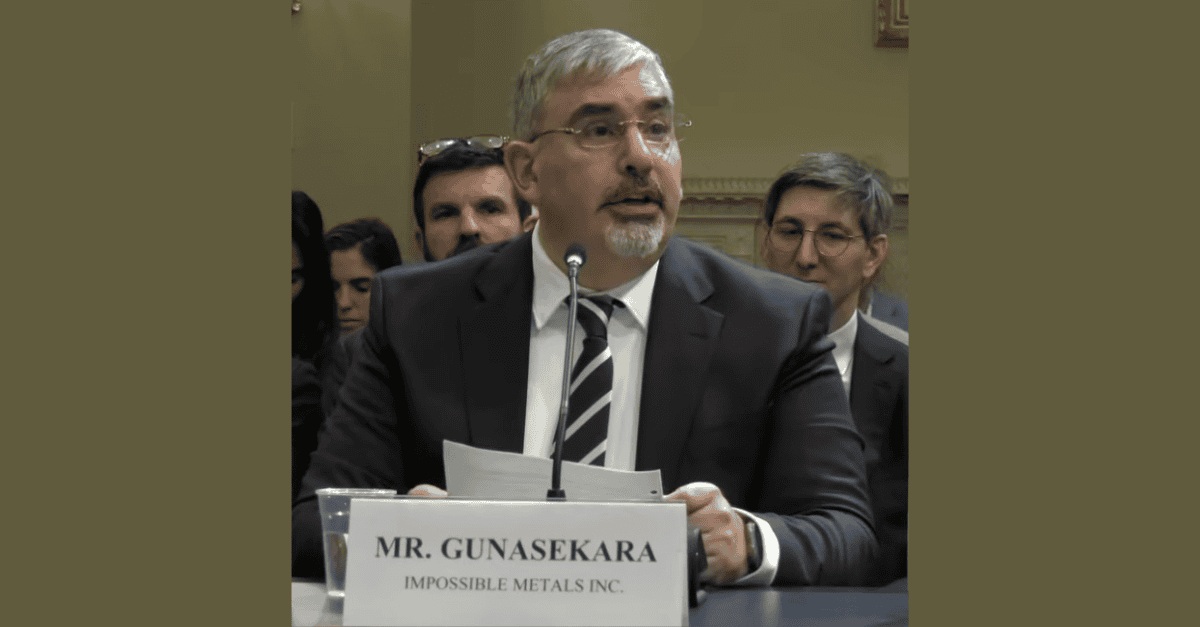
Gunasekara also became a public advocate. In April 2025 he testified before Congress on deep-sea mining and American mineral production. He introduced himself as a naturalized American citizen who had arrived in the country about twenty years earlier. His argument connected critical minerals with industrial capacity and national security.
He returned for another House hearing in January 2026, addressing regulatory barriers. By February, his writing about mineral supply chains ranged across processing capacity, project costs, workforce availability and the time needed to bring mines into production. The subject had expanded well beyond whether a robotic hand could close around a rock.
There is a difficult public bargain here. The demand for materials does not establish that a particular extraction project should proceed. Scientists have warned of potentially lasting damage to deep-ocean ecosystems, and environmental baseline knowledge remains limited. Selective collection has to be evaluated through measurements of sediment, biological communities, noise and other effects.
The company's proposed Eureka III test with Germany's BGR makes the distinction concrete. Impossible Metals is responsible for the collector; BGR plans the environmental monitoring and assessment. The current project page places the test in 2027 or 2028. Technical feasibility and ecological impact are separate purposes of the exercise. Both deserve results, rather than a clever demonstration standing in for the whole answer.
The invention outgrows the inventor’s job
In May 2026, Impossible Metals appointed Granger Whitelaw chief executive, succeeding Gunasekara. The founder's story now includes handing over the CEO role. The company described the transition as part of a move toward scaling its marine systems. Gunasekara's contribution remains the founding proposition and the years spent turning it into hardware.
The work has continued. In July, a non-binding agreement with Deep Sea Minerals established a framework to evaluate the collection technology, subject to licences and further agreements. In August, Impossible Metals released footage of Eureka II autonomously locating its surface vessel, aligning and attaching for recovery offshore Halifax. Returning the robot to the deck is part of making the business repeatable.
Gunasekara once explained his decision to start again with the words, “maybe there’s one more company in me”. There was. It demanded a new team, unfamiliar engineering and a much more public argument than selling a video encoder. It also changed the object of his attention from information moving around the world to material being taken out of it.
His career has repeatedly depended on noticing a bottleneck, assembling people who understand it and changing the design. The seabed venture adds a demanding final condition: some of the things the machine recognises must remain beyond its grasp. Whether that restraint can hold at commercial scale is the unfinished business. The rocks left behind will be part of the evidence.