A ship’s next problem may be sitting in a training record. Someone needs a course, a certificate needs checking, or a crew manager needs to know who can take the next assignment. Ocean Technologies Group built a business around this unglamorous traffic between people, paperwork and ships. Its software teaches seafarers, helps assess what they know and gives managers tools to organise their working lives.
The scale makes the paperwork interesting. At its November 2024 acquisition, Lloyd’s Register said OTG served more than 1,000 shipowners and operators and more than one million seafarers. That is a substantial audience for lessons most landlubbers will never take. The subjects stretch from navigation and cargo handling to marine engineering and language training.
Today, the sign on the door has changed. In October 2025, Lloyd’s Register brought OTG and LR OneOcean together under the OneOcean brand. The familiar products remain: Ocean Learning Platform, COMPAS and TM Master. Understanding OTG means following how a maritime classroom became part of a much larger software proposition.
OTG’s reported reach at the November 2024 acquisition.
Two course libraries started the voyage
OTG began with an investor’s combination of established businesses. In 2019, Oakley Capital acquired Seagull and Videotel, two maritime e-learning providers. Rather than start with an empty catalogue, the combined business inherited content, customers and technical expertise. Subsequent acquisitions widened its responsibilities beyond teaching.
The Ocean Technologies Group identity arrived in 2020. Its early collection included Tero Marine’s fleet software and Coex’s document management technology. Maritime Training Services joined in March; Marlins, known for maritime English assessment, followed in June. Each addition brought an existing speciality. The resulting company could talk to a ship operator about several related problems.
Launch-era chief executive Manish Singh had worked at sea and in ship management. His stated ambition connected learning and seafarer development to safer, more efficient operations. The group’s employees acquired a collective nickname, too: Oceaneers. Even enterprise software has room for a little nautical wordplay.
In January 2021, the group launched Ocean Learning Platform, combining learning resources with a redesigned user experience. The commercial packaging mattered alongside the interface: a unified account team and streamlined contract reduced the number of separate relationships customers had to manage. Consolidation had to show up in the customer’s working day.
The classroom lost its walls
The pandemic gave distance learning an urgent job. Writing during 2020, Singh reported that online training activity on OTG’s platform had risen by 175% since the onset of Covid-19. He also argued for a blend of digital and onshore teaching. Closed classrooms accelerated demand, but the company’s proposition depended on more than moving a lecture onto a screen.
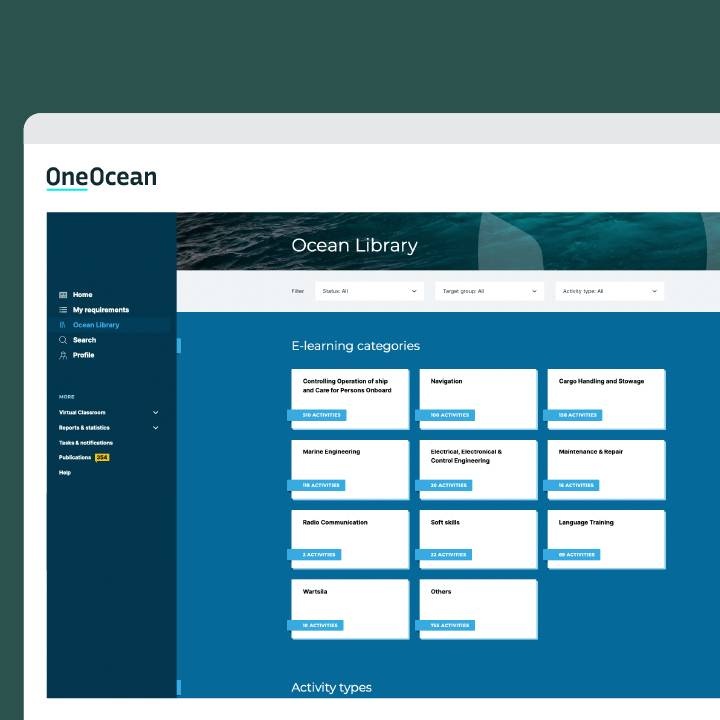
Ocean Learning Platform brings learning, assessment and competency management together. Managers can allocate training and examine progress; seafarers can work through content and build their records. The legacy Ocean Learning Library advertises more than 800 titles. Its range reflects an industry where the required lesson depends on the vessel, equipment, role and task.
The mobile app offers a particularly sensible concession to geography: learners can download material for offline completion. Finished courses synchronise with their records. Company-specific procedures can also become interactive learning with quizzes and assessments. A ship operator gets a way to teach its own methods alongside the broader maritime curriculum.
Wallem offered an early customer example. Its January 2021 agreement covered access for 7,000 seafarers. The ship manager highlighted training gaps, automated processes and the ability to track crew achievements online. Those are useful purchasing criteria: a learning system must help the people assigning courses as well as the people taking them.
Practical instruction still has a place. OTG’s February 2021 partnership with Wärtsilä Voyage proposed connecting digital training and assessment with cloud simulation and in-person experiences at training centres or aboard ships. The combination recognises that watching, understanding and performing a task are different stages of learning.
Fugro’s old system ran out of room
The clearest example of what needed replacing comes from a customer. In May 2024, Fugro Fleet Services announced its COMPAS implementation for more than 800 offshore colleagues. Its previous crew system, introduced in 2014, had become outdated as the business expanded. The account described shortcomings in speed, efficiency and usability.
Fugro sought a replacement that could improve crew workflows. COMPAS connected with its learning management system and brought together crew, training and development records. It also supported work-and-rest administration, port-related crew documents and travel booking. Senior fleet project manager Ilja Becker described the change as a significant moment for Fugro.
The preparation is the part other buyers can copy. Fugro tested and trained with selected users before migrating legacy data. It also carried out a data protection impact assessment and established document-retention protocols. This was a software purchase with organisational homework attached.
COMPAS’s wider offering explains the fit. Maritime HR encompasses personnel documents, crew planning, payroll, travel and certification. The software includes crew self-service, giving seafarers access to records and assignments. Its purpose is to make the administrative chain easier to follow, from the office arranging a change to the person boarding a vessel.
Courses · assessments · records
Crew · documents · travel
Equipment · spares · procurement
A spare part belongs in the story
Tero Marine’s TM Master takes the portfolio into technical ship management. Planned maintenance, procurement, crewing and quality, health, safety and environmental processes sit within its scope. Equipment histories and spare-parts information can inform maintenance planning; purchasing workflows cover requisitions, approvals and suppliers.
This is where OTG’s expansion becomes legible. People need training to operate equipment. Equipment needs maintenance. Maintenance needs records and parts. The company assembled products around these adjacent responsibilities, giving ship operators a broader supplier relationship. A fleet is a collection of interdependent jobs, and the product list follows them.
There are alternatives. Mintra offers Trainingportal for learning and competence management and OCS HR for crew administration, including payroll. OTG’s position rests on the combination of its established maritime content brands, operational software and, now, access to OneOcean’s wider portfolio. Buyers still have to compare the individual products against their own requirements.
The buyer’s trade-off is therefore worth spelling out. A company seeking only a small set of courses may have little reason to adopt additional crew or technical software. A larger operator trying to connect learning records with personnel decisions has a different problem. Breadth is helpful only when the additional tools match work someone actually needs to do.
The same discipline applies to outcomes. A dashboard can show overdue learning; managers must still act on it. A maintenance record can document a job; someone must perform and verify the work. These are limits of the software’s role, and useful questions to take into a demonstration.
The bill has more than one line
OTG’s business model combines software subscriptions, learning content and contracted services. Its master service agreement places subscription fees and the relevant scope in customer service orders. For an operator, the useful starting point is a specification: which vessels, which users, which products and which implementation work the agreement covers.
The purchasing lesson is to consider the work surrounding the licence. Fugro’s preparation illustrates why data migration, user training and record governance belong in the project plan. A cheaper subscription can still accompany a demanding transition. That is an implementation consideration, rather than a measured comparison of OTG’s prices with competitors.
At the ownership level, Oakley’s 2024 annual reporting put the OTG exit at a 2.7x gross money multiple and a 21% gross internal rate of return. Oakley Capital Investments reported £49 million of look-through proceeds from the investment. That figure describes its share of proceeds; it should not be read as the amount Lloyd’s Register paid for the company.
“We need tools to accelerate the time-to-competence for our seafarers.”
John-Kaare Aune · Wallem interim CEO · January 2021
OneOcean inherits the integration assignment
Lloyd’s Register completed the acquisition on November 25, 2024. It had already bought OneOcean in 2022. Adding OTG gave it more tools for developing and managing maritime personnel alongside its vessel and voyage services. LR said the combined reach would allow these solutions to be offered across more than 30,000 vessels, a different measure from OTG’s standalone customer base.
The following October’s OneOcean launch organised the combined portfolio into five areas: human capital management; technical ship management; governance, risk and compliance; voyage planning and management; and voyage performance and optimisation. The ambition was to reduce fragmentation. A common brand supplies a clearer front door; customers experience the result through the products behind it.
Development continued under the new name. In March 2026, OneOcean announced Docmap 2026, with document-version comparison, changes to risk-assessment workflows and a rebuilt mobile app. It described future AI-based information access as a direction of development. The immediately useful features were more concrete: see what changed in a document and complete forms on the move, including offline.
The broader commercial opportunity is an industry learning to operate different technology. In announcing the OTG deal, LR pointed to a Maritime Just Transition Taskforce-commissioned estimate that up to 800,000 seafarers could need training on alternative fuels and new engines by the mid-2030s. New hardware brings a substantial teaching assignment.
For a prospective customer, OTG’s history suggests a practical evaluation. Follow one training need through assessment and crew planning. Check how records move between the systems you actually use. Include practical instruction where the task demands it. A broad portfolio becomes valuable when those everyday connections work; a completed course and a well-maintained database are useful beginnings.
Keep exploring
OneOcean website · Learning platform & demo request · COMPAS · TM Master · The OneOcean announcement · Fugro deployment story · Docmap 2026
OTG LinkedIn · OneOcean LinkedIn · OTG X (legacy) · OTG Facebook (legacy)
OneOcean on YouTube · Watch: LR CEO on the acquisition · OTG presentations & virtual-classroom videos