The ship changes course. The spreadsheet stays put. For Carnival Corporation, that mismatch made environmental planning difficult: crews and shoreside staff had to keep regulations, operating restrictions and company policies aligned with passage plans that could change. OneOcean’s answer was to put the rules on the route, then make the view move with the vessel.
It is a wonderfully unglamorous software problem. A cruise ship can carry an elaborate entertainment programme, but somebody still needs to know which onboard operations are permitted in the next stretch of water. The important border may be invisible from the bridge. Missing it is an operational problem with consequences beyond a messy spreadsheet.
OneOcean sells tools for that world. Its portfolio stretches from navigation and regulatory libraries to maintenance, crew management and training. Owned by Lloyd’s Register, the business now reports 30,000 vessels using its solutions. Its pitch becomes easier to understand when you start with a single practical question: when the voyage changes, who else needs to know?
The border you cannot see from the bridge
The Carnival project offers a revealing answer. EnviroManager+ displays environmental zones and the restrictions associated with them, alongside a ship’s passage plan. Colour coding helps crews distinguish permitted, restricted and prohibited operations. Carnival can overlay its own policies, including requirements stricter than the underlying rules.
That separation matters. OneOcean maintains regulatory information; Carnival maintains its company and industry policy overlays. The software makes both available to people aboard and ashore. The case study describes more than four years of collaboration, a useful reminder that fitting software to cruise operations involves sustained work with the customer.
“This capability did not exist previously, other than an estimate made on paper.”
Nikki Rigl, Carnival Corporation
On the forward-looking environmental view
The current EnviroManager+ product describes a rolling 12-hour display that adjusts to position and speed. It advertises coverage of 78,000 maritime zones across 182 nations. Those are database coverage figures, not a count of laws or a guarantee of flawless compliance. The useful feature is the connection between location, timing and the next decision a crew must make.
A rulebook with a sense of direction
EnviroManager+ connects environmental information to a moving voyage. Diagram explains the workflow; it is not a navigation display.
First came the charts. Then came the rest of the ship.
OneOcean’s origin is a merger story. ChartCo and Marine Press combined in 2019. The UK entity behind OneOcean Group Limited dates to 1998, when it was incorporated as ChartCo Limited. That distinction explains why company histories can appear to disagree: the brand, the legal entity and its predecessors have different birthdays.
Private equity firm Equistone invested in ChartCo in 2016. By the time Lloyd’s Register completed its purchase in September 2022, the transformation had involved four acquisitions, two divestments and a merger. LR described a cultural shift from distributing products to supplying software solutions. OneOcean’s tools then served more than 16,000 vessels.
LR already had interests in fleet management and vessel performance, including Hanseaticsoft, i4 Insight, C-MAP Commercial and Greensteam. Adding OneOcean brought navigation and compliance closer to those capabilities. In November 2024, LR completed another consequential purchase: Ocean Technologies Group, which supplied training, compliance, operational and HR software.
The resulting combined reach exceeded 30,000 vessels. OneOcean now also reports serving more than one million seafarers. These numbers describe an expanded portfolio assembled through transactions. They should not be read as a same-product growth chart, or as evidence that every customer uses every application.
A passage plan is only the beginning
PassageManager brings routing, weather, port information, navigational warnings and other planning inputs into one workflow. Digital signatures and revision histories make the plan traceable. FleetManager gives shoreside teams visibility into vessel positions and passage information. EnviroManager+ adds the environmental context. Each addresses a different part of preparing and following a voyage.
For regulatory research, Regs4ships provides a searchable library of official documents, with offline access. In a published NSB Group case study, the ship manager installed it across 45 vessels. Its problem was familiar: increasing regulatory information, busy crews and too much time spent researching what applied to each ship. Standardising access gave people a common reference.
NSB’s account also describes pandemic-related maintenance disruption and reduced onboard inspections, followed by renewed inspection pressure. This gives the buying decision some texture. The demand came from the everyday difficulty of keeping crews informed and inspection-ready, with little spare time for document hunting.
The buyer might be a fleet operator, a cruise company or a technical ship manager. The person using the software could be a navigator, a compliance specialist or a shoreside manager. OneOcean has to satisfy both: the organisation buying consistency across its fleet and the individual trying to finish a specific task.
The engine room and the crew office enter the picture
The technical management portfolio includes Cloud Fleet Manager, Docmap and TM Master. Their scope covers fleet operations, safety-management documents, planned maintenance, procurement and related workflows. A recurring target is duplicate information scattered through emails, spreadsheets and separate departmental systems. Bringing records together should make follow-up actions easier to trace.
Crew software broadens the story further. COMPAS handles maritime HR and crew management. ISF Watchkeeper supports work and rest hour compliance. Ocean Learning Platform combines learning, assessment and competency management. These products address whether the right people are available, prepared and supported to operate the vessel.
For a buyer, this breadth offers the possibility of coordinating more work through one supplier group. It also creates a sensible procurement question: which connections are available for the particular products being purchased? A broad portfolio is a starting point for that discussion; buyers still need to inspect the actual data exchanges, responsibilities and implementation plan.
The voyage-performance side adds another set of decisions. Risk Manager addresses emissions exposure associated with FuelEU and EU ETS, while optimisation tools consider vessel behaviour and operating conditions. A route can therefore be examined for its commercial and environmental implications alongside its navigational requirements. OneOcean is selling several ways to examine the same journey, for teams with different responsibilities.
The price of a better handover
OneOcean operates as a business-to-business supplier of software, data, training and maritime services. Its contract materials span multiple product families, while its enterprise product pages direct prospective customers toward conversations and demonstrations. The buying unit is a defined operational requirement: particular vessels, teams, information and services.
The Carnival example makes one cost visible even without attaching a currency symbol: collaboration over several years. Operators evaluating a system should budget attention as well as money. Who maintains internal policies? Who approves changed plans? Who trains incoming crew? An elegant interface cannot settle those ownership questions on its own.
The earliest weakness in the Carnival account was the spreadsheet process’s difficulty keeping up with changing plans. The reason to change was concrete: environmental visibility needed to follow the voyage. Readers can copy that approach by choosing a handover that repeatedly creates rework, then testing whether shared information makes the next decision easier.
That test should include awkward conditions: a revised route, a staff change, a stale record or interrupted connectivity. Regs4ships’ offline access addresses one such constraint, but capabilities vary across products. If staff must keep re-entering the same information elsewhere, or nobody maintains the policies displayed, the expected benefit will be harder to achieve.
A useful demonstration would follow one proposed change from start to finish. Let the navigator revise a passage, ask the compliance team to review its implications, and check what the shoreside manager sees. Then inspect the record of who changed what. That exercise gives a buyer something more concrete than a list of modules: evidence that the people involved can complete a shared task without rebuilding the information between steps.
Experienced mariners still get a vote
OneOcean competes in a populated market. NAVTOR’s NavStation also combines passage planning, chart overlays, weather and regulatory information. StormGeo combines voyage optimisation, weather intelligence and expert support. Connected data and better routing are shared ambitions across these suppliers.
OneOcean’s particular proposition is the combination of its regulatory and navigation tools, its enlarged crew and technical portfolio, and its position within Lloyd’s Register. Its Shoreside Routing service also describes a 24/7 team led by Master Mariners reviewing recommendations from modelling and optimisation tools. Expertise remains part of the service being sold.
That fits the company’s stated mix of software developers, maritime professionals and environmental specialists. Its careers material emphasises learning, inclusion and collaboration. The combination is relevant to the product: a development team working on passage planning needs to understand what a route change means to the people responsible for executing it.
Now the fleet dashboard takes questions
In an August 26, 2026 update, OneOcean described a redesigned Cloud Fleet Manager portal with AI assistance, customisable dashboards and weather layers. Users can ask about operational information such as schedules, port calls and crew changes. A separate AI Manual Search returns guidance from documentation with cited material.
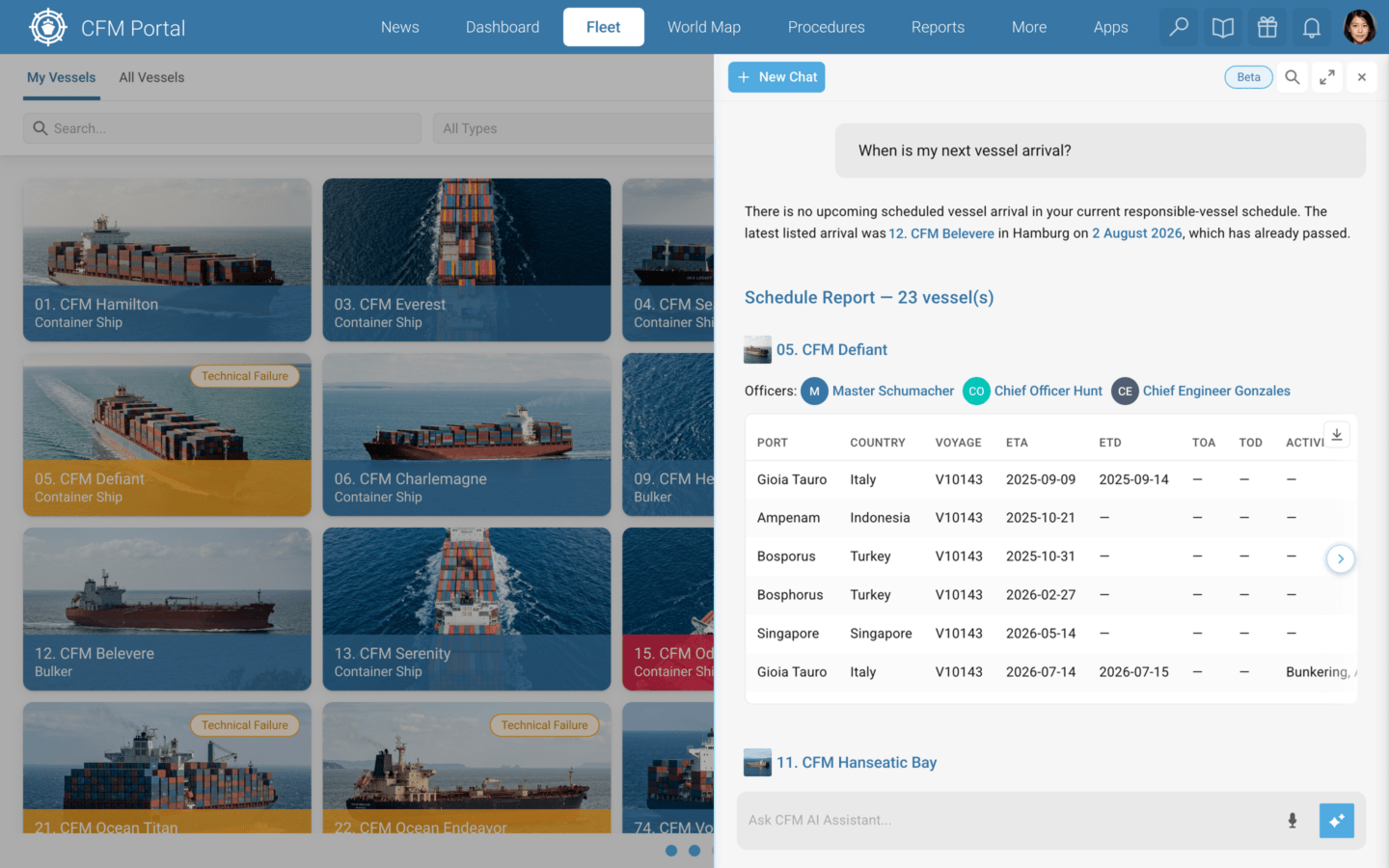
The permission boundary is a consequential detail: the assistant is designed to retrieve information the user is already authorised to see. That puts the emphasis on finding existing operational knowledge more easily. It is a practical use for conversational software in an application where navigation through menus can itself become work.

PRODUCT & TECHNOLOGYClaus ReimersAppointed CPTO in August 2026, returning to Lloyd’s Register after leading product and technology at Akselos.
Six days before the portal article, OneOcean appointed Dr Claus Reimers to lead product and technology, with responsibility across product, engineering and architecture. The direction is clear enough. OneOcean is adding new ways to work with maritime information. Its most persuasive test remains an old one: when the ship moves, does the person making the next decision have the right information?