There is a small linguistic trick hiding in OBERLAND’s favorite sentence. “Let’s make good money” sounds, at first, like the sort of thing a cheerful banker might say before lunch. Then the words rearrange themselves. Good describes the money, but it also describes the making of it. Profit is the noun. Purpose is the method.
This has been the New York agency’s argument since Drew Train and Bill Oberlander founded it in 2014: the social role of a brand should not live in a worthy little annex called corporate responsibility. It should be connected to the reason people notice, choose and remain loyal to the business. OBERLAND defines the purpose, turns it into campaigns, identities, packaging, content and digital experiences, and then looks for evidence that anyone behaved differently.
That last step is what separates the proposition from a thousand agency manifestos. OBERLAND says its work has helped nonprofits raise more than $750 million, contributed to founder exits or transactions totaling more than $200 million in valuation, and produced double-digit gains for brands across retail, beauty, food and business services. These are company-reported figures, but they reveal the standard the agency wants applied to its own work: count something harder than applause.
The spreadsheet makes the joke land
The agency’s most visible work began with an absurd fact hiding in plain sight. In research for e.l.f. Beauty’s campaign about corporate-board diversity, the team found that men named Dick outnumbered entire groups of underrepresented women on the boards of American public companies. A compliance-minded campaign might have placed the finding in a report. OBERLAND put it in 12-foot letters and called the campaign “So Many Dicks.”
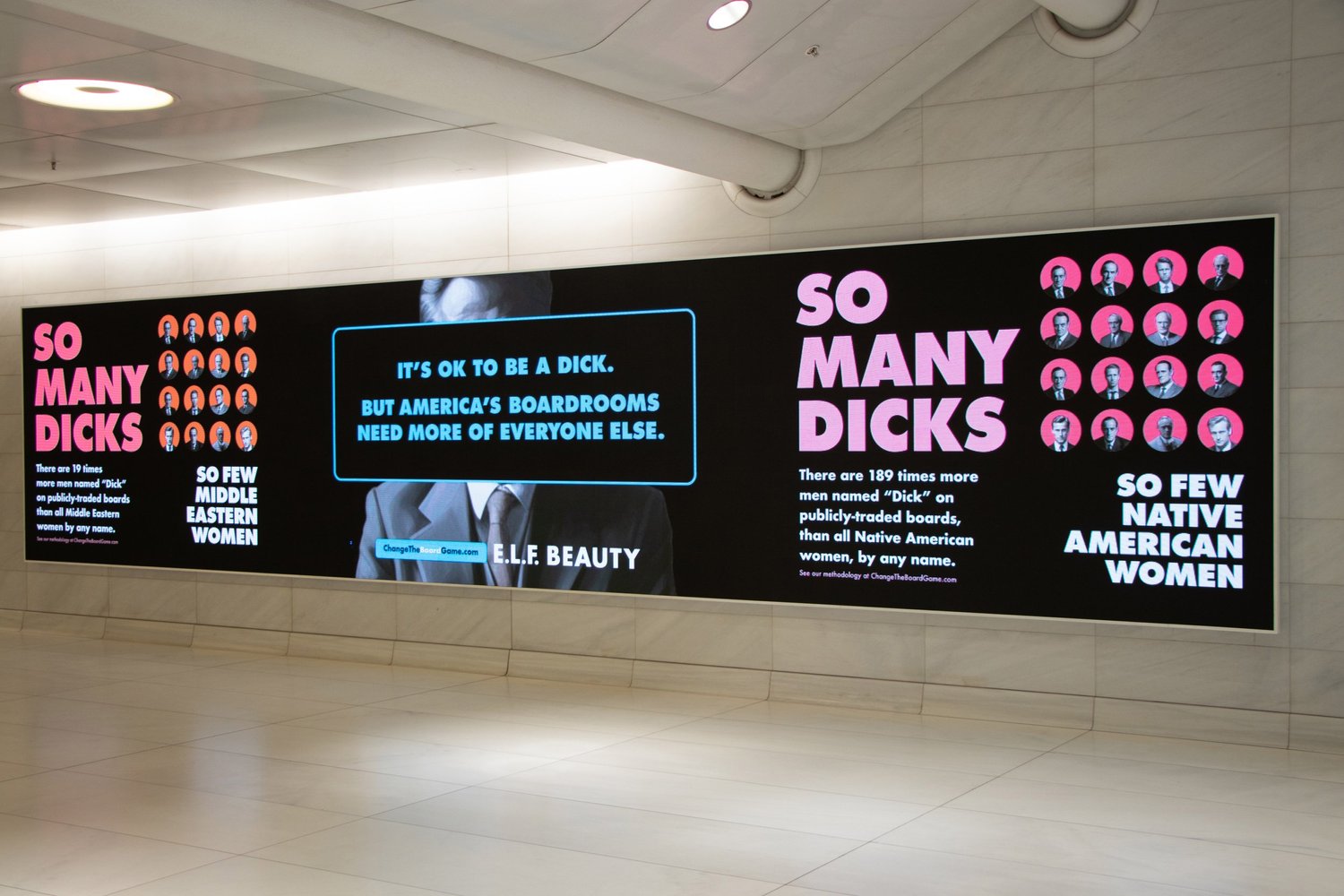
The campaign used more than 100 assets and occupied stations around Wall Street for four weeks. It was funny enough to travel and specific enough to survive scrutiny. OBERLAND reports 2.3 billion media impressions, 98 percent positive media sentiment and 81 percent net sentiment on social. e.l.f. also sponsored diverse candidates through the National Association of Corporate Directors; the agency says 10 percent of that group had been placed on boards by the time its case study was published.
“Good isn’t nice to have, good is the multiplier.”OBERLAND’s operating thesis
The stunt was rewarded with a 2025 Cannes Silver Lion, an Effie and two Gold Anthem Awards. But trophies are almost beside the point. The campaign worked because the client had permission to make the argument. e.l.f. had an unusually diverse board and a broader “Change the Board Game” initiative already in motion. The line was not borrowed virtue. It was an extension of observable behavior.
What failed first was the ordinary answer
The pattern becomes clearer in less flamboyant work. Michaels arrived with a familiar retail problem: sales had declined 6.4 percent and the company had fallen to number two in its category. The ordinary response would have been more product, more price and more urgency. OBERLAND instead built “Create the World You Want to Live In,” a platform about the pleasure of making things. Its spots used “Joy to the World” and small vignettes of creative possibility.
That emotional reframing did a practical job. Michaels reported a 2.3 percent increase in same-store sales in the second quarter of 2025. The 2024 Halloween work improved click-through rate by 43 percent; holiday creative lifted purchase intent by 30 percent and ad recall by 11 percent. When the Halloween brief returned in 2025, the agency did not throw away the platform. It widened the same world with vampires, spooky twins and a yeti browsing the aisles like highly motivated seasonal consultants.
Strong Roots, the plant-based frozen-food company, had a different obstacle: it needed to enter America without disappearing into a freezer full of worthy green packages. OBERLAND redesigned the identity and packaging, then created outdoor work for New York. The agency reports a 212 percent store-sales lift against the prior period, more than 40 product launches and 14,000 new retail locations around the world. In 2021, McCain Foods invested $55 million for a minority stake. OBERLAND did not cause a transaction by itself, of course, but a coherent challenger brand helped make growth legible.
The cheapest campaign may be the most revealing
In 2018, OBERLAND made itself the client. “Nothing Changes If We Don’t” addressed racism, sexism, homophobia, tokenism and ageism inside advertising. The campaign softened each accusation with an “-ish” - racist-ish, sexist-ish, ageist-ish - not to excuse the behavior but to keep the accused person in the conversation long enough to recognize it.
The reported paid-social cost of Nothing Changes If We Don’t. Distribution came from press, participating industry figures and other agencies sharing the work.
The money is almost comic. Less than $100 in paid media produced millions of impressions, according to the Shorty Awards case study. Yet the campaign was not free. The agency paid in the more difficult currencies: attention, internal discomfort and operational change. It commissioned a compensation study, environmental analysis, diversity and inclusion training, mental-health and harassment training, and an HR policy audit. The external message changed the internal checklist.
That is also the answer to what changed OBERLAND’s mind. The campaign’s raw material came from negative experiences inside the industry, including its own orbit. The agency concluded that public persuasion without private examination would be empty. It later documented investments in employee experience, DEI and carbon measurement in an impact report. Purpose stopped being only a service line and became a constraint on how the company operated.
A useful recipe, with sharp edges
There is plenty here another organization can copy. Not the campaign titles - a boardroom full of imitators is merely another form of sameness - but the architecture beneath them.
- Start with the commercial wound. Declining sales, weak differentiation, low enrollment or a looming trust problem gives the work a job beyond being admired.
- Earn the position before announcing it. e.l.f.’s own governance made its diversity argument credible. Internal proof is creative material.
- Turn research into one repeatable tension. “More men named Dick” travels farther than a deck of demographic tables without falsifying the underlying fact.
- Match media to the people implicated. A boardroom message in Wall Street stations is not just reach. The location completes the sentence.
- Choose the measure before launch. Sales lift, donations, enrollment, board placements and brand perception are harder to retrofit than impressions.
Where the model fits
Brands with a real operating record, a clear business problem, leadership willing to take a position and enough measurement discipline to connect creative work with behavior.
Where it loses force
Companies seeking a borrowed cause, a quick reputation rinse or universal approval. Provocation without proof attracts attention to the gap between message and conduct.
OBERLAND sits in the market between a traditional full-service creative agency, a brand consultancy and a social-impact practice. Its clients include consumer companies such as e.l.f. Beauty, Michaels, Thinx and Strong Roots; platforms such as Uber; and institutions and nonprofits including the ACLU, March of Dimes, The Nature Conservancy and The Leukemia & Lymphoma Society. The work ranges from positioning and identity to film, social, packaging, out-of-home, fundraising and digital experiences.
The company is privately held, employs a few dozen people and does not publish its pricing or revenue. That matters because purpose is not a scalable software product here. It is senior judgment sold through projects and client relationships. OBERLAND’s answer to larger networks is founder attention and specialization; with Cutwater, it co-founded Indie at Large, a coalition arguing that independent agencies can offer focus that consolidated groups struggle to reproduce.
Its newest research product, “Speak or Surrender,” extends the pitch into election season. The report asks which issues consumers expect brands to address, what roles companies should play and how leaders can engage without improvising under pressure. It is a logical turn. If culture keeps placing contested questions in the path of business, then a purpose agency is not selling moral decoration. It is selling preparation.
The funny thing about “Make Good Money” is that it refuses the comforting version of either side. Doing good is not accepted as proof of effectiveness. Making money is not accepted as proof of value. OBERLAND wants both words to keep an eye on each other. For an advertising agency, that may be its most persuasive line.