A shoe seller in São Paulo does not wake up wishing for “unified commerce infrastructure.” She wants the Pix payment to clear, the last blue size 39 to disappear from inventory, the shipping label to print and the customer on WhatsApp to stop asking whether the parcel will arrive by Friday. Nuvemshop has spent 15 years turning that anxious list into a product map. The storefront is merely where the public sees the work.
The company began in Buenos Aires in 2011 as Tiendanube, a university project built by Santiago Sosa, Alejandro Vázquez, Martín Palombo, Alejandro Alfonso and José Abuchaem. It entered Brazil the following year as Nuvemshop - both names translate roughly to “cloud store” - and eventually made São Paulo its headquarters. Today, it says more than 180,000 active brands use its software across Latin America. They range from people testing a first product to direct-to-consumer businesses running high-volume operations.
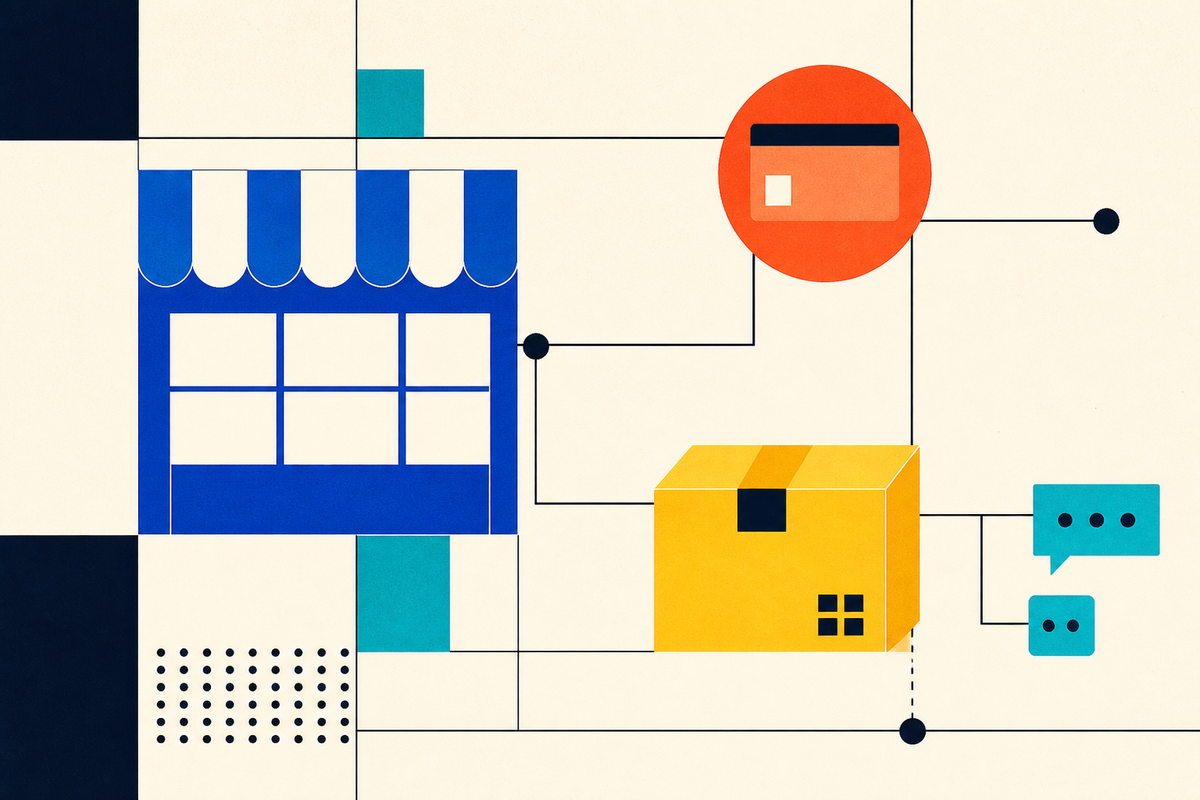
Calling Nuvemshop a website builder is accurate in the way that calling a supermarket a room with shelves is accurate. A merchant can choose a theme, publish a catalog and accept orders. But the company’s ambition lives behind the screen: Nuvem Pago processes money, Nuvem Envio coordinates parcels, Nuvem Marketing automates follow-up, Nuvem Chat handles sales conversations, and a network of apps and agencies fills the peculiar gaps of each business.
The local details are the product
Global commerce platforms offer scale, mature tooling and enormous developer communities. Nuvemshop’s counterposition is not that Latin American merchants dislike those things. It is that retail remains stubbornly local. Brazilian buyers expect Pix. Delivery networks vary by country and postcode. A shopper may discover a product on Instagram, negotiate over WhatsApp and pay without ever behaving like the tidy browser customer imagined by a generic checkout funnel.
Nuvemshop builds for that untidiness. Its payment product sits inside the same dashboard as orders and inventory. Its shipping layer produces quotes and labels while tracking exceptions. Marketplace connections let a brand borrow the reach of Mercado Livre or Shopee without making those platforms its only home. The merchant keeps a branded destination and the customer relationship, while still selling across channels.
“They want to connect more directly with consumers and convey their own brand, image and voice.”Santiago Sosa, co-founder and CEO
That direct relationship is the strategic center. Marketplaces are excellent at aggregating demand, but they can flatten a seller into a thumbnail beside ten alternatives. Nuvemshop sells control: the merchant’s domain, presentation, data and post-purchase conversation. It calls the model D2C, but the emotional appeal is simpler. Build a place that belongs to the brand, then connect it to everywhere customers already shop.
The company says stores on its platform generated more than R$6.5 billion in 2025 sales, 35 percent above the prior year, and reached 12 million unique buyers. Those are company-reported figures, but they show the shape of the machine: many independent brands sharing a common operating layer rather than one giant marketplace owning the shelf.
One dashboard, several businesses
Nuvemshop makes money first as software. In Brazil it offers a free starting plan and paid subscriptions that add capability and support; Nuvemshop Next uses custom pricing for larger operations. Yet subscription fees explain only part of the model. Native payments create processing economics. Shipping adds another transactional layer. Nuvem Chat charges by AI-handled conversation, with rates tied to the merchant’s plan.
This matters because the company can grow without merely charging more for the same webpage. A young merchant may begin with a free store, then pay for a plan, route transactions through Nuvem Pago, print labels with Nuvem Envio and automate abandoned-cart messages. Each useful addition raises revenue per merchant and makes the workflow harder to disassemble.
There is a tension inside this convenience. An integrated stack reduces setup and reconciliation, but it can also deepen dependence on one vendor. Sophisticated brands may prefer specialist tools or demand more control over code and data flows. Nuvemshop’s answer is an open ecosystem: APIs, apps, agencies, ERP connections and alternate payment or logistics providers. The platform wants to be the control room, not necessarily the maker of every instrument.
store
The box became part of the software
Nuvemshop’s 2021 acquisition of Mandaê was a revealing move. Mandaê used data and software to connect smaller online retailers with carriers and manage the trip from collection to delivery. By buying it, Nuvemshop acknowledged that a perfect checkout followed by a late parcel is still a failed commerce experience. Logistics was not an integration to list on a features page. It was part of the product.
The acquisition followed an unusually rich year. An Accel-led Series D brought in $90 million in March 2021. Five months later, Insight Partners and Tiger Global co-led a $500 million Series E that valued Nuvemshop at $3.1 billion. Capital allowed the company to expand its geography and its definition of commerce. It entered Colombia, added enterprise service through Next and developed native payment, shipping and marketing units.
The public valuation remains a 2021 marker, not a live appraisal. Private software markets changed sharply after that fundraising cycle, and Nuvemshop does not publish the recurring financial detail of a listed company. The operational story is more observable: more native products, more countries and a merchant count that has continued to rise.
When the sales counter is a chat window
Nuvem Chat is the clearest expression of the company’s local instincts. Introduced in 2025, the AI assistant uses a store’s catalog, orders and chosen tone to answer questions on WhatsApp. It can recommend items, create a cart and support payment inside the conversation. In July 2026, Nuvemshop extended the same assistant to Instagram direct messages and Story replies.
This is less a chatbot novelty than a bet about interface. In much of Latin American retail, chat already functions as fitting room, help desk and cash register. The merchant problem is not persuading customers to message; it is answering promptly at midnight without hiring a night shift, while keeping stock and order data synchronized. Nuvemshop charges only for AI conversations, creating a usage business that rises with customer activity.
The risk is familiar. Automated service can become a brisk way to misunderstand a customer, and product claims such as fully conversational payment are constrained by channel, rollout and geography. The useful measure will not be the number of generated replies. It will be whether a small seller sees fewer abandoned conversations, fewer incorrect promises and more completed orders.
The valuable AI is not the one that chats most fluently. It is the one that knows the green shirt is sold out before promising it.The operational test for conversational commerce
Where Nuvemshop sits in the market
Shopify is the obvious global comparison. VTEX competes for sophisticated commerce operations, while Loja Integrada, Tray, Wix and WooCommerce offer different combinations of price, simplicity and control. Mercado Livre and Shopee occupy another axis: they are partners when connected as channels, and competitors when a merchant decides a marketplace page is enough.
Nuvemshop’s position sits between those poles. It offers the accessibility of hosted SaaS, the expanding service bundle of a commerce operating system and the regional specialization of a local operator. Its expertise is not one miraculous algorithm. It is the accumulated handling of payment approval, carrier coverage, catalog synchronization, store design, marketing triggers and customer support across countries with different habits.
The culture the company presents follows that practical work. One internal program, “Everyone Delivers Customer Happiness,” puts teams in contact with merchants so product decisions do not become abstractions. The phrase can sound like office-wall optimism, but the practice addresses a real platform danger: engineers and executives forgetting the person whose Friday depends on a label printer.
For merchants, the proposition is equally plain. Nuvemshop can shorten the distance from product idea to functioning store, then postpone the moment when operational complexity demands a patchwork of vendors. It will not create demand, choose a winning product or rescue weak unit economics. It can make the mechanics of selling less punishing.
That is also what distinguishes the company. Nuvemshop did not discover that businesses want websites. It noticed that in Latin America, the website is surrounded by regional frictions that decide whether a sale completes. By absorbing those frictions - payment method, parcel route, marketplace feed, midnight message - it made the supposedly boring parts of commerce into the main event.