At nine years old, Jini Kim enrolled her brother in Medicaid. Kimong had severe autism and later developed grand mal seizures. Their parents, recent immigrants to America, relied on their daughter’s English to navigate the system. Before Kim had much occasion to consider what healthcare ought to be, she had learned how much work it asked of a family.
The company she eventually co-founded carries that experience in its name. Nuna means big sister in Korean. It is an unusually intimate name for a business that once spent its days organizing government health data. But the distance between a Medicaid application and a medication reminder is smaller than it looks: both require someone to make a complicated system usable by a person with other things to worry about.
- Nuna began with healthcare data for employers, health plans and government.
- Its patient app combines daily coaching, connected blood-pressure readings and habit-building tools.
- A Rush study found greater blood-pressure improvements among app users than matched usual-care patients.
- In September 2026, Nuna Health announced an offering for eligible Medicare beneficiaries through ACCESS.
A big sister learns to think in millions
Kim and David Chen founded Nuna in 2010. Their previous jobs supplied an interesting combination of skills: she had worked at Google Health; he had been a senior data scientist at Netflix and trained in biomedical informatics at Stanford. They started by working with large self-insured employers. Chen later named Home Depot and Facebook among the early customers.
The initial obstacle was access to enough useful data. An employer paying for its workers’ healthcare needed to understand what it was buying. Records scattered across different sources made even the questions troublesome. Nuna worked on assembling those records into something employers could examine, rather than merely accumulate.

Then came an unexpected detour. Kim joined the team brought in to repair Healthcare.gov after its troubled launch. Nuna subsequently became a partner in the development of a national Medicaid data platform. At its public launch in January 2017, the company described a system intended to bring together eligibility, provider and managed-care information covering more than 73 million people.
Nuna worked under prime contractor Quality Software Services, or QSSI. That detail matters. This was a piece of public infrastructure built through a chain of organizations, with Nuna contributing the data work. The company’s account says its team delivered on time and on budget. The more interesting achievement was making records from separate state systems usable together.
“Every row of data is a life whose stories deserve to be told with dignity.”Jini Kim · Nuna’s 2017 public launch
Scale gave the company credibility. It did not, by itself, settle the question of what anyone should do differently tomorrow.
The dashboard has to leave the building
Healthcare analytics has a peculiar weakness: a beautifully organized answer can remain safely inside an office. Nuna’s work moved into the financial and operating machinery of value-based care, where payment arrangements try to reward better care rather than simply more billable activity. Its account of that work identifies the platform as the foundation for the patient app.
The distinction is practical. Organizations buying analytics need to understand cost, access and performance. Patients managing a chronic condition need help repeating ordinary actions. A clinician’s advice may be perfectly clear in the consulting room and difficult to follow at breakfast. The app takes that second problem seriously.
Nuna offers medication routines, condition education, meal feedback and a conversational AI coach. A connected cuff supplies blood-pressure readings. Points, streaks and badges give repetitive tasks a little ceremony. The proposition is easy to understand: make the next useful action visible, then give someone a reason to return.
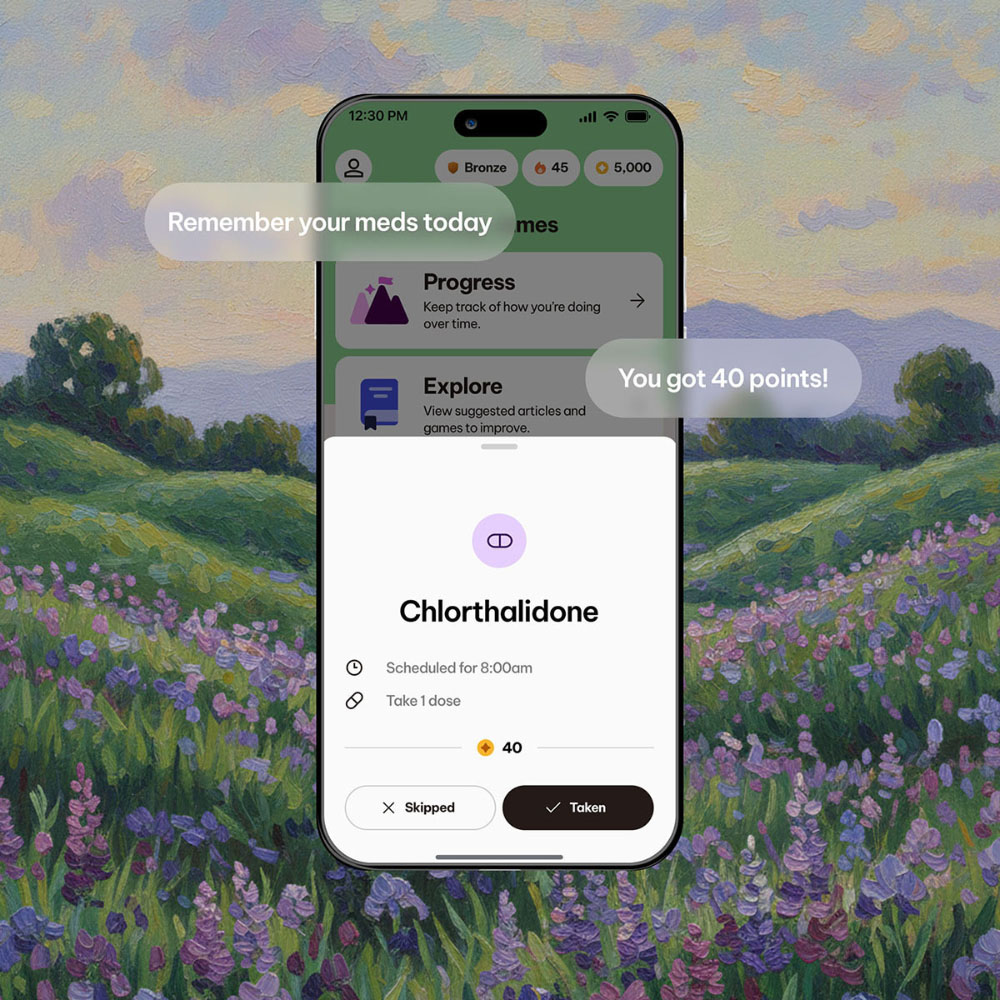
For someone using it, that can mean recording a reading, keeping track of medication, learning about a condition or taking a clearer health summary to an appointment. For a practice, it can mean patients arriving with information about the intervening weeks. The useful unit of work is the stretch of life between visits.
Read the number beside the number
In September 2026, a Rush study published in the Journal of General Internal Medicine compared 425 Nuna app users with 425 matched patients receiving usual care. Across the matched groups, systolic blood pressure fell by 4.6 mmHg among app users and 1.6 mmHg among controls. Among those starting with uncontrolled stage 2 hypertension, the declines were 13.6 and 9.0 mmHg respectively.
Blood pressure fell in both groups
Mean systolic decrease, stage 2 hypertension subgroup
The comparison is the story. Both groups improved; app users improved more. Because this was a retrospective matched study, it establishes an association rather than randomized proof that the app caused the difference. The program also included community health workers helping patients get started and a Rush nurse handling blood-pressure alerts during business hours. Software operated inside a care arrangement.
A separate company white paper, published in June 2026, described 595 onboarded Florida patients. Among 185 patients with stage 2 hypertension, mean systolic pressure declined by 12.7 mmHg; the paper reported 65% retention at twelve months for the onboarded cohort. Those findings concern another population and another analysis. They deserve their own label, rather than being blended into one grand success rate.
The lesson for a buyer is to ask what a result includes: which patients, what support, how long, and compared with what. The lesson for a builder is less glamorous than inventing a new feature. Getting people started, helping them return and measuring a meaningful change may be where the work pays off.
Free to the patient still requires a payer
In November 2025, Hill Physicians Medical Group announced a partnership to make Nuna available to 7,000 patients, initially focused on blood pressure and medication adherence. That figure describes access being offered, not a count of people using the app every day. The rollout placed Nuna alongside an established physician organization with existing patient relationships.
The business has also changed who can pay for its work. On September 15, 2026, Nuna Health announced no-cost coaching for eligible Original Medicare beneficiaries in markets where it operates. It participates in CMS’s ACCESS model, which tests payments linked to health outcomes. Nuna’s announcement also named Northwestern Medicine as a collaborator on bringing that support into care-team workflows.
Nuna says the app and blood-pressure cuff are free to patients. Eligibility and clinical enrollment determine the program behind them.
Nuna says it covers patient copays and currently pays the full cost for people outside the Medicare pathway. Free use is therefore a distribution choice supported by a funding arrangement. The company has substantial venture backing: it disclosed more than $90 million raised by January 2017, led by Kleiner Perkins and John Doerr. That was cumulative funding, rather than the price of a particular product.
CMS describes ACCESS as a ten-year voluntary test that began in July 2026. Its wager is whether technology-supported chronic care can be paid for according to what patients achieve. For Nuna, payment design and patient behavior now meet in the same proposition.
The person behind the reminder
Nuna occupies more than one market. Its enterprise heritage sits among healthcare data and analytics businesses. Its current app belongs among chronic-care coaching and remote-monitoring services. Its distinguishing combination is that history of institutional data work, attention to daily behavior and relationships with care organizations. None of that makes the work automatic.
It also offers three different relationships. A person can use the app independently for wellness tracking, without clinical care through the app. A partner program can support an existing provider. An enrolled Nuna Health patient can receive care from the affiliated clinical organization. Knowing which relationship applies is more useful than knowing that the app contains AI.

The company’s stated culture keeps returning to Kimong. Its published values ask employees to consider whether a decision will help him and whose voices are missing. Live Healthy Chicago reported a donation of 2,000 Nuna app licenses in June 2026. Reaching people through community organizations gives that aspiration a concrete setting.
There are practical limits. A phone, a cuff and a reward cannot remove every obstacle to following a care plan. Reliable access, usable onboarding and a route back to a clinician matter. The Rush results evaluate a supported program; copying only its interface would leave some of the experiment behind.
What a reader can borrow is the attention to the handoff. Find where a sound instruction becomes an inconvenient daily task. Reduce the effort, make progress visible and test whether people benefit. Nuna’s story begins with a child translating a system for her family. Its present question is how much of that burden a company can finally take off someone’s hands.