In 1985, Noubar Afeyan went to a conference in Washington and found himself sitting beside an older engineer at lunch. Afeyan was a doctoral student at MIT. He had not arrived with a business plan. His companion began describing how he had started a company with a friend, making instruments for a new generation of engineers. Eventually, the name emerged: David Packard.
Afeyan had been talking to the co-founder of Hewlett-Packard without knowing it. There are networking strategies considerably more elaborate than this one, and considerably less effective. He asked how an engineer knew where to begin. Packard’s advice, as Afeyan later recalled it, was to start and learn along the way. The conversation made entrepreneurship seem available to him.
The encounter is a useful place to begin because Afeyan’s career can look rather orderly from a distance: engineering degrees, a first business, more businesses, then an organisation devoted to creating them. At the table, he was still deciding what kind of working life he might have. A conversation opened a door that his qualifications alone had not shown him.
Three cities, and the business of belonging
He was born in Beirut in 1962, to Armenian parents. His family left Lebanon during the civil war in 1975 and settled in Montreal. At thirteen, he was already learning the difference between a place you know and a place in which you must learn how to live. That move sits behind his later interest in immigration as a source of economic and scientific possibility.
Montreal became the setting for his undergraduate education. He earned his chemical engineering degree at McGill in 1983, then moved to the United States for doctoral work at MIT. The route joined three cities, but each move also brought a different set of expectations: childhood, university, and a field of engineering still establishing what it could become.
At MIT, he worried about belonging. He spoke with an accent; his pastime was Armenian folk dance. In a story he later told the graduating class, a poster in the Infinite Corridor challenged the casual habit of calling other people immigrants. Its image of a Native American made him reconsider who, in the United States, could claim to have always been there. He found reassurance in the question.
It is a small incident beside the companies that followed, but it gives his arguments about unfamiliarity a personal texture. Starting again involves ordinary, sometimes embarrassing questions about how you sound and what you enjoy. The person learning to navigate a corridor is also learning which judgments deserve to keep their authority.
A company that makes companies
Afeyan completed his doctorate in biochemical engineering in 1987. He became the founder and CEO of PerSeptive Biosystems, an instruments business that grew to $100 million in annual revenue. Following its acquisition in 1998, he took a senior executive role at Applera and helped initiate Celera Genomics. He had moved from learning about entrepreneurship to managing its practical consequences.
His experience also extended beyond the laboratory. He was involved as a founding-team member, director, and investor in Color Kinetics, later acquired by Philips, and Affinnova, later acquired by AC Nielsen. These were different businesses, but they belonged to the same career-long question: how does an invention become an organisation that can keep working?
In 2000, he founded Flagship Pioneering. Its working arrangement brings scientific invention, company leadership, and capital into one institution. A company can begin inside that institution, with a team and resources already connected to one another. Afeyan had spent years assembling those pieces separately. Flagship gave him a way to change their relationship.
A conventional account of a founder often turns on a single idea. Afeyan’s work asks how an organisation might repeatedly produce ideas worth building around. That shifts attention toward recruitment, experiments, and the point at which a promising possibility deserves a larger commitment. A good opening question still needs people who know what to do on Tuesday morning.
At Flagship, explorations become prototype companies. Experiments test whether their underlying science holds up; some projects stop. Those that advance can become named companies with capital, executives, and boards. Eventually, growth companies attract outside investment and partnerships. The sequence makes room for imagination while giving evidence the power to end a project.
- 01ExplorationAsk a question.
Vary the hypothesis. - 02PrototypeTest the science.
Keep or discontinue. - 03New companyName it. Fund it.
Recruit its leaders. - 04GrowthBring in partners.
Build the business.
Ring Therapeutics is one example of that collaborative founding work. Its founding Flagship team included Afeyan, Avak Kahvejian, and Erica Weinstein; the company launched in 2017. The three names are a useful corrective to the solitary-founder picture. Even when one person’s philosophy becomes closely associated with an institution, the work requires other people to investigate, challenge, and develop it.
Optimism with an awkward companion
Afeyan calls his mindset “paranoid optimism.” The phrase has the slight comic discomfort of two dinner guests who would prefer different tables. One wants to discuss what might become possible. The other wants to know what has been overlooked. Afeyan considers both necessary company.
In his account, ambitious ideas can look unpromising at the beginning. Judging them only by how comfortably they fit existing expectations risks losing something useful. Yet pursuing every odd idea would be expensive chaos. The discipline lies in allowing an idea to be considered, then continuing to question it as evidence arrives.
That distinction explains why doubt has a place in his version of confidence. Belief supplies a reason to begin. Scrutiny helps determine what should happen next. The same person can be enthusiastic about a possibility and dissatisfied with the explanation currently offered for it. An experiment gives the disagreement somewhere productive to go.
His vocabulary sometimes gets playful. Speaking with Tyler Cowen in 2021, he proposed “thrival,” a word joining survival and thriving. He described entrepreneurship as something that can be learned through mindsets, practice, and decisions. He also discussed his mother, a classical pianist, and the influence she had on his musical tastes. There is room in this engineer’s conversation for both systems and music.
The word-making is revealing without being a personality diagnosis. Afeyan wants language for conditions that resist a neat choice: confidence with doubt, survival with ambition, unfamiliarity with belonging. His public explanations repeatedly return to holding those conditions together long enough to do useful work.
Gratitude acquires an address
Company building is only one part of his institutional life. In 2015, Afeyan, Vartan Gregorian, and Ruben Vardanyan founded the Aurora Humanitarian Initiative. It was established on behalf of survivors of the Armenian Genocide and in gratitude to the people who saved them. Afeyan’s grandfather was among those survivors.
Aurora recognises people who take personal risks to help others. Its founding purpose turns a historical debt into support for people facing present danger. The connection is explicit: the descendants of people who were helped can help make someone else’s rescue possible. Remembrance has work to do beyond the anniversary.
At Aurora’s tenth-anniversary ceremony on Ellis Island in 2025, Afeyan returned to his family’s history and the obligation to act. The setting placed that discussion in a building associated with arrivals, uncertainty, and beginning again. His career and his humanitarian commitments meet there in a concrete way: both ask what someone can do when the situation has no comfortable answer.
Education offers another form of that commitment. Noubar and his wife, Anna, became founding patrons of UWC Dilijan, the international boarding school that opened in Armenia in 2014. Alongside its founders and other patrons, they helped fund construction and startup costs. The school brings students from different backgrounds into a shared educational setting.
There is a practical generosity in paying for the beginning of a school. Before the institution can have alumni, it needs rooms, staff, and students. The Afeyans’ support helped provide the conditions in which other people could start their own, very different stories. An international school also creates daily opportunities to discover how much a familiar assumption depends on where you grew up.
Afeyan also helped establish the Foundation for Armenian Science and Technology, founded in 2017. FAST works on education, research, and the commercialisation of science. Its work connects people and expertise in Armenia with a wider community. The institution-building theme continues: give learning and invention somewhere to take root, with support that extends beyond a single promising conversation.
The assignment after the diploma
When Afeyan returned to MIT to deliver its commencement address on May 30, 2024, he reached back to another formative influence: watching Mission: Impossible reruns during curfews in Beirut. The television agents accepted difficult assignments. Decades later, he used their missions to ask graduates what they would choose to attempt.
He organised his advice around imagination, innovation, and immigration. The last word included a broader intellectual experience: leaving familiar circumstances and entering territory you do not yet understand. Someone could undertake that journey without leaving their country. A change in how you think can make the old map less useful.
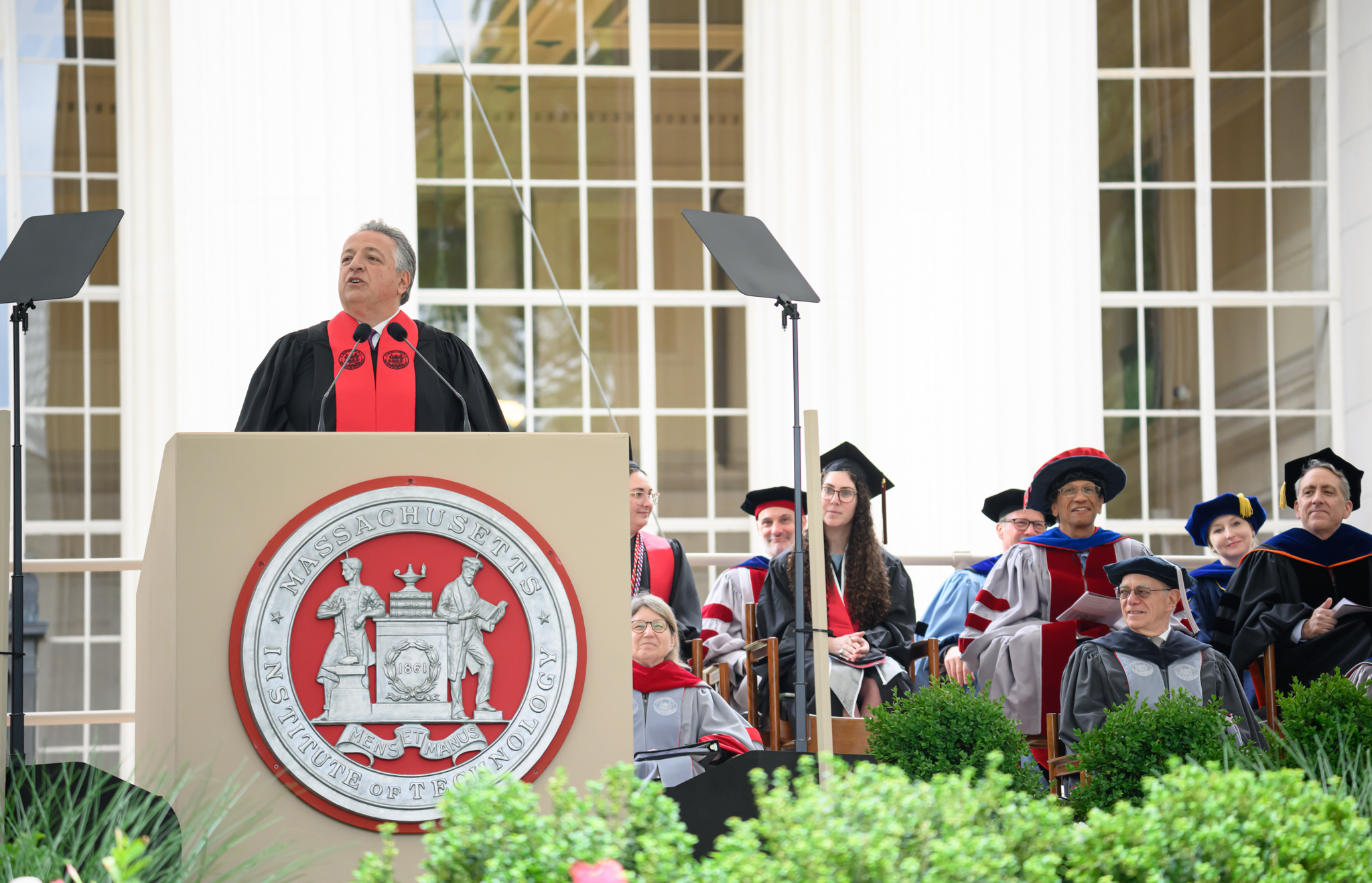
“You are far more than a technologist - you are a moral actor.”
Noubar Afeyan · MIT commencement, 2024
The speech also asked graduates to think about their legacy and the consequences of pursuing profit and power alone. It is a pointed subject for a company builder to raise. An education can equip you to solve a problem; deciding which problem deserves your time introduces another kind of responsibility.
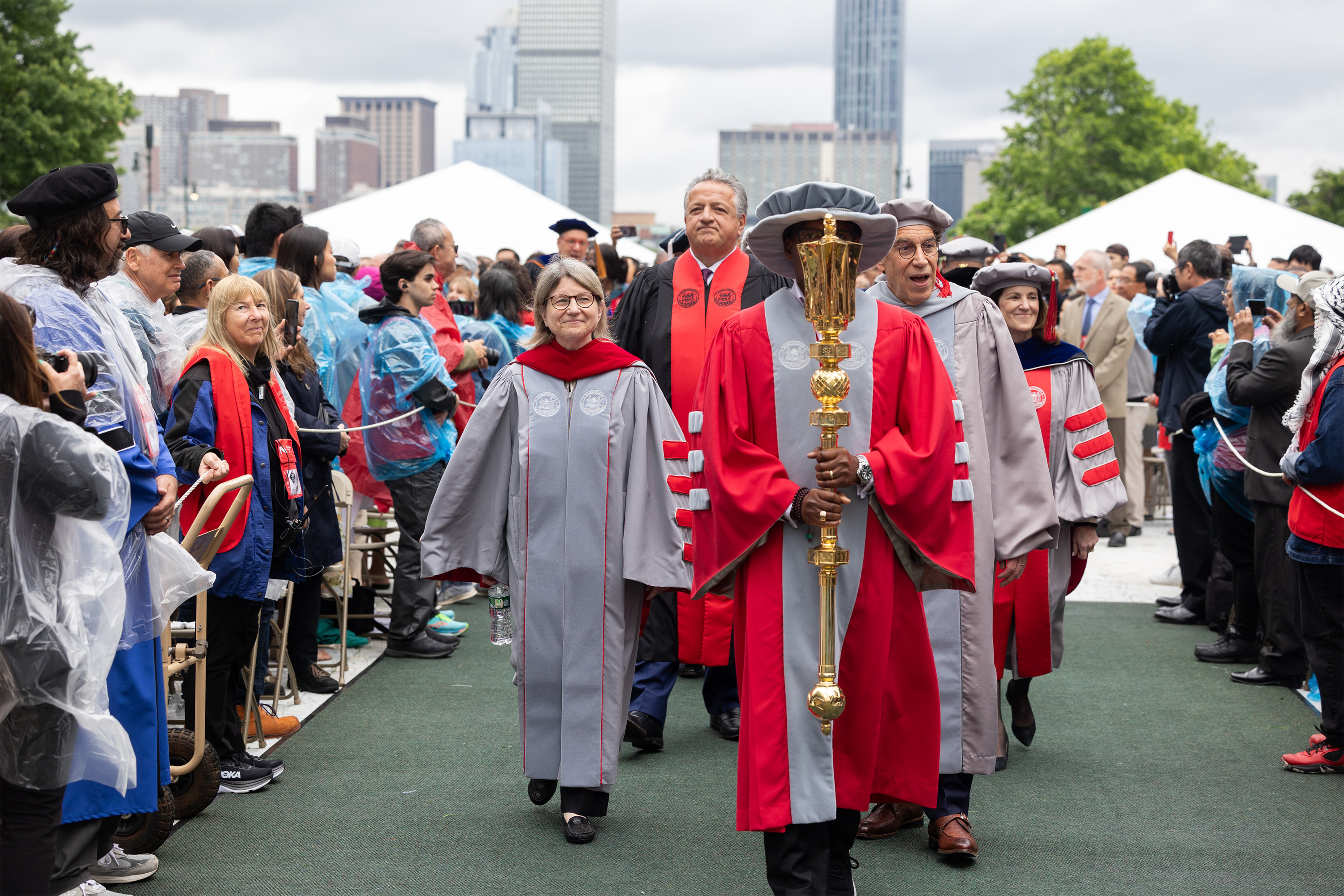
His own return carried several relationships at once. He was an alumnus, a former lecturer, a member of MIT’s governing Corporation, and the father of two MIT alumni. A university that once made him worry about belonging had become a place he helped govern and a place his children had attended. The earlier corridor story had acquired a long second chapter.
Still beginning with a question
His 2026 annual letter, Choosing Science, returns to the conditions that allow invention to happen. He argues for research, evidence, experimentation, and the ability to resolve disagreements through the scientific method. He also continues to explore the combination of human intelligence, machine intelligence, and the accumulated complexity of nature, an idea he calls polyintelligence.
In that letter, he points to Lila Sciences and its combination of AI models with autonomous robotic laboratories. The interest follows naturally from the rest of his career: how can the process of asking and testing questions itself become more capable? His ambitions concern the machinery of discovery as well as the discoveries.
There is something durable about the lunchtime beginning. A student listened to another engineer and found a possibility he had not planned for. Years later, Afeyan’s work still depends on making possibilities available, then giving them a difficult examination. The doubt remains welcome at the table. It has earned its seat.