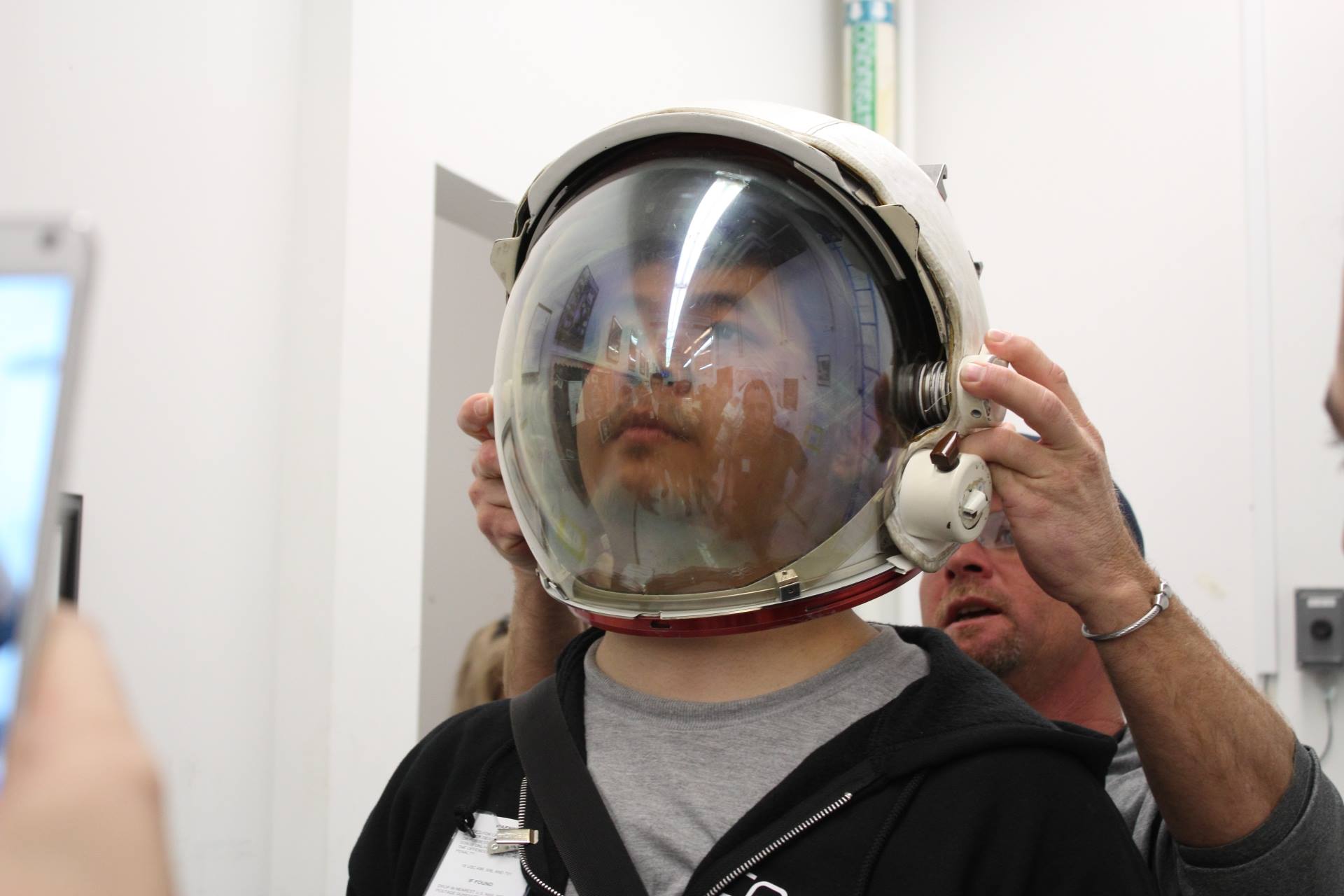
The first camera in Norman Wang's story was not really a camera. It was an astronaut helmet, wide and white and absurdly large, lowered over his head at NASA's Johnson Space Center. He had come to Houston with colleagues from Opaque Media to understand the physical world behind Earthlight, their virtual-reality space project. The field of view mattered. So did the hardware, the sounds and the small procedures that make an extraordinary job feel ordinary to the person doing it.
The photograph survives: Wang's face dim behind the curved visor, another pair of hands steadying the helmet. It captures the question that has followed him from research labs to film sets. How do you make a complicated machine feel like a place a human being can inhabit?
Wang was born in Kaohsiung in 1987 and moved to Australia before he was 20. He arrived with astrophysics in mind. Then a Star Wars game rerouted the plan. The pull was not simply toward games, but toward worlds that answered back. At Swinburne University of Technology, his studies crossed computer science, interactive multimedia, human-computer interaction and cognitive psychology research. The mixture looks restless until you notice that every subject sits between a person and a system.
A detour with a flight plan
In Melbourne, Wang and fellow Swinburne graduates built Opaque Multimedia around immersive experiences. Their work won the World Citizenship category at Microsoft's 2015 Imagine Cup. The prize mattered, but Wang later described the harder benefit: intense competition forced the team to prepare, stay flexible and know their material. It changed how they presented information. A good simulation still had to survive a pitch, a deadline and a room full of questions.
Earthlight raised the stakes. The project placed a player outside the International Space Station and grew through contact with NASA's public-affairs staff and technical teams. Wang, its executive director and project lead, visited Johnson Space Center with colleague Liam McGuire. They toured ISS simulators, examined suits and equipment, and spoke with people who knew what space sounded like. Accuracy came from asking wonderfully specific questions.
One career, four coordinates
The studio's path soon curved from experiencing a digital world to filming one. A connection made through the NASA work led to media projects around The Martian, then toward people working in feature-film visualization. Wang saw that techniques used in VR also solved a very old filmmaking problem: a director needs to stand somewhere, look through something and decide what belongs in the rectangle.
Give the director something to hold
Wang co-founded Glassbox Technologies in 2016 with Mariana Acuña Acosta. The Los Angeles company developed tools around real-time engines at precisely the moment those engines were escaping the games business. Film crews could render a scene while looking at it, combine tracked cameras with digital environments and move expensive decisions earlier in the production schedule.
There was, however, a translation problem. Game engines speak in scene graphs, coordinate systems, frame rates and plugins. Filmmakers speak in lenses, blocking, pacing and shots. Glassbox made that gap its address.
DragonFly, Glassbox's virtual camera, provides the most literal translation. It lets a director or cinematographer move through a computer-generated environment as though scouting and shooting a physical location. An iPhone or iPad can become a lightweight camera. Professional tracking systems can drive a more elaborate rig. The operator can frame, bookmark, rehearse, record and export camera movement while the image responds in real time.
The creative loop
The point is not to make cinematography virtual. It is to keep cinematography recognizable when the location is made of polygons. A director can still hunt for an angle. A camera operator can still feel the relationship between a small physical move and a large dramatic one. DragonFly's movement scaling can turn a modest room into a vast landscape. Additive recording can preserve one pass while another adjusts focus or movement. The software does the arithmetic; the operator keeps the instinct.
BeeHive addresses a less photogenic difficulty. Virtual sets are giant, changing bundles of assets and decisions. Artists may work in Unreal Engine, Unity or Maya while stages, review teams and remote collaborators need the same current scene. BeeHive was designed to synchronize, version and review that work. In 2019, Wang and Glassbox colleague Philippa Carroll collected an Advanced Imaging Society Technology Lumiere Award for it. The trophy recognized the technology. The practical win was fewer ways for a production to lose track of itself.
Interoperability is a stubborn theme in Wang's public conversations. Film and television crews do not all choose the same engine, tracking system or display hardware, and they rarely replace an established pipeline because a new demonstration looks elegant. Glassbox therefore built DragonFly across Unreal Engine and Maya, supported lightweight ARKit tracking alongside professional systems, and provided ways to carry recorded camera moves into other applications. The design accepts a useful truth about production: the new tool has to join the crew before it can change the crew.
That also explains why Wang talks about data with the same energy other founders reserve for images. A beautiful real-time frame is visible. The scene format behind it, the checkpoint that lets an artist recover it and the sync process that keeps an LED stage current are not. Yet those invisible pieces determine whether several departments can safely touch the same world. On the CGPro podcast in 2023, his hour-long discussion moved from early inspiration and team building to scene formats, cross-platform tools and the practical problems still worth solving. The glamour of a virtual set lasts until two machines disagree about which version is real.
The useful part of the future
Wang is unusually comfortable on both sides of the tool. He has spoken about the tension between staying hands-on as an engineer and managing a company. He has also spent years explaining virtual production in classrooms, conference halls and podcasts. At GDC in 2020, when the scheduled VFX Summit could not proceed as planned, he recorded a talk on democratizing virtual production for independent game makers. At SIGGRAPH he discussed augmented reality and volumetric filmmaking. In 2024 he joined a Beverly Hills Film Festival panel about AI and filmmaking.
This is where his research background reappears. Wang does not only ask what a system can do. He asks what confidence a user needs before trying it, what information a team needs before trusting it and which controls ought to disappear. The company homepage can promise real-time technology; the less visible work is making “real time” fast enough for a human conversation.
His colleagues' public biography adds a useful domestic detail. Wang cooks ambitious international food for the Glassbox team and is known to debate competing technologies over homemade shakshuka. The anecdote works because both activities require the same mild obsession: many ingredients, one shared surface, timing that cannot be postponed and an outcome everyone can inspect.
He has also made a habit of testing the whole process. During Los Angeles's 48 Hour Film Project in 2019, Wang joined a seven-person crew that completed a virtual production from beginning to end inside the two-day limit using DragonFly. Product demos are polite. Deadlines reveal where the buttons should have been.
The return route
The most personal stretch of Wang's work now runs back toward Taiwan. Glassbox has helped universities and production partners adopt real-time workflows, including work around Shih Hsin University's LED studio. Wang has argued that Taiwan already has the creative talent, varied landscapes and freedom to compete in screen production. His ambition is to connect those advantages to production methods learned across Hollywood projects.
That effort is not only about installing a wall of glowing panels. Virtual production compresses departments that once handed work from one to another. Art, camera, visual effects and software meet earlier. Someone must know how to translate among them. In November 2025, Wang taught the opening theory session in a Taiwan LED virtual-production training program designed to give crews both technical foundations and time on a working stage.
Teaching completes the loop that began in Australia. The student who combined computers with the study of people became a founder who combined game engines with film crews. The VR developer who went to NASA to learn how an astronaut sees now helps camera teams see places that have never been built.
There is a temptation to describe virtual production as the disappearance of the set. Wang's career suggests a more interesting change. The set becomes negotiable. It can be a desert in a university studio, a space station inside a headset or a location carried on an iPad. The enduring part is the group of people deciding where to stand, what to show and when the shot finally feels right.