The founding document for Aerogen Systems was written in a University of Michigan dorm room. Noah Vogel was a freshman, the client was NASA, and the problem was one that sounds ordinary until you put it inside a spacecraft: dirty air, no convenient replacement parts, nowhere to throw anything away. The proposal became a student project. The student project became a reactor. Several rebuilds later, the reactor has acquired a name, a company and a new destination. It is headed for the semiconductor fab.
Vogel, an aerospace engineer from Dexter, Michigan, is now the co-founder and CEO of Aerogen Systems in nearby Ann Arbor. The company is developing point-of-use contamination control for chipmaking equipment. Its machine, Talos, is designed to sit close to a wafer and destroy airborne molecular contaminants before those contaminants become defects. Its larger ambition, CleanPipe, would connect one purified tool environment to the next.
The appealing bit is not simply cleaner air. It is smaller jurisdiction. A cleanroom makes an enormous room behave. Aerogen asks whether the more useful boundary is the comparatively tiny space around the thing being manufactured. The wafer gets a private atmosphere; the rest of the building can stop auditioning for a laboratory drama.
A problem that would not stay in space
The original University of Michigan work sat within BLiSS, the Bioastronautics and Life Support Systems team. A 2024 NASA technical report names Vogel among the authors of a volatile organic compound removal system. The design problem was maintenance: conventional activated carbon captures unwanted compounds, but the filter eventually becomes another object to replace and discard. For long-duration space travel, every consumable brings a logistical tail.
Vogel put the complaint plainly: “Current technology relies on activated carbon filters, which just trap toxic compounds and eventually end up in landfills. Nothing has really changed since the '50s and '60s.” The reactor developed by the Michigan team pursued photocatalytic oxidation, using a chemical process to break compounds down rather than hold them for later.
That work continued past the first report. Vogel and teammates were listed on a 2025 International Conference on Environmental Systems paper about a continuous-flow VOC degradation reactor. Aerogen describes the resulting system as modular, monitored and free of consumable filters. Those are not decorative adjectives in hardware. They concern whether a machine can be integrated, watched and kept running.
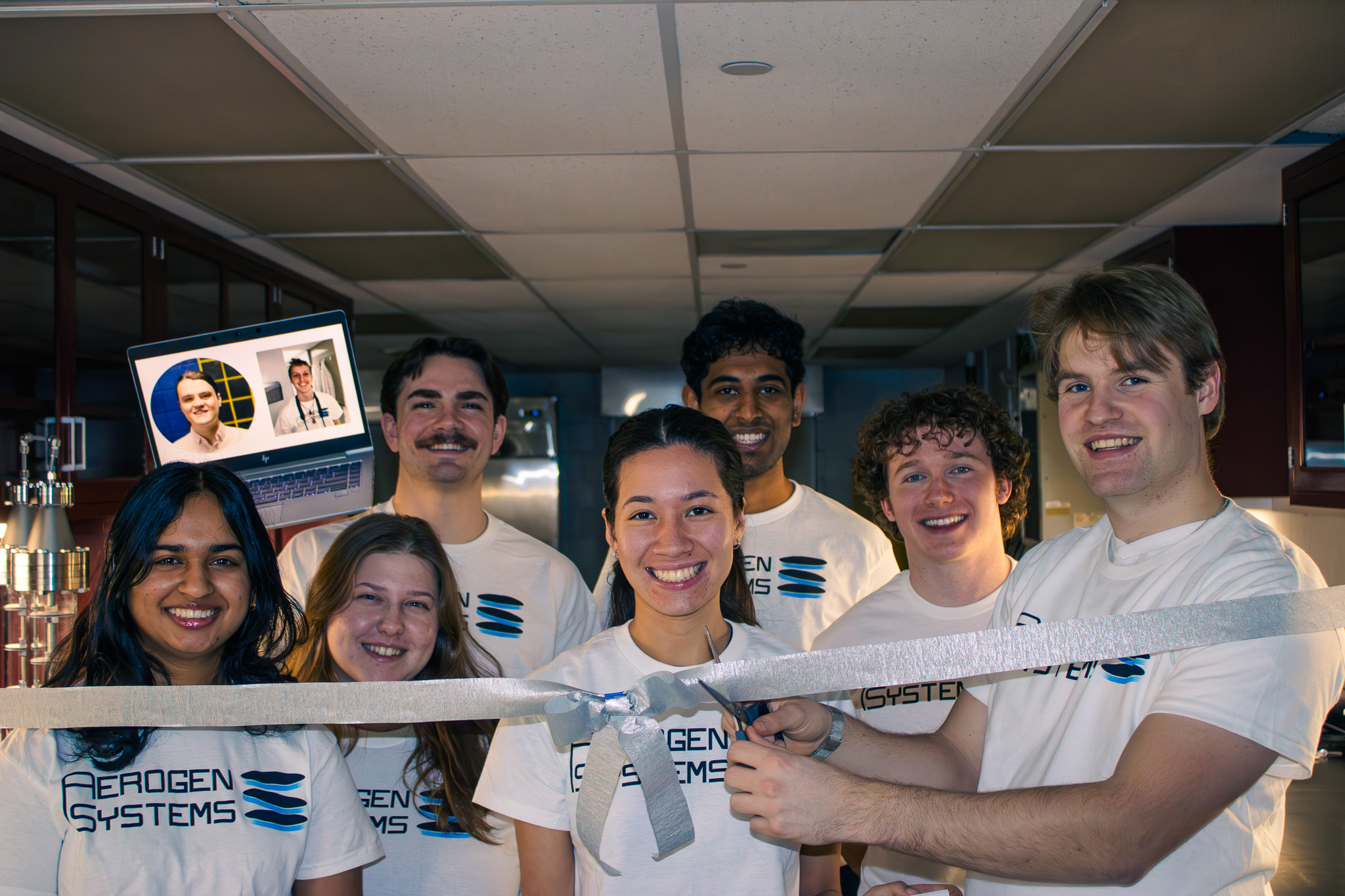
The route from a university reactor to a commercial machine was not automatic. Aerogen first described broad industrial air-quality applications. It joined VentureWell's spring 2026 E-Team cohort with a proposition for breaking harmful pollutants into safer compounds. Its public launch talked about industrial sites, HVAC and the recurring nuisance of filters. Then the company tightened its aim around semiconductor manufacturing, where a small amount of contamination can carry a very large invoice.
“The most important thing is to understand your customer base. Even when you think you do, you probably don't.”Noah Vogel
The customer changes the machine
Vogel's public advice is pleasingly short on founder incense. “Do some extra digging, figure out exactly who you're selling to,” he said. “That impacts all your design specs, and everything that follows.” The sentence is a small manifesto for the pivot. Keep the mechanism. Reconsider the user. Let the user's economics redraw the product.
A semiconductor fab spends heavily controlling particles, gases and airborne molecular contaminants. Yet wafers still wait, move and stage between machines. Aerogen's argument is that protecting every cubic foot of the building is a costly way to protect a small, valuable disc. Talos recirculates and purifies the air inside or immediately around manufacturing equipment. The company says its testing has reached contamination levels associated with 8N purity, compared with an industry-standard 6N benchmark - the claimed difference is one hundredfold.
cleans the tool
protects transit
stays controlled
CleanPipe extends the thought. If each tool has a controlled volume but a wafer travels through ordinary factory air between them, the architecture has a gap. Connect the volumes, Aerogen proposes, and contamination control can follow the wafer through the process. “Talos cleans the tools. CleanPipe connects them,” runs the company's economical summary.
The big claim is that the combined system could eventually reduce or remove dependence on the cleanroom itself. The immediate work is narrower: tool integrations, pilots and commercial deployments. Aerogen says Talos has passed through multiple hardware generations and that its core architecture is validated. A fab, however, is not a forgiving place for laboratory confidence. Integration, uptime, repeatability and economics must all survive contact with production.
The technical wedge
Destroy airborne molecular contaminants close to the wafer, without relying on a disposable filter.
The business wedge
Target the controlled volume where contamination has a direct relationship to yield and cost.
Yield as a way of seeing
Before Aerogen, Vogel worked in two institutions where failure is famously expensive. At Draper, he developed advanced mission simulators. At SpaceX, he worked on Starship actuators. Aerogen's account of the SpaceX stint emphasizes manufacturing engineering, production rate and yield improvement. That vocabulary travels neatly into chips. A defect is chemistry or physics on the line, then accounting in the quarterly report.
The resemblance should not be oversold. Rockets and fabs have different machines, tolerances and cultures. The useful continuity is attention to throughput. A purification system earns its place only if it helps the surrounding process produce more acceptable units at an acceptable cost. For a founder with an aerospace degree, the leap from spacecraft air to chipmaking air is less fanciful than it first appears. Both environments punish contamination, reward reliability and prefer hardware that can explain what it is doing.
Aerogen's own path has been built out of institutions and people. Professor Nilton Renno served as principal investigator on the university work. Colin Lavery, now co-founder and CTO, brought experience building advanced particle detectors at H3D and led early Talos design cycles. The wider student team crossed engineering, materials and marketing. Customer interviews supplied another discipline: the freedom to abandon a broad pitch for a sharper one.
“Because we've been working on this for two years, we knew exactly what we needed to buy.”Noah Vogel, on the Fuel grant
The shock of getting the money
When the University of Michigan Center for Entrepreneurship awarded Aerogen its full Fuel grant request on the first attempt, Vogel did not pretend the outcome had been foretold. “We were genuinely in shock,” he said. The money had a literal shopping list attached. The team needed components for its pilot prototype, lab infrastructure and a permanent place to work.
January 2026 turned those plans physical. Aerogen launched publicly, moved into Michigan Innovation Headquarters and filled a workspace with people, parts and prototypes. Vogel called the transition from a student effort to a real company “surreal.” In April, the team won the MVP Award at Michigan's Impact Venture Demo Day. In summer, Aerogen entered Y Combinator's S26 batch.
The sequence looks brisk when compressed into dates. Hardware time feels different from calendar time. Components arrive, tests fail, housings change, measurements accumulate. A grant does not make a product. It buys the next honest encounter with matter.
By August, Vogel and Lavery were at the SEMI Americas Strategic Materials Conference, listening to people from materials, equipment and manufacturing companies. Vogel came away emphasizing molecular contamination in advanced packaging and hybrid bonding. His phrase for the trip was “Innovation is a two-way street.” It suited a founder who had already carried one technology from NASA research toward industrial air, and then allowed industry conversations to carry it somewhere more specific.
The ambition, measured in cubic feet
Aerogen's aspiration is architectural: fabs that do not need billion-dollar cleanrooms to make advanced chips. Its present tense is more modest and more interesting. The team is looking for equipment partners, pilot sites and proof that Talos can deliver its laboratory promise inside manufacturing equipment. CleanPipe remains the connective idea on the roadmap.
Vogel's story is still early enough that achievement and experiment occupy the same bench. The NASA report exists. The conference paper exists. The grant, lab, demo-day award and YC place exist. Talos now has to perform in the world that customer interviews selected for it.
There is something elegant in the company's chosen constraint. Instead of purifying a cathedral of factory air, draw a precise enclosure around the wafer. Instead of treating contamination as a building-wide abstraction, meet it at the tool. A smaller boundary does not make the engineering easy. It makes the question wonderfully clear: can this machine keep this tiny, costly place clean?