A dump truck is difficult to overlook. It is considerably easier to lose track of who has booked it, where it is going, and whether the paperwork will agree with the work. Noah Dolgoy encountered that administrative puzzle while advising an excavation company. Moving material required calls to as many as a hundred subcontractors. One person’s full-time job was phoning dump trucks. The machinery could move earth. Arranging its arrival required another sort of endurance.
That was the opening for Tread, the construction logistics software company Dolgoy founded in 2016. His starting point had little of the gleaming novelty usually attached to a startup. There were trucks, contractors, jobs, and a great deal of coordination. The opportunity lay in getting the arrangements to travel as reliably as the material. A road may be built from aggregate and asphalt; its working day can still depend on somebody answering a telephone.
A problem that followed him back
Dolgoy’s route into software began with an earlier business in residential construction, started while he was at university. Managing equipment and subcontractors gave him an introduction to the complications behind a building project. His later path included a JD/MBA at the University of Toronto, work in infrastructure private equity, and corporate law. The sequence carried him through several ways of looking at the same broad industry: doing the work, financing it, and dealing with its commercial arrangements.
When he subsequently advised an excavation company, familiar difficulties reappeared. Equipment had to be organized. People had to be coordinated. Waiting for trucks or materials interrupted the work. The recurrence matters to the story: the founding problem had survived changes in Dolgoy’s own occupation. He had moved through law and finance and encountered a version of the operational headache he had met as a student entrepreneur.
The resulting company addressed a specific stretch of construction: moving materials and organizing the people who move them. Excavators, haulers, dispatchers, and contractors have different responsibilities, but their schedules meet at the same job. Software in that setting has to cross company boundaries. A perfectly organized office is of limited comfort if the next truck belongs to somebody else and nobody knows when it will arrive.
The fleet you already know
Tread’s early approach worked through existing relationships. Construction companies invited the equipment operators they already used onto the platform. Dispatchers could assign jobs in batches; operators could accept them on their phones. Location tracking helped show progress and expected arrivals. The practical idea was to make independently owned trucks manageable together for the work at hand. Buying the vehicles was unnecessary. Knowing what they were doing was rather more useful.
That choice gives the business a particular character. Construction companies already had subcontractors and working relationships. Tread offered a way to organize those relationships digitally. The social connections remained part of the operation; the repeated administrative exchanges could become more consistent. For someone whose background included commercial law, a product concerned with assignments, records, and payment makes a coherent next chapter, although the software had to earn its place with dispatchers.
Consider the paper ticket. It records something that happened, then has to reach somebody who can use it. A digital record can connect a completed haul to the next administrative task without another round of transcription. In Tread’s model, dispatch, location information, and job records belonged to a connected workflow. The unglamorous details were the point. Nobody orders a load of gravel in the hope of receiving a fascinating spreadsheet.
- 01Assign the job
- 02Follow the haul
- 03Record the work
- 04Prepare the invoice
A schematic of the early product, rather than a measured performance chart.
A founder’s talk with an uninviting title
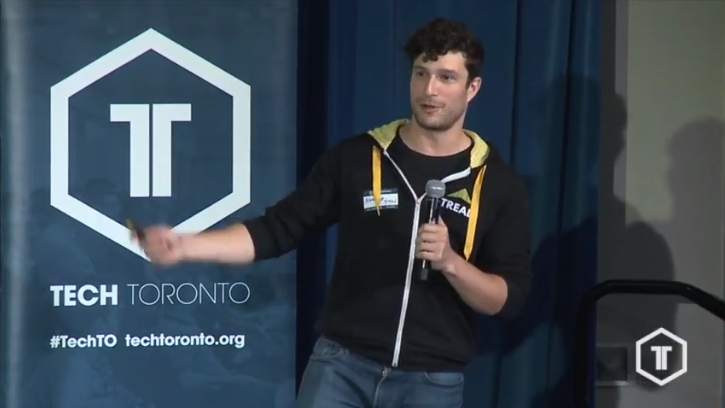
In October 2018, Dolgoy appeared at TechTO with a presentation called “This is going to hurt.” He said his first technology event had been a year earlier, to the day. It was an unusually brisk journey from entering the room to addressing it. The title also suggested that the audience should adjust its expectations before settling in. The usual promise of entrepreneurial enlightenment had acquired a small warning label.
His subject was the startup as an experiment. An idea, a method, variables, an outcome: this was a more useful framework than a magical moment of inspiration followed by an obliging growth curve. Being wrong belonged inside the process. A mistaken assumption could lead to an adjustment, provided the founder could bear to recognize it. The danger was treating every correction as a verdict on personal intelligence.
The advice he gave was practical and personal. Ask for help. Pay attention to candid feedback. Spend effort on the people whose decisions shape the company, including the founding team and staff. He highlighted adaptability, resilience, and humility as qualities to seek in colleagues and cultivate in oneself. The attraction of that list is its modesty. None requires an entrepreneur to predict the future; each helps when the future declines to cooperate.
“Adaptive, resilient, and humble.”
The three qualities Dolgoy urged founders to look for at TechTO, 2018.
There is an interesting fit between the talk and the product. A dispatcher needs information about what is happening outside the office. A founder needs information about what is happening outside the plan. In either case, a system that filters out inconvenient news becomes less useful. This is a way to read the two parts of his public work together: the software improves visibility, while the talk asks entrepreneurs to tolerate what they see.
What the paperwork could tell you
By 2021, Dolgoy was explaining the implementation work behind paperless construction. Tread could capture tickets digitally, present profitability reports, and compare activity across jobsites. It also examined whether drivers and dispatchers were using the application properly. The distinction was practical: purchasing software and consistently recording the work are separate accomplishments. A dashboard cannot repair a record that nobody entered.
He described tailoring adoption to a customer’s comfort with technology. That is a telling detail for a company selling into working operations. The customer brings an established routine, staff, and a day that already has demands on it. Training has to join that day. The quality of the application matters, but so does the route by which people become accustomed to using it.
In his own writing about digitalization, Dolgoy began with a company’s particular operational difficulties. He advocated openness with employees and contractors, attention to feedback, and regular training. He also emphasized keeping the purpose of a change in view. Better invoicing or less cumbersome administration gives a business a reason to persist through the learning period. Technology earns a useful place when people can connect it to work they already need to finish.
His work also reached into the industry’s less visible discussions. In April 2021, he appeared on the participant list for Ontario’s Excess Soil Registry industry stakeholder working group, representing Tread. The list included construction businesses, infrastructure organizations, and environmental specialists. Moving material involves records and coordination beyond the dispatch desk. Even a load leaving a site has a wider network of people interested in where it goes.
Capital, colleagues, and the next CEO
Tread passed through Creative Destruction Lab and Techstars and expanded into the United States. By December 2020, Dolgoy described a US$12 million Series A financing package, led by Crosslink Capital with participation from Real Ventures, Radical Ventures, Ripple Ventures, and FJ Labs. Most of the round had closed in November 2019; the package also included debt financing from Silicon Valley Bank. Those dates matter: the reported total did not represent a single new cheque arriving on announcement day.
Series A package, including debt. Most of the round closed in November 2019.
There is another trace of the collaboration behind the product. A patent application titled Systems and methods for filling driver positions, published in August 2020, names Dolgoy alongside Alicia Francis, Simon Ho Ming Chong, Vivekanand Ravichandran, and Edmond Siu Ching Lau as inventors. The application concerns dispatching and sub-dispatching. It puts several names beside a problem that a founder’s biography can too easily make sound solitary.
The leadership changed later. In a February 2023 announcement, Sameer Bhalla said he had joined Tread as CEO the previous November. He thanked Dolgoy as founder and former CEO and said he looked forward to working together. That places the transition in November 2022. It also establishes the right tense for Dolgoy’s role: he founded and led Tread; the chief executive position subsequently passed to Bhalla.
From jobsite logistics to the live event
Dolgoy’s later public activity includes Plugz.Live. He has written about working with Josh Epstein, Tom Pistore, and Connor Karaim, and about Oak View Group’s help with deployments and strategic decisions. Epstein’s February 2025 partnership announcement named concert venues in Palm Desert, Baltimore, Austin, and Toronto. The setting had changed from construction sites to live entertainment, with another business requiring cooperation across organizations and physical locations.
It would be easy to tidy this career into a single predetermined plan. His TechTO talk offers a better ending. Dolgoy had urged founders to stay receptive when assumptions fail and to invest in the people around them. The public record shows construction work, law and finance, a software company, a leadership handover, and activity in a different business. There is continuity in the attention to practical arrangements. There is also room for a career to turn.
The dump truck remains a useful place to begin. Its absence can hold up an entire job, while the small exchanges that arrange its arrival rarely attract attention. Dolgoy built a company around those exchanges. For anyone interested in where businesses come from, that is a concrete proposition: look closely at the work people repeat, the information they chase, and the ordinary problem that keeps following them back.