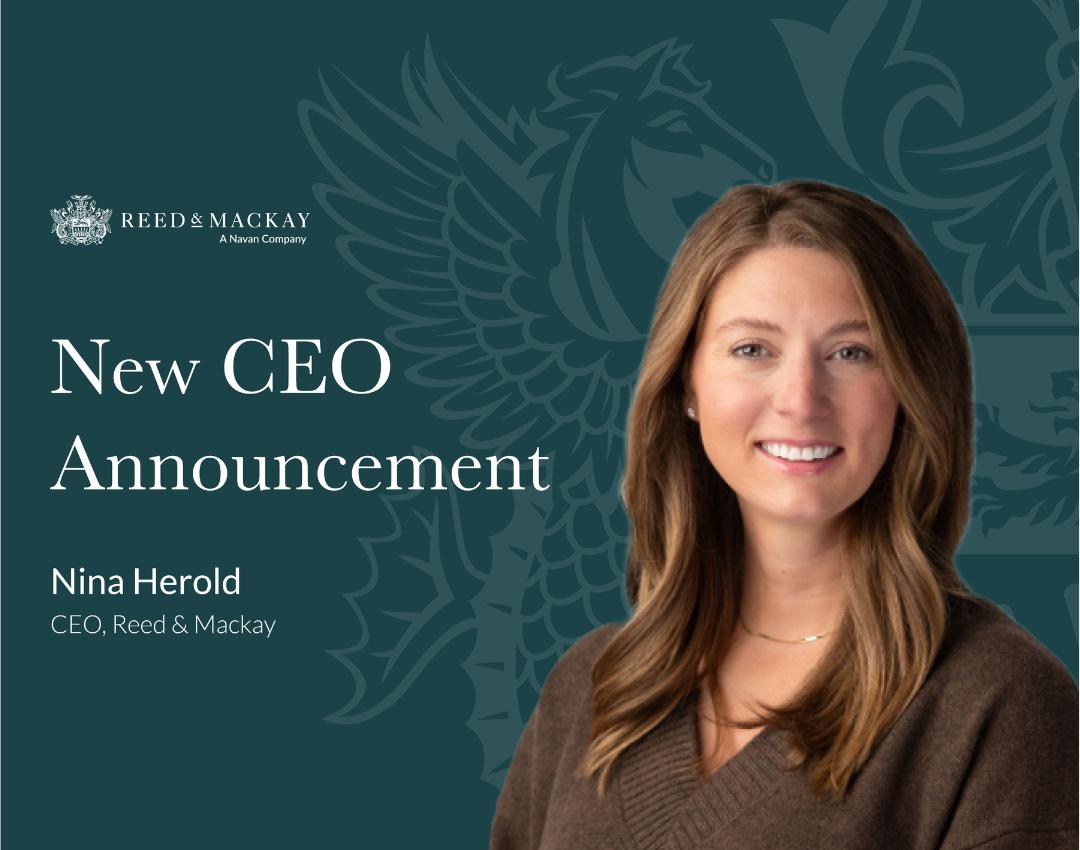
On October 1, 2025, Nina Herold became the CEO of Reed & Mackay. The London-headquartered travel management company is older than the steam locomotive. Her predecessor, Fred Stratford, held the seat for thirteen years. Before him, Reed & Mackay had something close to dynastic continuity. The board did not look outside the family of corporate travel for his replacement. They looked across the Atlantic, at the technology company that bought them in 2021, and picked the operator who had been quietly running its product and travel verticals.
Herold's path to that office reads less like a travel-industry resume than a Silicon Valley one. She came up through finance at BNY Mellon and the University of Pittsburgh Medical Center. She spent close to four years at Uber, scaling driver-facing operations during the years when "rideshare" was still a word people questioned. In 2018 she joined a young startup called TripActions. Seven years and one rebrand later, that startup is Navan, a publicly profiled fintech-and-travel platform, and Herold has worn most of the senior badges it issues: VP of Business Operations, Chief Product Officer, EVP and General Manager of Travel, Chief Product and Operations Officer, Chief Operating Officer.
Then she packed a suitcase and went to run the prize on the shelf.
Reed & Mackay had been the most prestigious acquisition Navan made during its consolidation push. Founded in 1812 as a stationery and forwarding agent, it became a high-touch travel and events business serving law firms, financial institutions, and the kind of multinational clients who do not enjoy being placed on hold. Navan's pitch was technology. Reed & Mackay's was service. The marriage required someone who could speak both dialects without sounding like a translator. Ariel Cohen, Navan's CEO and co-founder, called Herold a "proven leader." Stratford, the outgoing CEO, said he had worked alongside her for four years and was confident handing her the keys.
None of that explains why she is interesting. What explains it is the shape of her instincts.
At a SaaStr session a few years ago, asked what she had taken from Uber, she gave the kind of answer most operators reach for only after a few failures: "You have to be willing to react and change quickly when things don't go as planned. Don't prioritize expansion over solving the problems of your users." It is a sentence that sounds reasonable until you notice how few companies behave as if they believed it. Most growth-stage executives confuse expansion with progress. Herold's record at Navan suggests she does not. During the pandemic, when business travel cratered and the company faced an existential question about what it even was, Navan pivoted hard into expense management. Navan Expense became a product. Team Travel became a product. The travel side, instead of dying quietly, more than doubled unique users and tripled booking volume from FY22 to FY23. Those are not the metrics of an executive trying to look busy.
Travel as an industry is older than most American cities. It is also rich with the kind of dynastic loyalty that punishes outsiders. The traditional path to running a TMC of Reed & Mackay's stature runs through the major GDSs, the global agency networks, perhaps a stint at a hotel group, then a slow climb. Herold's path runs through Pittsburgh finance rotations, an Uber product-ops desk, and a hyper-growth SaaS company that did not exist when Reed & Mackay had already been around for two hundred years. The travel press noticed. Several outlets - Business Travel News, The Business Travel Magazine, Business Travel News Europe - covered the appointment with the careful tone of an industry watching a generational handoff happen in real time.
Inside Navan, Herold had been known as the executive who insisted on direct customer contact. The Women's History Month interview Navan published with her in 2023 described someone who communicated strategy across teams with what the company called "transparency and customer-centricity" - a phrase that sounds like marketing until you read her actual quotes, which are short, declarative, and unsentimental. She talks about touchpoints. She talks about friction. She talks about the small mechanical interactions that determine whether a product works. "The best disruptors identify touchpoints and micro-interactions that create friction for users to create seamless experiences." The sentence could be cynical if Navan's product weren't actually decent.
By the time Reed & Mackay transitioned to the Navan brand and platform - a move announced as part of the same leadership rotation that brought her aboard - the integration thesis was clearer. Reed & Mackay's legacy clients want service. Navan's platform offers scale. Herold is the person who has to make those two things stop being opposites. The travel industry has watched dozens of acquisitions of this shape go sideways, usually because the buyer flattens the seller's culture in pursuit of unit economics. Whether Herold can avoid that is now the most-watched question in corporate travel.
Her aspirations, in the only public statement she made about the new role, were unflashy: she is "honoured" to take the seat, she wants to build on the service legacy, she wants to enhance the technology. The understatement matters. Reed & Mackay clients have not, historically, responded well to companies announcing transformation. They respond to companies that quietly raise their reliability. The fact that Herold's public posture matches that culture - rather than imposing a Silicon Valley vocabulary onto Mayfair - is the early signal she has been read correctly by both organizations.
She does not look like the executive a casting director would send to play a 213-year-old British TMC's first technology-era CEO. That is part of the bet.