The first factory in Niklas Panten's career was built to ask inconvenient questions. On TU Darmstadt's Lichtwiese campus, the ETA Factory treated production machines, the building, heating, cooling, and compressed air as one connected organism. It was a laboratory with pipes and consequences. Change a setpoint over here and a cost might appear over there. Recover waste heat from one process and the next system suddenly has a new problem to solve. Panten helped build that research environment from 2014 to 2019. The closer he looked, the less sensible it seemed to manage such an organism with fixed rules and inherited habits.
Industry was already collecting the evidence. Sensors watched temperatures, flows, pressures, loads, and weather. Yet critical energy systems could still be operated partly by feel because no person could comfortably hold every interaction in mind at once. More instrumentation had produced more visibility, but not necessarily a better decision. Panten found his problem in that gap.
A course plotted near the Baltic
Panten was born in Aachen in 1987 and finished school in Kaltenkirchen, Schleswig-Holstein. Kiel University was close to his hometown near Hamburg, close to friends, and close to the Baltic. The last point mattered. He has described himself as a huge sailing fan. He studied electrical engineering and business administration, a combination that placed programming, physical systems, and commercial questions on the same timetable.
His education kept moving. He spent time in Shanghai at Delta Electronics and joined a fellowship at the University of Wisconsin-Madison, working with a control-engineering research team. Madison, set between two lakes, offered another agreeable address for a sailor. More importantly, it let him go deeper into the engineering of systems that must continuously react to changing conditions.
In Darmstadt, that interest acquired industrial scale. He joined the Institute of Production Management, Technology and Machine Tools, became a research associate, and later led the ETA research group. He has recalled a team of 25 doctoral researchers. The work was academic, but the factory's relationships with industry kept it answerable to the untidy world outside a simulation.
The doctorate becomes a test drive
Panten's 2019 dissertation studied deep reinforcement learning for operating hybrid industrial energy networks. In plain English, he investigated whether an intelligent agent could learn operating strategies across connected energy systems while balancing several goals. The experiments compared learned control with conventional approaches across three setups of different complexity.
The reported range was 28 to 59 percent lower average energy costs than conventional control, with electrical peaks reduced by 21 percent. TU Darmstadt awarded the work its €3,000 prize for the best dissertation at the 2019 Darmstadt Energy Conference. The numbers were promising. The setting also supplied an essential warning: a controller that works in research still has to earn the right to touch expensive equipment.
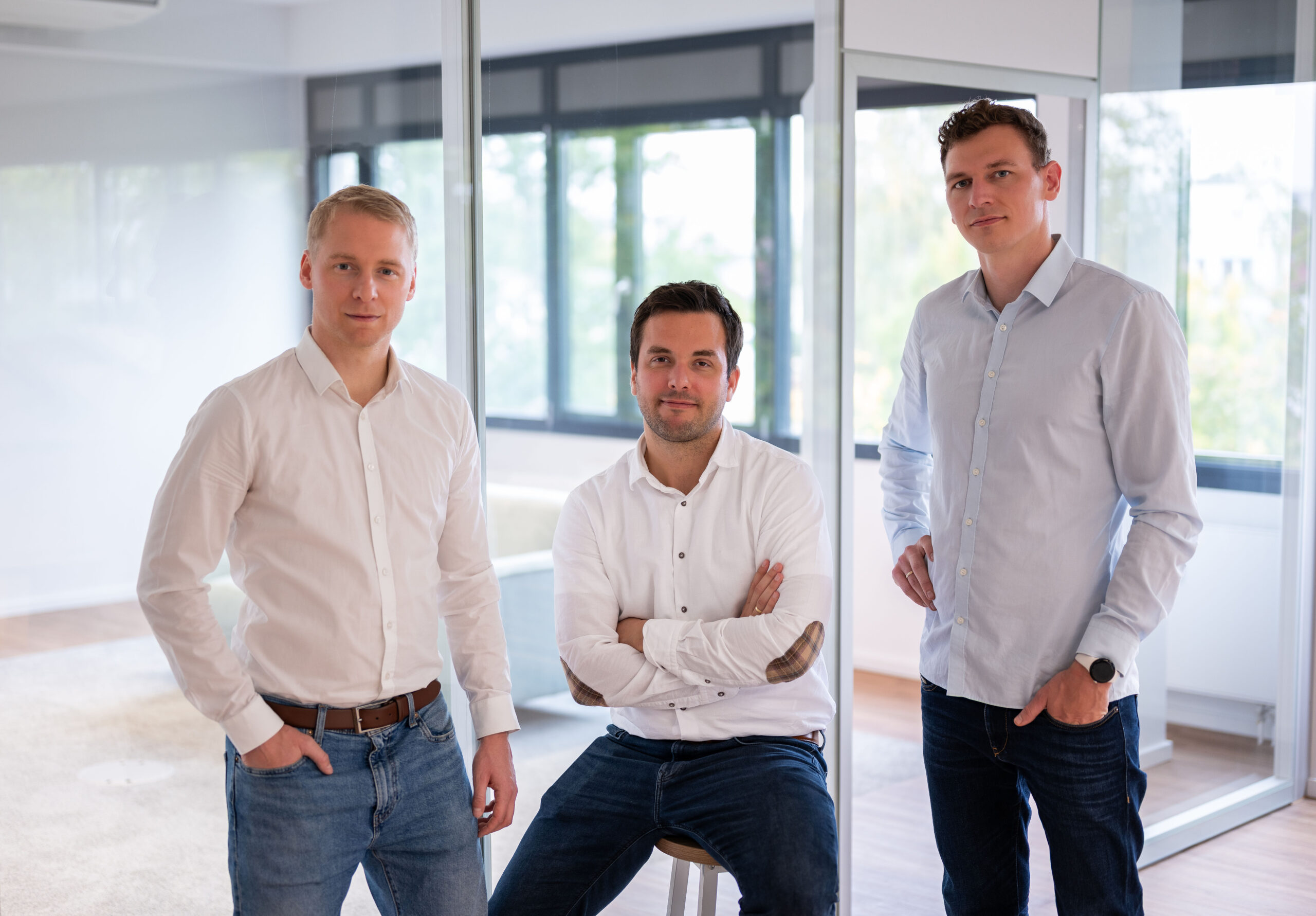
Panten and fellow researcher Thomas Weber had already noticed that available energy-management software felt complicated and inflexible. Their ambition became practical: make the tools easier to use, add more analytical capability, and sell the software rather than leave it inside a project report. Software architect Björn Scheurich, now known as Björn König, brought the missing product engineering. The three began etalytics in 2019 and formally spun it out from TU Darmstadt in early 2020.
Trust is an engineering material
etalytics' etaONE platform sits above industrial hardware. It collects operating data, builds digital models, forecasts system behavior, and recommends or executes more efficient control strategies. Its customers include data centers and companies in automotive, chemical, and pharmaceutical production. The machines may differ, but the recurring task is familiar: deliver heating, cooling, ventilation, or other useful energy without wasting power or compromising reliability.
The company's early deployment method was deliberately gradual. Start with a tightly bounded pilot. Advise the operator before directly controlling equipment. Expose the data, logic, and constraints so an engineer can challenge a recommendation. Increase automation only after savings and stable operation are visible. For software people, the black box can sound mysterious. For an operator responsible for uptime, it can sound like paperwork after an outage.
One early colocation data-center project exposed why the sequence matters. The drawings showed a standard collection of chillers, pumps, cooling towers, and building controls. The physical plant had accumulated undocumented overrides and historical fixes. Its real behavior no longer matched its official portrait. A mixed team of data scientists, controls engineers, software engineers, customer specialists, and site operators walked the plant room, checked sensors, and reconciled model with machine. Only then could the digital twin become useful.
The graph behind the glamorous acronym
Industrial AI attracts grand language, while its daily work can be wonderfully uncinematic. A cooling tower reacts to humidity. A chiller has an efficiency curve. Pumps affect one another. Production schedules change demand. Electricity prices move. Operators add safety margins because a slightly wasteful system is preferable to a stopped one. Optimization has to respect all of it.
What the 2019 research reported
Results from the dissertation's tested setups, compared with conventional control. They are research outcomes, not a promise for every facility.
This is where Panten's preference for system-wide thinking becomes more than a slogan. Improving one component can shift cost into another. A chiller running at its local sweet spot may force pumps or towers into poor conditions. The useful unit of thought is the network. AI helps search the larger field of possible operating choices, while the digital twin gives those choices a physical grammar.
Panten has recently sharpened the distinction between general AI assistants and specialized physical AI. A language model may help an engineer find information or summarize an event. Critical infrastructure needs intelligence designed around real equipment, hard constraints, latency, and safe failure. In his view, the two can complement each other. They should not be mistaken for the same job wearing different badges.
Money for the long crossing
The company financed its first steps through university support, an EXIST grant, prizes, customer work, and investment. A pre-Series A followed in 2022. In 2024, Alstin Capital led an €8 million Series A alongside ebm-papst and BMH. In October 2025, Microsoft's venture fund M12 led another €8 million extension, bringing the round to €16 million.
The money attached a geographical plan to the technical one. etalytics said it would build a Bay Area team, install more systems across the United States, Europe, and Singapore, and expand its platform across data centers and energy-intensive manufacturing. Panten described scaling along three axes: markets, product, and partnerships. The company wants to turn deployments that once required bespoke engineering into repeatable integrations, while enabling equipment makers and integrators to carry the platform farther.
There is a useful restraint inside that ambition. Industrial sales reward evidence. A plant manager is unlikely to surrender control because a founder has arranged a persuasive sequence of adjectives. The system has to connect, explain itself, keep running, and save something measurable. Panten's phrase for this is compact: results beat slide decks.
Two cities, one company
In May 2026, after 12 years in Darmstadt, Panten moved with his family to the San Francisco Bay Area. Both of his children were born in Darmstadt. He wrote openly about the move's unphotogenic inventory: schools, paperwork, logistics, routines, and the intensity of transplanting a family across an ocean. During the first week came visits to NVIDIA, a House of AI gathering, and two days meeting people from the data-center, automotive, and pharmaceutical industries.
The Bay Area puts etalytics near customers, partners, investors, and an unusually dense conversation about AI. Darmstadt remains the engineering home where the company was born and where its technology continues to develop. Panten's new job is partly to keep those two places in productive tension: the German research lineage that values proof and the Californian market that rewards speed.
Sailing is an irresistible metaphor here, so it deserves careful handling. A sailor does not argue with the weather or set one course forever. Conditions arrive, instruments report, and control becomes a series of adjustments. Panten's work asks industrial systems to behave with similar attentiveness. Measure what is happening. Understand how the parts pull on one another. Choose the next move. Check again.
The deeper proposition is modest enough to sound obvious: complicated equipment should not have to rely on guesswork when it is already producing the data required for a better answer. Turning that observation into software took a research factory, a doctorate, three founders, patient pilots, and a company spanning two cities. The machines were always talking. Panten built his career around helping them finish the sentence.