At a water innovation summit in 2019, Nicole Neeman Brady reached for a car. A metaphorical one, fortunately for the conference organizers. Entrepreneurs could bring her an impressive turbocharger, she suggested, but a buyer needed the vehicle around it. “Bring me the whole car!” was the line that stayed with an audience member. It was a compact way to describe a large commercial problem: a component can work beautifully while leaving its customer with a second job assembling the solution.
The example suits a career spent moving among the people who build essential services, the people who finance them and the people who oversee their delivery. Brady has founded a water business inside an energy company, managed investment work and served on the commission governing Los Angeles’s water and power utility. In September 2024, she announced that she had joined TPG Rise Climate as an operating partner. Water runs through the résumé; so does the less photogenic business of getting things done.
“Bring me the whole car!”
Nicole Neeman Brady, Imagine H2O Water Innovation Summit, 2019
The buyer wants a car
Her conference shorthand was amusing because it gave an engineering pitch a familiar consumer test. Imagine buying a marvelous engine and receiving an invitation to arrange the wheels yourself. The joke carried a serious question for a young business: how much work does your customer have to do before your invention becomes useful?
In water, that question follows an idea out of the presentation and into a system with existing equipment, operating routines and people responsible for the result. A sale has to survive that journey. Brady’s point placed the customer’s problem at the center of the discussion, where an inventor might otherwise place a device.
There is a practical distinction between admiring a technology and deciding to use it. Her metaphor makes room for both. A buyer can appreciate the clever part and still need someone to supply the complete service. That is a useful lens for her subsequent work as an investor and advisor: look beyond the attractive component to the organization that will make it dependable.
A contract is a kind of infrastructure
Brady studied architecture and economics at Brown University, earning honors, and completed an MBA with distinction at Harvard Business School in 2008. Buildings and markets are a reasonably good preparation for a working life concerned with the physical world and the agreements that sustain it. Neither discipline lets a person assume that a handsome drawing will pay for itself.
Her early employers included Goldman Sachs, Twentieth Century Fox and McKinsey & Company. The film-company stop is a pleasing interruption in a résumé otherwise populated by finance and utilities. It was strategic planning work, rather than a detour into acting. By 2008 she was at Southern California Edison, where her responsibilities developed across renewable power contracts, trading and energy procurement.
The numbers from that period explain why procurement deserves a place in the story. In 2014, she oversaw the evaluation of more than 2,800 offers. The resulting work contracted over 4,475 megawatts of power through approximately 100 agreements with about $17 billion in notional value. Those figures describe a portfolio of commitments, rather than a personal fortune or a single purchase.
2014 procurement work under Brady’s oversight. Approximately $17 billion in notional agreement value.
Procurement occupies the space between an intention and a supply someone can count on. An offer must be assessed, a counterparty selected and terms agreed. The paperwork may look modest beside a power station, yet it establishes how that station’s output enters a business relationship. In Brady’s career, contracting was part of learning to operate at scale.
She then created Edison Water Resources, an Edison International subsidiary pursuing distributed water treatment and recycling. She served as its president from 2015 to 2017. The idea involved smaller, modular systems rather than relying exclusively on large centralized facilities, bringing the treatment model closer to the sites that needed it.
She presented that approach at the 2016 VERGE conference. It extended a familiar question from energy into water: what can happen when infrastructure is organized nearer to demand? There is an appeal to the smaller unit, but the business still has to manage the full service. Edison Water Resources grew, and its projects and assets were sold in early 2017.
A city on the other side of the table
In November 2019, Los Angeles confirmed Brady to its Board of Water and Power Commissioners. The appointment put her experience into a different setting. A commissioner oversees a public utility on behalf of its customers, with obligations that extend beyond finding an investment or building a company. A city’s residents live with the decisions after the meeting ends.
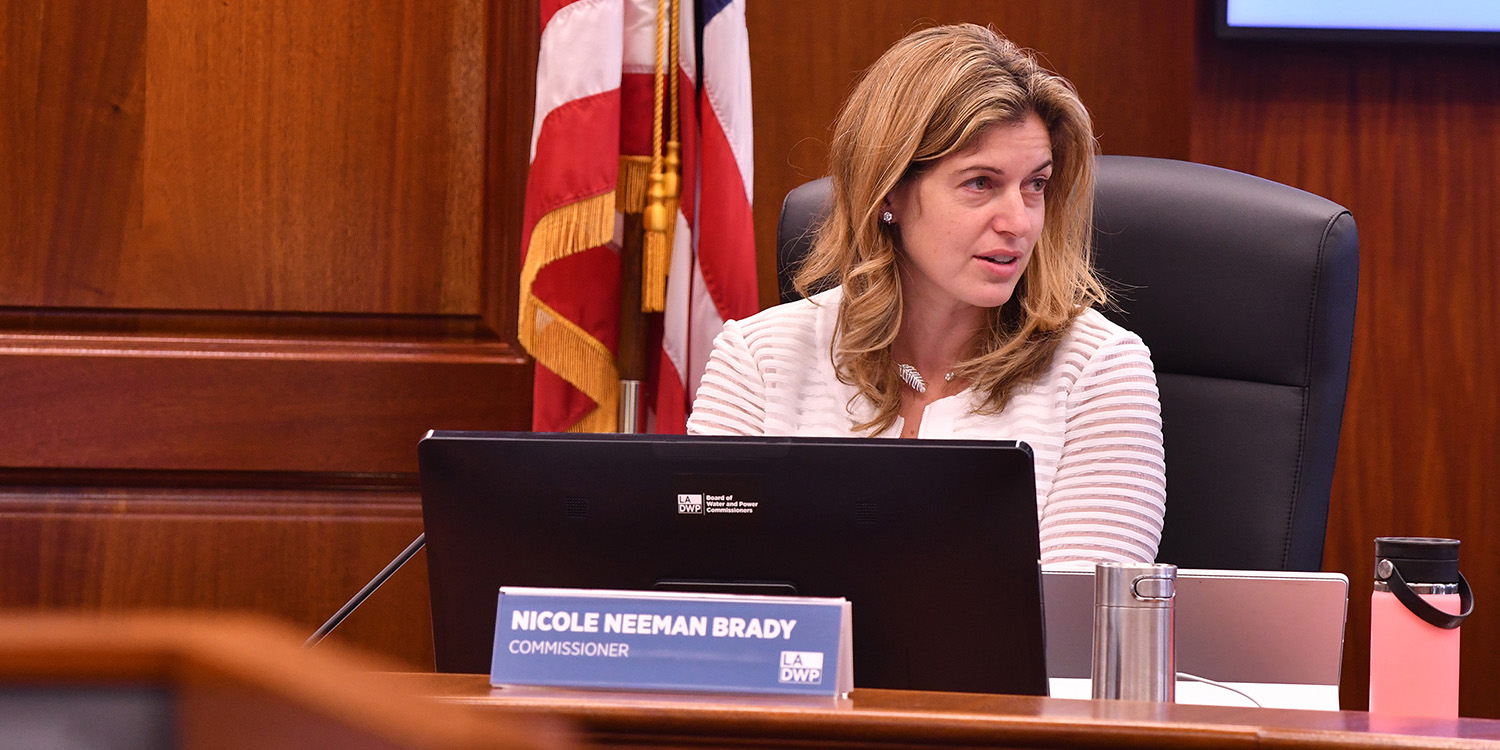
Brady was part of the department’s first all-female board, formed in 2020. Its members brought different backgrounds to the same set of responsibilities. Cynthia McClain-Hill, Susana Reyes, Jill Banks Barad-Hopkins and Mia Lehrer served alongside her. The composition was a milestone; the work remained the patient business of policy and oversight.
She became board vice president in July 2023. During her tenure, she served on committees concerned with audits, executive matters and the relationship between Los Angeles and Inyo County. Those subjects give a sense of the distance a water decision can travel. A city’s supply involves communities well beyond its own streets.
Some of her oversight took her away from the commission desk. She joined hydrographers on remote snow surveys in the Eastern Sierra, visited work sites and spent time at the customer contact center. The itinerary connected three versions of the utility: the landscape supplying it, the staff operating it and the customers trying to reach it.
The snow-survey detail deserves a moment. A customer turns a tap; elsewhere, someone measures the conditions that help shape future supply. The survey does not resemble the final service, but it belongs to the same chain. For a commissioner, going to see that work is a way to make an abstract agenda item less abstract.
- 01The supplyEastern Sierra snow surveys
- 02The operationsUtility work-site visits
- 03The customerContact-center visits
Her commission work also included efforts to improve the review of contracts and agreements, as well as work with the City Council on paid parental leave. In early 2024 she chaired meetings and oversaw board-office operations during a leadership transition. She left the board that March, after nearly five years of service.
Capital has its own weather
Brady’s investment career developed at Renewable Resources Group, where she took leadership roles beginning in 2017. The firm worked across agriculture, land, water and renewable energy in the United States and internationally. These interests belong together in the physical world, even when financial presentations put them on separate slides.
Her work included helping raise and deploy the $927 million Sustainable Water Impact Fund. The size matters as a measure of the capital involved, rather than a substitute for the story. Water investment needs decisions about assets and operations, and a fund brings those decisions together within an investment mandate.
In 2021 she was CEO and a director of Sustainable Development Acquisition I Corp., or SDAC, created through Renewable Resources Group and Capricorn Investment Group. It was a special purpose acquisition company: a vehicle raised to seek a business combination. Its focus included water, food and agriculture, renewable energy and environmental resource management.
SDAC used a public-benefit corporate structure and pursued a sustainability-centered investment proposition. Its launch brought those ideas into public markets. But an investment vehicle has a timetable as well as a mission, and its history cannot stop at the launch photograph.
In July 2023, SDAC announced that it would dissolve and liquidate after a suitable acquisition had not materialized. That outcome belongs alongside the original ambition. It records a venture that raised capital and searched for a transaction, then closed without completing the intended combination. A career in investing includes decisions that do not end in an operating company.
Taking the operating experience to TPG
In July 2024, Upwell Water appointed Brady to its board of advisors alongside sustainable-finance investor Stuart Bernstein. The appointment drew on her experience with supply, treatment and utility management. It was another role requiring her to connect the commercial view with the practical work of providing water.
Her civic interests also include the Library Foundation of Los Angeles, where she serves on the board. The institution is a different kind of public-service connection from a utility commission, though both sit within the life of her city. A professional biography can make every affiliation look like a strategic move. Sometimes it is more useful simply to notice where a person gives time.
When she announced her move to TPG Rise Climate, Brady described applying her experience building companies in water, energy, food and sustainability to portfolio work. The operating-partner title is significant. It puts the emphasis on helping businesses execute, drawing on experience accumulated before the investment relationship begins.
In March 2026, she appeared in TPG’s Inside TPG Ops series discussing how impact measurement informs operating work across its impact platform. Measurement gives an environmental ambition something a team can examine. It invites questions about the result, the business decisions producing it and how those decisions can be improved.
She has also advocated greater coordination of water innovation in the United States, where responsibilities are distributed among different bodies. “There is no Department of Water,” she observed. The remark captures her concern with the institutional arrangement around a resource, alongside the technology used to manage it.
Her recurring subject is the work required to make an essential service function: the company around the equipment, the agreement around the supply, the governance around the investment. The car joke still fits. A turbocharger can earn applause. Someone has to make sure the customer gets home.