Founders adore clean origin stories. Reality prefers a paddock. In 2018, at the Long Beach Grand Prix, Nicholas “Nick” Esayian found himself talking with Bill Simpson, the racing-safety pioneer who had built Simpson Racing and Impact Racing. Simpson and Chip Ganassi had already tried carrying racing technology into football through a company called SG Helmets. The product had reached professional players. The business had not broken through.
Simpson was ready to hand off the idea. Esayian was an unusually plausible recipient. He had spent decades selling products, running direct-response ventures and racing sports cars. Fellow racer Boris Said and former military trainer Phil Freeman encouraged him to take the opportunity seriously. By the end of 2018, Esayian, Joseph Hegener, Justin Bert and other investors had acquired SG’s assets. They renamed the company LIGHT Helmets and moved the work to Carlsbad, California.
A helmet, unlike a pitch deck, must survive contact with reality. It also enters a market in which familiarity has the force of gravity. Equipment managers know the established brands. Dealers know their catalogs. Players know the shapes they have worn since childhood. Esayian had purchased more than molds and intellectual property. He had volunteered to persuade an old industry to reconsider what “normal” should weigh.
A résumé that becomes sensible in reverse
Esayian grew up in the Midwest, played several high-school sports and a little college football, and graduated from the University of Wisconsin-Whitewater. His early career supplied the conventional pieces: sales, marketing and management work at Xerox, ADP and Executone Business Solutions. He later became vice president of sales and marketing at Real Marketing Services, an affiliate of the production company behind COPS.
Then the résumé escaped its lane. He started an entrepreneurial marketing venture in 1998. By 2001, he was developing, selling and fulfilling products of his own through a direct-to-consumer operation. Revenue Solutions used television and digital channels to move products at scale. He also founded Direct Path, a platform built around audio recognition, media traffic and consumer-marketing analytics. While those businesses grew, he earned an MBA from the University of Redlands.
Running beside all of that was a 27-year professional racing career. Esayian competed in the Pirelli World Challenge, IMSA and Rolex series and drove programs involving BMW, Acura and Aston Martin. In 2010, he finished second in the SCCA Pro Racing World Challenge GTS standings in an Acura TSX. Racing made weight, materials and consequences visible. Direct response made vague language expensive. If the benefit cannot be explained before the viewer wanders away, the cash register stays quiet.
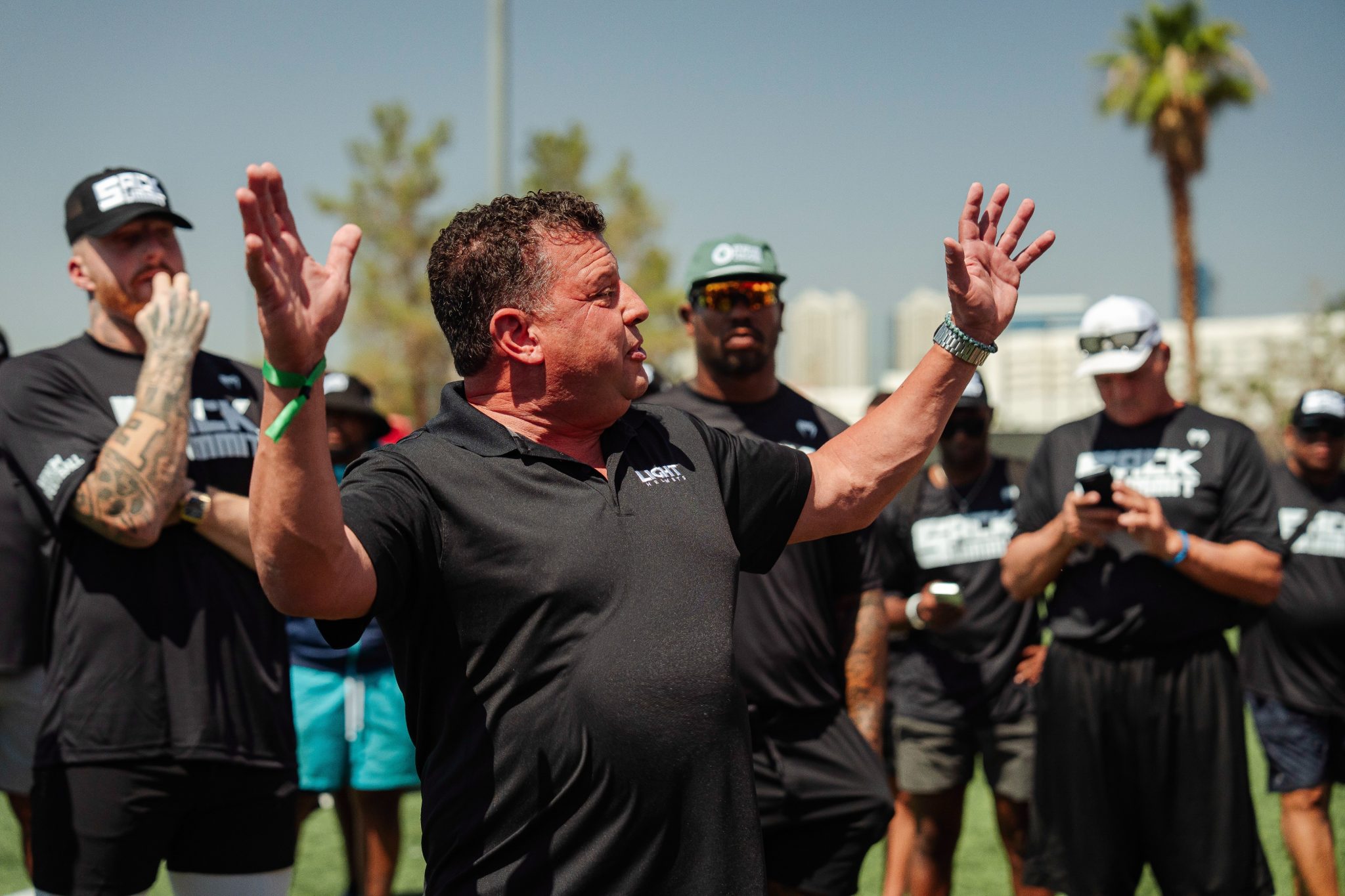
“Our goal is to bring these advanced materials and put them on the sports field.”Nick Esayian
The pitch is an equation
LIGHT’s product argument starts with mass. Esayian explains that a helmet contributes to the energy carried into an impact. Reduce unnecessary weight, while maintaining the structure and energy management demanded by testing, and the player carries less mass through every snap. The company combines composite shells, specialized liners and light facemasks, drawing on materials and techniques associated with motorsport, military aviation and other demanding equipment.
Velocity has the dramatic exponent. Mass is the lever a helmet designer can directly reduce. The engineering challenge is removing weight while preserving strong performance across the test program.
This sounds obvious only after somebody says it plainly. In helmet design, added material can feel intuitively reassuring. Racing teaches a less sentimental relationship with mass. Every component must earn its place. LIGHT’s name therefore works as both brand and instruction: be lighter, then prove it.
The proof includes independent testing. Virginia Tech tested the LIGHT Apache in 2024 with a facemask attached at a total 3.5 pounds. Its STAR value was 0.46, placing it first among 38 varsity helmets in the lab’s latest published table. Lower scores indicate better laboratory performance within that protocol. Two newer LIGHT models, the Apache Lightning and Apache Tomahawk, also received five-star ratings in the 2025 update.
Selected varsity STAR values / lower is better
Scores are from Virginia Tech's varsity ratings updated in July 2025. They compare models within this specific test protocol.
When the market stopped, the work changed lanes
LIGHT began rolling out products, and then the pandemic halted organized play. A young helmet company had inventory for games that were not happening. Esayian has joked about the temptation to meet the moment with whiskey. The company chose product work instead. It assembled advisers, including specialists from football, engineering and performance, and used the interruption to keep refining the line.
The episode is useful because it resists the usual founder theater. There was no brilliant shortcut around an absent season. Demand disappeared. Attention moved. Product, testing, supply and credibility could still advance while the sales calendar sat in neutral. When teams returned, LIGHT resumed selling with a broader case to make.
Esayian’s direct-response background mattered here. A technical founder may enjoy the molecule; a buyer still needs the meaning. LIGHT could describe its composite shell, liner architecture and facemask materials, then return to three buyer questions: How does it test? How much does it weigh? Can you deliver and service it? The company designed helmets that can be resized during refurbishment and kept reconditioning work in Carlsbad while it developed outside relationships. Clever chemistry is charming. A three-week turnaround is the sort of detail that renews a purchase order.
League testing added another kind of proof. The NFL placed the Apache Pro and Gladiator Thunder in its recommended group of new models for the 2025 season. On the 2026 NFL-NFLPA all-position laboratory poster, the Apache Pro 2025 sits fourth and the Gladiator Thunder 2025 seventh among recommended models. The company had moved from asking for a hearing to appearing on the same equipment-room sheet as firms with generations of history.
Trust has a bill of materials
The engineering is only half the sale. Football helmets form a trust category. A coach or equipment manager is not buying novelty for its own sake. They want testing, fit, supply, reconditioning and the confidence that the manufacturer will answer next season. Esayian built a wide group around LIGHT: operators, former players, professional athletes, military veterans, engineers and advisers. Drew Brees served as a spokesperson. Investors and advisers have included Cam Jordan, Tony Romo, John Sarkisian and the late FedEx founder Fred Smith.
Those connections are useful because they translate across rooms. An engineer can discuss the liner. A player can discuss balance and feel. An experienced operator can discuss scale. An equipment manager can discuss the Tuesday problem that never appears in launch copy. For physical products, trust belongs inside the product architecture. The network around the shell helps the shell cross the threshold.
Esayian’s own life adds another layer. He volunteered for a decade with San Diego County Sheriff’s Search and Rescue. Since 2004, his racing and companies have supported the Special Operations Warrior Foundation through fundraising and motorsport experiences for families. He has also coached youth football. These are separate commitments, but they keep his professional thesis close to actual people wearing actual equipment.
“You have to be crazy enough to try something like this and smart enough to make it work.”Nick Esayian
The next lap is wider
LIGHT now sells across varsity, youth and flag football, with soft headgear for flag football and soccer. Esayian has publicly described development ambitions across lacrosse, hockey, snow sports, cycling, baseball and commercial protective equipment. The strategic idea remains consistent: find a category carrying old assumptions about weight, bring in materials from elsewhere, and build an argument that can survive a laboratory and a locker room.
His own path is the more interesting prototype. Corporate sales taught cadence. Direct response taught measurable persuasion. Racing taught discipline around weight and preparation. Coaching supplied a view from the field. Search and rescue supplied service without applause. None of those chapters predicted football helmets on its own. Together, they made the handoff from Bill Simpson look less like a career change and more like several roads arriving at the same workshop.
The romance of invention usually goes to the blank sheet. Esayian’s story gives some credit to the unfinished sketch. He did not create SG Helmets’ first idea. He recognized that the idea deserved another operator, another round of materials work and many more conversations with skeptical buyers. Carrying another person’s promising work forward requires a peculiar confidence. It also requires humility: the baton comes with fingerprints already on it.
On a racetrack, lightness is never a decorative adjective. It changes how a machine accelerates, stops and changes direction. Esayian has spent the latest chapter of his career asking football to treat the word with similar seriousness. The proposition fits neatly on a label. The company required years of less neat work. Old markets, like old race cars, tend to loosen one stubborn bolt at a time.