Neil Movva was an impatient Stanford student with a fairly specific complaint. He wanted to build AI chips. Why, he asked his adviser, should he spend his time on networking and operating systems? The adviser made the case for a larger ambition: understanding a computer system from the silicon to the service someone uses over the internet. Movva remembered the conversation years later. The supposedly distracting subjects had become rather relevant to his job.
Today he is co-founder and CEO of Sail Research, building infrastructure for AI agents that work in the background for hours or longer. His career has passed through NVIDIA, Apple and Together AI, with detours into robotics, displays and private computing. The common interest is efficiency. The interesting change is what efficiency means when the customer is a machine with no appointment to keep.
For an engineer who wanted to hurry past his basic classes, it is an agreeable turn of events. His company is organized around workloads that can sometimes take their time.
The student with a server farm
There is a useful detail in Movva’s earlier résumé. Alongside the usual languages and coursework, he described operating a small server farm for deep-learning experiments: a 48-terabyte storage system, virtualized computing nodes and optical 10-gigabit networking. Some students list proficiency in office software. Movva had apparently brought the office infrastructure.
He studied electrical engineering at Stanford, completing both his bachelor’s and master’s degrees in 2019. His internships moved between layers of the machine. At Intel in 2015, he explored language and speech-recognition techniques on the Edison embedded platform. At NVIDIA in the summers of 2016 and 2017, he worked on deep-learning architecture and performance, including fine-grained optimization on the Volta GPU.
The work was specific enough to resist the usual résumé fog. One investigation concerned BatchNorm, an operation used in neural networks; his résumé reported a speed improvement of up to 20 percent over the public cuDNN implementation. In summer 2018, at Built Robotics, he worked on combining sensor inputs and compressing neural models for real-time vehicle perception.
His university interests also extended to what computers let people see. With Jason Bud Ginsberg, he shared the 2018 SMPTE Student Paper Award for research on changing the field of view in a tomographic light-field display. Their work was advised by Stanford’s Gordon Wetzstein. Away from class, Movva competed with Stanford Robotics, concentrating on electrical engineering and high-power systems. His stated ambition then was to lead a processor-design team for large-scale visual understanding.
A friendship before the business plan
Stanford supplied a collaborator as well as an education. Movva and Samir Menon met on the first day of freshman year. In the account they later published for their startup Blyss, they described becoming best friends. Menon studied computer science and went into applied security at Yubico. Movva joined Apple in August 2019, working in deep learning and computer vision.
Movva’s work included the Apple Neural Engine; Menon brought cryptographic research experience. Their first company together combined those interests. Blyss, founded in 2022 and part of Y Combinator’s Winter 2023 batch, offered developers infrastructure for private data access. Its launch described a service that could retrieve an item without learning which item the customer had requested.
The company later described its offering as encrypted AI, using GPU-based secure enclaves to protect workloads during processing. The practical aim was to let developers use advanced privacy technology without building every cryptographic component themselves. Blyss is now listed as inactive. It remains an important part of the partnership’s history: the two had already tried turning difficult systems work into something another developer could use.
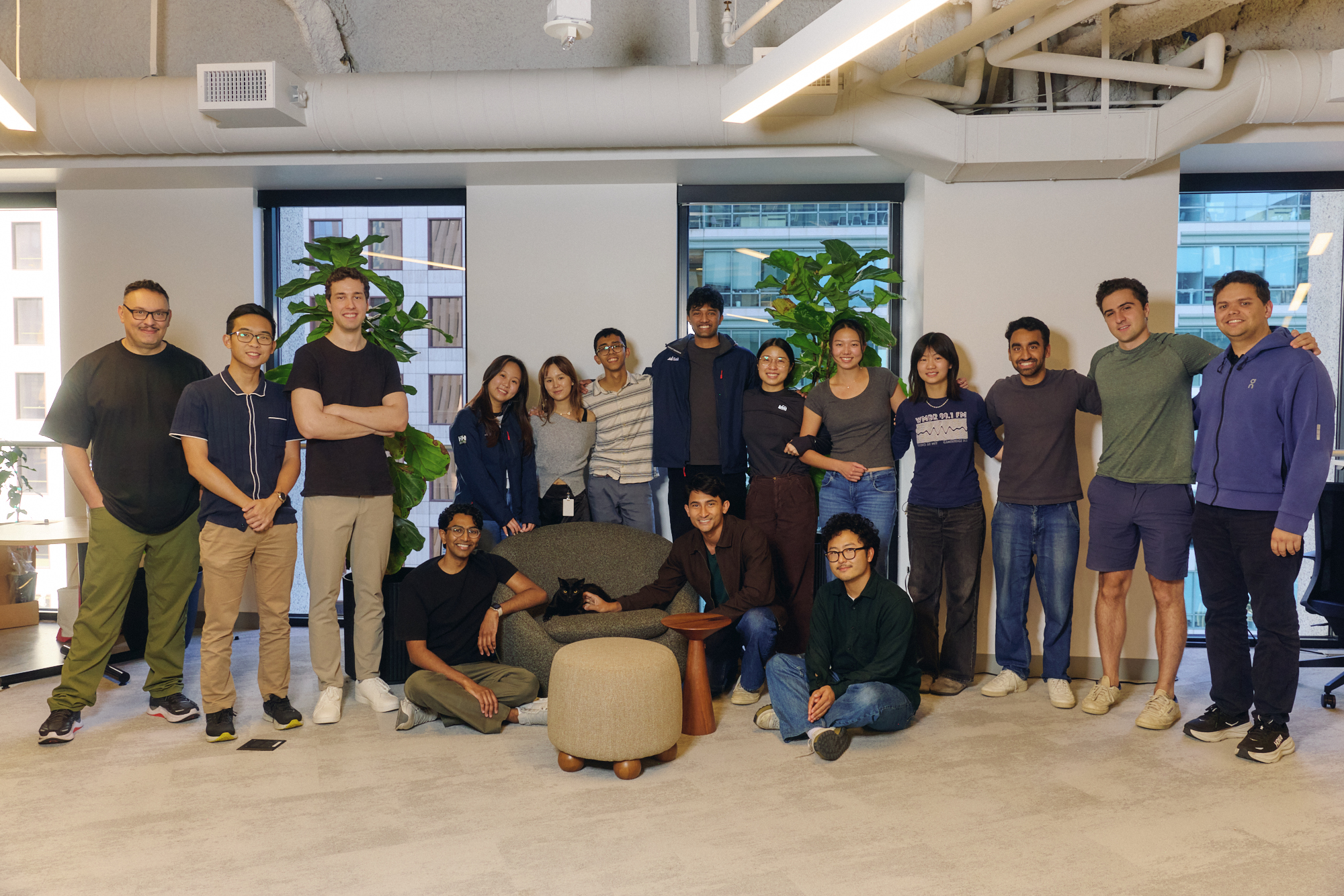
At Sail, Movva is CEO and Menon is CTO. Their division of responsibilities sits on top of a relationship that predates either company. The friendship is an unusually durable connection in a career otherwise described by successive changes of hardware, employer and technical problem.
When the customer can wait
Movva also worked at Together AI, where he helped build the language-model inference stack. Kleiner Perkins identifies him as the company’s first kernels hire. A kernel is a small program doing the computational work on an accelerator; improving it can change the economics of a much larger service.
Sail takes that attention to machinery and applies a different priority. Interactive AI has an impatient human at the far end. A person asking a coding assistant for help notices a pause. A background agent reviewing a repository or conducting research may run for hours between human interventions. Its total bill becomes a central constraint.
Latency measures how long an individual response takes. Throughput measures how much work the system completes across requests. Those goals can pull in different directions. Sail’s founding argument is that long-running agents give engineers room to prioritize throughput and cost, while still delivering a usable service. Saving a little time on every answer matters less when nobody is watching every answer arrive.
A person at a keyboard
Interactive turns
Response time matters
An agent in the background
Longer trajectories
Total work per dollar matters
The financial commitment to that argument became public in June 2026. Sail disclosed $80 million in combined seed and Series A financing, with Sequoia leading the seed and Kleiner Perkins leading the Series A. The announcement named customers including Parallel Web Systems, Detail, Jack & Jill and Quadrillion Labs. Movva described a company choosing chips, writing inference engines and coordinating a fleet as parts of one system.
A calculator with an awkward answer
For a quieter view of his interests, visit his personal website. On September 16, 2025, he published a KV Cache Calculator. It plots the memory required by common open models as context lengths and request counts change. This is the sort of small tool that makes an expensive abstraction inconveniently tangible.
A language model retains information about earlier tokens in a key-value cache so it can use that context while generating later tokens. Longer contexts consume more memory. Movva pointed out that sufficiently large caches also reduce the room available for batching other requests and increase memory traffic during inference. The impressive context window has to live somewhere.
His accompanying notes compare approaches to storing that information and consider compression. They show the same interest visible in the server-farm detail: understanding what the system is physically doing, rather than treating the interface as the whole machine. A model can promise a vast working context; the engineer still has to find space for it.
A computer that moves while you use it
An agent also needs somewhere to run its tools and keep its files. Sailboxes, made generally available on July 14, 2026, provide persistent Linux virtual machines with independent disks, Docker support and root access. They extend Sail’s work beyond generating tokens into hosting the programs that use them. An agent can have an ongoing computing environment rather than begin again after every exchange.
Sail’s engineers Nirvik Baruah and Charley Cunningham described how those environments can move between physical hosts. The network connection must survive. Memory must become available at the destination. Resource use must be tracked closely enough to pack the fleet efficiently. Their system combines a network proxy, memory transfers between hosts and mechanisms for expanding or reclaiming memory as workloads change.
To demonstrate migration, the team ran a Minecraft server and forced it to move every two minutes. The published account describes it continuing across dozens of migrations, with brief lag around the moves. A block-building game turned out to be a useful witness for a cloud architecture. It also gave the networking classes a fairly persuasive closing argument.
In his October 2026 conversation with Cat Tang, Movva discussed taking the distributed approach further, into small modular data centers and many separate pools of compute. He acknowledged the management overhead. His interest was in doing the difficult systems work that could make those resources useful for inference. Small sites were a direction he wanted to pursue, with the attendant failures treated as an engineering problem.
The craft, down to the microsecond
There is a public trail of what this outlook produces inside Sail. In August 2026, Ben Mayer introduced HTDYM, or How To Deploy Your Model, the company’s open-source performance-modeling infrastructure. It evaluates the relationship between a model, its workload, hardware capabilities and deployment configuration. A chip’s value depends on what it can deliver for a particular job and at a particular price.
September brought further team accounts. Rohan Menon described improving decode throughput on Intel Gaudi 3 by changing how sliding-window attention used memory. Mayer described taking prefill utilization for Gemma 4 31B on Google TPU v6e from roughly 32 percent to 63 percent. Those are reported results for specific setups, and the work belongs to the named engineers. They give substance to the company’s interest in hardware that takes effort to use well.
Movva’s own description of the culture is less technical. Reflecting on what NVIDIA and Apple taught him, he summed up Sail’s approach with a distinction between how to treat machines and how to treat colleagues.
“frugal with machines and generous with our people”
Neil Movva
There is a sensible allocation of thrift in that sentence. Computers can tolerate a demanding accountant.
The student who wanted to skip ahead to chip design now has reasons to care about storage, networking, operating systems, software and electricity. His company’s ambition is to make sustained AI work affordable by finding efficiencies across those layers. The answer to his old classroom complaint has become a career: every supposedly peripheral part of the system eventually sends an invoice.
Follow the work
More from Neil Movva and the teams around him.