When Cari Steiner’s name came up on the awards screen, she could barely get out of her chair. Around her, the people running her agency were already celebrating. Neil Mortine, her CEO, was among the colleagues jumping up and down and hugging her. She had won PRWeek’s 2012 Young PR Professional of the Year award. For a moment, the executive hierarchy seems to have dissolved into a very happy crowd.
It is a useful place to begin with Mortine. An agency executive’s life can be told through transactions, account wins and titles. His has plenty of those. But that small scene gives the larger story a human scale: a young professional receiving recognition, with senior colleagues behaving as though the good news belonged to the whole table. An organizational chart rarely captures anyone jumping.
Mortine’s professional base is Columbus, Ohio. He spent years leading Fahlgren Mortine as president and CEO, helping expand its work across public relations, advertising, digital and social media. The agency’s current leadership page lists him as vice chairman. Between those titles lies a business that changed its range of services and its ownership while continuing to carry his surname.
A place for someone else’s name
Four years after Steiner’s win, another awards photograph caught Mortine beside a younger colleague. Heather Bartman holds the trophy. Gretchen Torres and Aaron Brown complete the group. Mortine stands at the left, smiling. The picture is formal enough for the company archive and cheerful enough to suggest why anyone would want to keep it.
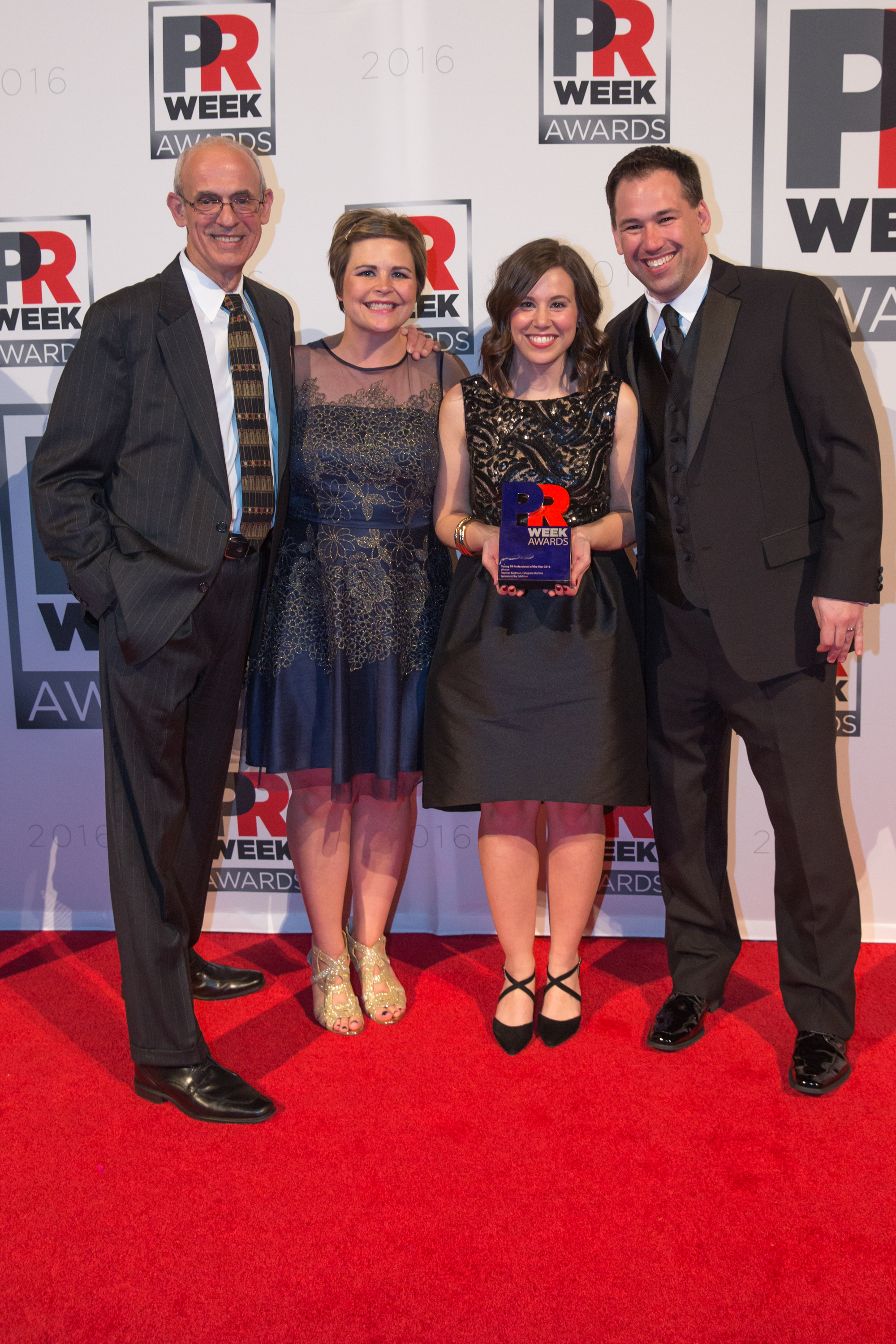
Mortine had nominated Bartman for the recognition. Her entry required a portfolio of about 200 pages. There is a pleasingly concrete detail in that number. Public relations is often associated with the brief statement, the sharp pitch, the message reduced to a line. Demonstrating that a young practitioner deserves an award apparently required something closer to a small book.
Those two episodes show Mortine participating in other people’s advancement. They also give a reader something more useful than a claim that he values talent. You can see the nomination and the celebration. The record contains an action, followed by a consequence for somebody whose name was not on the agency door.
Rebuilding after the accounts left
The beginning of Mortine’s chief executive period was less festive. In 2009, the recession cost the agency major accounts. He became chief executive around that turn of the decade, with a company to rebuild in an economy that was offering few courtesies. Losing an account changes more than a revenue forecast. It changes the work available to the people who came in expecting to do it.
Over the following five years, agency revenue grew by 53 percent. The rebuilding emphasized recruiting people suited to a collegial, collaborative workplace. Associates visited clients’ offices to understand the brands they represented, and Mortine often accompanied them, including on pro bono work. That places him somewhere more specific than the far end of a boardroom: alongside staff, learning how a client’s business actually worked.
A visit has a different value from a briefing document. You encounter the people who must use the campaign, answer questions about it and live with its promises. For a communications agency, those encounters can expose a gap between a polished description and an ordinary working day. Mortine’s involvement made that part of the job visible at the executive level.
Agency revenue growth over the five years described in the 2014 Smart 50 profile.
Growth did not leave the firm’s offer frozen in place. The agency developed into a business where public relations worked alongside creative, digital and social capabilities. That shift matters because clients rarely experience their own communications in neat departmental boxes. A story may start with a press inquiry, continue on a website and end with a sales conversation. Each handoff can strengthen the message or scramble it.
More work under the same roof
In 2011, the Fahlgren Mortine name was extended across the advertising, PR and digital businesses. It put a shared identity on work that had been divided into separate units. The practical challenge behind that choice is familiar to anyone who has worked in a growing organization: putting people under one name is easier than getting their work to meet cleanly.
The acquisitions widened the possibilities. In January 2014, Turner PR became a wholly owned subsidiary, adding a travel, tourism and active lifestyle specialty. It operated with its own leadership. An agency can gain expertise through a transaction, but the expertise still resides in people who know a field, understand its customers and can recognize when an idea sounds wrong.
By 2018, the company had also combined with SBC Advertising following its acquisition by Eastport Holdings. The next year brought the Holmes Report’s Corporate/B2B Agency of the Year recognition. One of the cited assignments involved tourism brand development for Dominica after Hurricane Maria. The work placed destination storytelling beside the complications of rebuilding a place’s public image after a disruptive event.
That range helps explain the career without turning it into a catalogue of clients. Mortine was leading a firm asked to move between different kinds of audiences and different kinds of decisions. The same agency might need to make a destination appealing and a business proposition understandable. The creative question changes; the obligation to understand the audience remains.
The classroom has questions, too
Mortine’s involvement with young practitioners extended beyond his own employees. PRSA Central Ohio lists him as the 2006 recipient of the Walt Seifert Award, which recognizes service to the student public relations society. In 2013, the chapter named him its Tom Poling Practitioner of the Year, an award for professional service, leadership and contributions.
At Capital University, he joined agency colleagues in critiquing students’ public relations methodology for a project addressing youth homelessness. The students were working on awareness, a familiar word in the profession that becomes more demanding when attached to a community problem. They needed to think about public perception as well as the message they wanted to deliver.
The exercise gave Mortine a different audience from a client meeting. Students were learning to connect a method with a purpose, while practitioners could test whether the work would make sense outside the classroom. A critique can be a generous form of participation when it helps someone explain why an idea should work, rather than merely whether an experienced person likes it.
His four years on Capital’s board of trustees ended in 2020. It was one of several connections to institutions with lives longer than any campaign. His public LinkedIn profile lists study at Ohio State from 1973 to 1977. The university connection is a small biographical anchor in a career whose public record is weighted toward the work that followed.
Columbus, with a wider field of view
Outside agency leadership, Mortine appears in the governance and support networks of conservation, history and public media. The National Parks Conservation Association lists him on its Midwest Regional Advisory Council. The Philander Chase Conservancy at Kenyon College lists him on its board of directors. Those affiliations put the communications executive in settings concerned with places and their future.
History supplies another connection. The Rutherford B. Hayes Presidential Library & Museums lists Mortine among its trustees. His earlier civic work included the Ohio Historical Society, the Columbus Symphony Orchestra and Franklin Park Conservatory. Neil and Christine Mortine also appear in WOSU Public Media’s Producers Club. Taken together, these are quite specific interests in the public life around him.
They give the profile some geographic texture. Columbus is more than the location on a professional biography; institutions in and around Ohio recur in his record. A communications career can travel widely while remaining attached to a home city. In Mortine’s case, the agency work and the civic affiliations occupy overlapping maps.
A bigger table at The Shipyard
On May 14, 2024, The Shipyard completed its acquisition of Fahlgren Mortine. The announced combination represented 400 professionals, ten offices and $350 million in billings. Those figures describe the combined business at the time of the deal, rather than Mortine’s agency alone. The Fahlgren Mortine brand stayed, with its leadership continuing in place.
“We are certain this is the right next move for Fahlgren Mortine.”
Neil Mortine, May 2024
Mortine also became a vice chairman of The Shipyard. Marty McDonald, appointed Fahlgren Mortine president in 2022, continued in that role. The arrangement brought additional media buying, creative and analytical resources around the agency. It carried a familiar problem into a larger setting: how to make separate capabilities useful together without losing the relationships that made each business work.
The later numbers offer a view of the agency’s continuing business. For 2025, Fahlgren Mortine reported $40.8 million in revenue, up 3.5 percent. More than 85 percent of growth came from existing clients, and top client tenure averaged nearly a decade. Those are agency figures. Their interest here is the emphasis on continuity within a business whose ownership and available resources had changed.
Return, finally, to the awards table. The young colleague’s name is called; the senior colleagues get to their feet. It is a modest scene beside a $350 million combination, but it keeps the larger story intelligible. Mortine’s career involves organizations changing shape. The people inside them still need work worth doing, a chance to become good at it and someone nearby who is pleased when they succeed.