Nayrhit Bhattacharya bought advertising space in suburban Pennsylvania. For the co-founder of an AI company, this was a pleasantly earthbound decision. There was a road, there were people driving along it, and some of those people might buy what he was selling. The internet could wait until they got home.
Before buying the billboards, Gushwork mapped where its American prospects actually worked. The map pointed toward manufacturers, distributors, equipment businesses and trades outside the usual technology capitals. In July 2026, Bhattacharya described buying a static billboard and digital placements in those customer clusters. The roadside advertising would reinforce calls and emails already reaching the same buyers.
The detail is useful because his company helps businesses get discovered through AI search. Its chief executive was willing to advertise beside an actual road. His working premise seems refreshingly practical: start with the customer, then choose the machinery. A hydraulic crane has little use for fashionable addresses. Neither, apparently, does its marketing budget.
First, a seat on the judging panel
Bhattacharya studied industrial and systems engineering at IIT Kharagpur, completing his dual-degree studies in 2016. He joined American Express, working in data science. In his later telling, the early learning gave way to frustration with the pace of personal growth inside a large organization. He wanted more room to affect what happened next.
Venture capital offered a different vantage point. He joined IDG Ventures India, now Chiratae Ventures, in 2018. Instead of working inside one business, he could examine many. An investor's working day provides an unusually concentrated education in other people's ambitions: the market they see, the evidence they bring, the difficulties their slides leave politely unmentioned.
His subsequent career makes that period more interesting than a conventional finance credential. He moved from assessing companies to helping operate one, and then to starting his own. Each change brought him closer to the consequences of a decision. An investment memo can describe a customer's problem elegantly. A product still has to survive the customer.
At Chiratae, his work included analyst and associate roles. His professional biography also records board-observer positions at Bounce, Policybazaar and Lenskart. These were opportunities to watch businesses with very different operating demands. The common thread was exposure to people making decisions while the facts were still incomplete.
A product job, a transatlantic detour
In 2020, he joined Prodigal as a founding product manager. The company worked on conversational AI before ChatGPT made the phrase a dinner-table topic. Product work brought a different kind of education: the distance between a promising technology and something a business will repeatedly pay to use.
The next move was Chicago Booth, where he began his MBA in 2021. His explanation for choosing the United States included an unusually ordinary consideration for a startup biography: his then-fiancée was there. Being in the same country and time zone mattered. She later became his wife. Even a career involving artificial intelligence can be redirected by the inconvenience of scheduling a call.
Then ChatGPT arrived in late 2022. Bhattacharya and Adithya Venkatesh began exploring what the new technology might make possible. His recollection places the first burst of work within weeks of that launch; Gushwork's formal founding followed in 2023. He finished Booth, although he has cheerfully acknowledged being largely absent during the final two quarters.
The distinction between the first experiment and the formal company matters. Businesses rarely begin as neatly as the year on a funding announcement suggests. In this case, the early question was broad: could people equipped with AI tools perform business work more efficiently, and could smaller companies buy that work without hiring a whole department?
The company that learned to get narrower
Gushwork's first proposition was a marketplace for offshore workers trained to use AI applications. Businesses could delegate operational tasks and buy capacity as needed. The company launched in April 2023 and announced a $2.1 million pre-seed round that July, led by Lightspeed, with B Capital, Sparrow Capital, Seaborne Capital and Beenext participating.
There was a recognizable small-business difficulty underneath it. Hiring somebody for an entire role is a large commitment when the immediate need is a few hours of useful work. Finding a freelancer also creates work: explain the job, select someone, check the result, repeat. Gushwork proposed to organize that process and equip the workers with better tools.
By February 2024, Bhattacharya was describing a business combining human expertise and AI for recurring workflows, with sales tasks prominent and SEO becoming a focus. The company's early experiments included a GPT bot intended to help business owners identify actionable workflows. The product was being shaped through use, rather than protected as a finished idea.
That evolution helps explain his recurring interest in productized services. Many small businesses want the job done but lack the time or expertise to manage a collection of software subscriptions. Standardizing the delivery of a service offers another route. Software can handle repeatable work while people supply judgment where the process still needs it.
The joke he took to Google's office
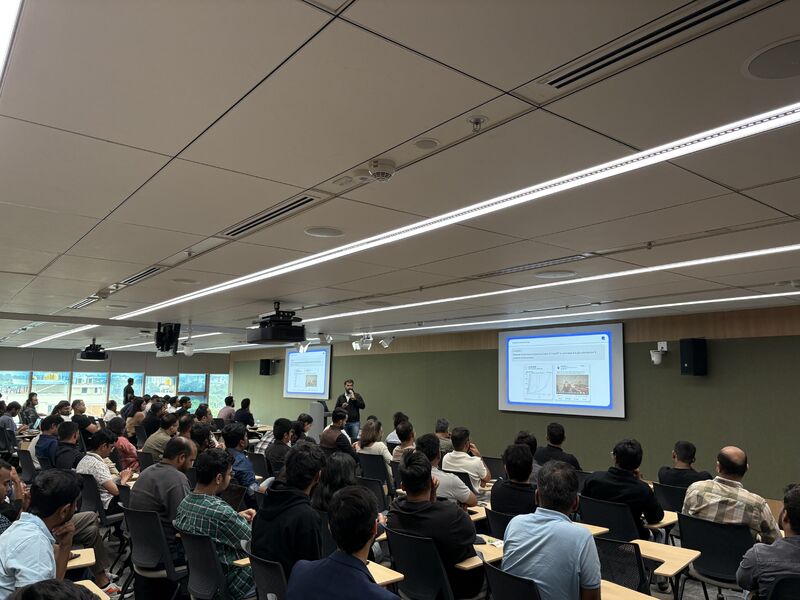
In August 2025, Bhattacharya spoke at an AI Immersion Day organized by Google AI and Lightspeed India. He announced the engagement with a joke about teaching bank robbery at the Federal Reserve. Search marketing at Google's office was an invitation too good to waste on a solemn LinkedIn introduction.
But his account of the talk quickly turned practical. Attendees asked about lessons from building Gushwork. He described business owners thinking about acquisition costs, sales efficiency and conversion. Technology buyers, in this account, are preoccupied with familiar commercial problems. The mechanism earns its place by solving one of them.
He makes a related distinction when discussing content. In subjects with abundant online material, generating text is relatively easy and competing for attention is difficult. Where information is scarce, human expertise becomes more necessary. His shorthand is a contrast between thick and thin content universes. The thin ones require somebody to know something.
There is a useful corrective here to the idea that publishing more is automatically progress. A company selling specialized equipment needs content that understands the equipment. Entering another country adds questions of language, context and local knowledge. Bhattacharya's discussion of cross-border marketing includes bringing in native-language writers and working with local opinion leaders.
“Always have a plan B.”
Nayrhit Bhattacharya, on fundraising, November 2024
Five agents, one very human invoice
By February 2026, he was describing Gushwork through five AI agents. One maintained knowledge about the customer's business. Another researched what buyers searched for. A third produced content and design, a fourth refreshed existing pages, and a fifth worked on backlinks. It was a division of labor recognizable to anyone who has managed a content operation.
The less ethereal detail was the bill: $46,758 for AI in the preceding month, according to his February 24 post. He reported the system working across more than 300 customer websites and generating over 1,000 leads a month in aggregate. These were his operating figures for that period, rather than a promise about what any individual customer would receive.
Two days later, he announced a $9 million seed round led by Susquehanna Asia Venture Capital. He named Lightspeed India, B Capital, Seaborne Capital, Beenext, Sparrow Capital and 2.2 Club among the backers. The announcement also opened general availability for the AI search product after a roughly 90-day beta.
He reported $1.5 million in annual recurring revenue from that product within 90 days. ARR expresses a recurring revenue run rate; it does not mean that amount had already been collected over a full year. For Bhattacharya, the selling point was the possibility of qualified inquiries from buyers researching vendors through conversational search.
Seed funding announced for Gushwork's AI search business.
Company announcement. Funding is company capital, not the founder's personal wealth.Returning to the people with the questions
Fundraising brings an amusing reversal for a former investor. Once, he helped evaluate other people's plans. Now he has to explain his own, find the interested listeners and keep the business moving while they decide. In his 2024 conversation with Prateek Mathur, he stressed preparation and the need for an alternative to venture funding.
He also spoke about hiring people who can operate amid ambiguity and using founder-led communication to attract customers. These subjects sit close together. A founder has to make a business legible to prospective colleagues as well as buyers. A polished job description does little good if the work requires someone to notice a problem before being assigned it.
On August 19, 2026, Bhattacharya reported that Gushwork had reached $6 million ARR over eight months, with net revenue retention above 120%. He and Venkatesh had spent 45 days meeting more than 70 later-stage founders and investors. His account emphasized clearer ownership, better evidence behind promises and more deliberate product decisions.
That update reads as another turn in a career built around changing vantage points. He had already worked inside a large company, observed founders as an investor and learned product work inside an AI startup. At Gushwork, he keeps returning to the people who might know what comes next. Then he has to choose what advice to act on.
The Pennsylvania billboard offers a compact expression of that habit. An AI search company studied its customers and found a reason to buy roadside advertising. Bhattacharya's ambition is to make inbound marketing simpler. Getting there has required an appetite for experiments, a willingness to narrow the brief and occasional attention to the view through a car window.
Follow the work
Continue with Gushwork, Nayrhit on LinkedIn and X.