The awkward truth about selling enterprise technology is that the product often arrives as a cloud of nouns. AI, transformation, engineering, modernization, platforms and experience all sound important. Put them in one sentence and they can become strangely weightless. Naveen Blazey's job is to give that language gravity. As Wipro's Chief Marketing Officer for the Americas and the global marketing lead for Engineering Services, he works in the narrow passage between what thousands of technologists can build and what a buyer can understand, trust and fund.
His career has prepared him for exactly that passage. Blazey graduated with Goa Institute of Management's class of 2006, joined Wipro in 2010 and stayed long enough to learn the business from the inside. When he marked 15 years at the company in late 2025, the anniversary came with an expanded brief. He would keep leading marketing across the Americas and add Engineering Services globally. The assignment was not framed as another territory on an organization chart. He described it as an opportunity to bring marketing and engineering closer together.
The compounding value of context
Fifteen years in one company can produce two very different careers. One repeats itself. The other compounds. Blazey's path looks like the second kind. By 2017 he was appearing at a San Francisco digital marketing conference as Wipro's Head of Marketing, discussing social media practices in a program packed with operators from SAP, Uber, Visa and other large brands. In 2018, the consumer-business marketing team he led received Wipro's Alpha Squad recognition. His profile also lists a Wall Award for Outstanding Contribution to Business Marketing.
The work around those titles appears to have been practical and orchestral. A former colleague, Remedia Fernandes, recalled two years of Mobile World Congress projects that moved from brief to content to stakeholder management. She also remembered a college crowdsourcing experiment, unusual at the time, and Blazey's willingness to test formats and take feedback. Those details matter because enterprise marketing rarely fails from a lack of concepts. It fails in the handoffs: between the brief and the words, the words and the event, the event and the commercial conversation.
“This expansion is an opportunity to bring marketing and engineering closer together.”Naveen Blazey, on his expanded Wipro role
Staying at Wipro gave him a map of those handoffs. His remit crossed retail, communications, media, consumer goods, healthcare and life sciences, technology and gaming. Each sector carries a different vocabulary, buying committee and burden of proof. The common task is translation without dilution. An engineering claim has to remain technically credible after it becomes a headline. A brand idea has to survive contact with a sales pursuit. A campaign has to say something memorable without promising more than delivery teams can defend.
A CMO with an operator's vocabulary
The clearest view of Blazey's management style comes from how he recruits. In May 2026, he advertised five marketing roles across New York and Bengaluru. His description avoided the comfortable split between brand people and performance people. The team, he wrote, would operate where strategy, storytelling and measurable business impact meet. He wanted marketers who think like business leaders, simplify complexity, turn ideas into pipeline and keep moving in a collaborative environment.
That is less a job post than an operating system. Strategy decides where to play. Storytelling makes the choice legible. Measurement keeps the story honest. Remove one part and the model weakens. Strategy without narrative stays trapped in a slide deck. Narrative without commercial consequence becomes decoration. Measurement without a point of view optimizes whatever happens to be easy to count.
Blazey calls marketing a force multiplier for growth, pipeline and brand authority. The phrase is useful because a multiplier cannot rescue a zero. Marketing amplifies the quality of the underlying offer, the evidence and the coordination around it. In a services company, this places the CMO unusually close to operations. The raw material is not a single product in a box. It is a shifting portfolio of expertise, partnerships, platforms and people. The marketer has to decide what deserves the spotlight, then assemble enough proof to make the spotlight useful.
Scale is a coordination problem
The usual picture of a CMO centers on the finished artifact: the campaign on a screen, the keynote on a stage, the slogan people remember. Blazey's record points to the machinery behind that moment. Mobile World Congress required two years of repeated coordination across briefs, content and stakeholders. The Alpha Squad award recognized a team, not a solo performance. His latest recruiting push spans industries, seniority levels and two countries. Even the verbs in his anniversary note were collective: working alongside people, building connections and bringing functions together.
That emphasis is easy to miss because coordination sounds ordinary. At enterprise scale, it is a creative constraint. A useful idea may have to cross industry leadership, engineering, sales, legal, regional teams and a client before it reaches the market. Every crossing introduces the chance that specificity will be sanded away. The operator's craft lies in keeping enough people aligned without turning the work into consensus paste. Fernandes's description of Blazey's timing and sense of proportion is revealing here. Good judgment is partly knowing which detail deserves a debate and which decision simply needs to move.
His Bay Area activity shows the same instinct in a smaller setting. A Wipro community page listed Blazey among the marketing and people-team organizers who helped colleagues gather for a hike at Rancho San Antonio Open Space Preserve. It was not a product launch or an executive panel. It was a local afternoon built around colleagues spending time together away from a conference room. In a career dominated by global briefs, that small entry gives the word connection a physical shape.
The combination of large-stage marketing and local participation also explains why his role is best understood as executive and operator. The executive chooses the direction. The operator creates the conditions in which other people can carry it. Blazey's public comments thank mentors, colleagues and teams more often than they celebrate individual authorship. His aspiration to connect engineering with marketing depends on the same habit. Functions do not move closer because an organization chart says so. They move closer through shared language, repeatable meetings, useful briefs, visible proof and people willing to translate without claiming the whole result.
AI, with the customer left in
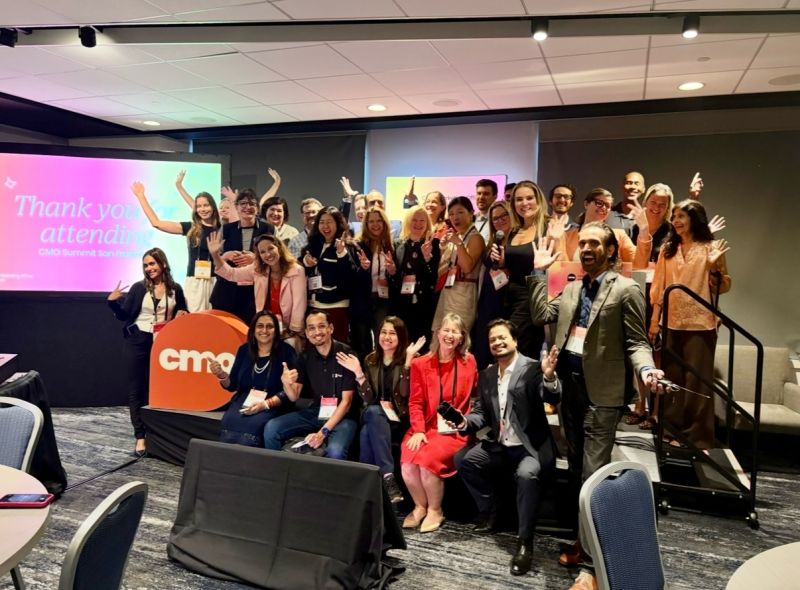
In September 2025, Blazey joined a San Francisco CMO Summit panel built around a pointed question: AI knows your customer, do you? The agenda pushed beyond prediction and personalization into the frictions that make both useful. Emotional intelligence. Customer choice. Clean data. The point at which automation begins to over-engineer the journey it was meant to improve.
For a technology-services marketer, that discussion has two layers. AI is part of the offer, and it is part of the machinery used to market the offer. Blazey's public positioning embraces generative AI and data-driven insight as tools for finding growth. Yet the summit topic made room for restraint. A system can produce more messages, more segments and more recommendations while making the experience feel less human. Scale is an output. Relevance is a judgment.
Does automation reveal a customer need and make the next choice easier, or does it simply increase the volume of decisions made on the customer's behalf?
That distinction fits Blazey's broader career. His language repeatedly returns to connections: marketing with engineering, insight with value, brand with growth, ideas with impact. Colleagues describe a detail-oriented project manager who remains open to new ideas. Those traits can look contradictory only from a distance. At close range, experimentation needs structure. The larger the event, company or AI system, the more valuable someone becomes who can welcome a new format while keeping the brief, stakeholders and outcome aligned.
The bridge is the job
Blazey's next chapter is not a departure from the first 15 years. It is the accumulated version of them. The GIM graduate who learned management in Goa, the marketer who worked major industry gatherings, the consumer-business team leader, the Americas executive and the engineering-marketing lead all solve variations of the same problem: turn complexity into a choice someone can make.
There is a lesson in that progression for ambitious operators. Careers often expand at the seams between functions. Engineering knows what is possible. Sales knows what is urgent. Clients know what is painful. Marketing is useful when it does more than broadcast each group's vocabulary. It has to build a shared one. Blazey's wider mandate gives him a chance to make that bridge repeatable across sectors and continents.
His stated mantra is to redefine what is possible in B2B technology marketing. The grounded version of that ambition is less theatrical and more demanding: better briefs, clearer proof, cleaner data, stronger teams and stories that can carry technical truth into a commercial decision. Enterprise marketing does not need another cloud of nouns. It needs a disciplined way to decide which details matter, which promises hold and which story earns the next conversation. That is the engineering inside the marketing.