A company website is an unlikely place to look for a turning point. Usually it offers a new coat of paint and a button inviting you to get in touch. In September 2016, Nathan Gokul used a website announcement to say something more revealing: the preceding six months had been challenging, and the business had been changing with them. The announcement was small. The responsibility behind it was considerable.
Gokul Nath A V, known professionally as Nathan Gokul, is the co-founder and CEO of Socius Innovative Global Brains. He works in the business of enterprise software: the applications through which companies sell, make, move and account for things. The name on his professional profile is Nathan. At an office opening in Kerala, he was introduced as Gokul Nath A V. Follow either name carefully and the same organization comes into view.
His career is easiest to understand by following that organization through a few concrete moments. An enterprise architecture role. An application-development announcement. An Indian company registration. Another office at Technopark. A stronger presence in Ann Arbor. Each adds a different kind of responsibility, and each puts a little more substance behind the title of founder.
The architect becomes an owner
Before Socius, Gokul worked at UST Global as an Enterprise Business Architect. His professional biography describes work on projects for large corporate clients. It is a useful starting point for the story because enterprise architecture concerns how a business and its technology fit together. A department’s application may work perfectly well while the information another department needs remains awkwardly out of reach.
His professional credentials span technical and management subjects. They include a bachelor’s degree in computer engineering and an MBA in international business. His LinkedIn profile also lists Certified Scrum Master, ITIL Service Operation and Lean Six Sigma Green Belt credentials. The subjects sit close to the practical concerns of his company’s work: organizing delivery, operating services and examining how processes perform. They add detail to a career that crosses both engineering and management, without turning a list of qualifications into a personality portrait.
The distance between those two situations is fertile territory for a software consultancy. An architect considers the arrangement of systems. A founder must also build the organization that delivers the arrangement. Client commitments, the people assigned to them and the continuing work after delivery become part of the picture. Gokul’s move into Socius put him on that ownership side of the business.
Socius dates its operating history to 2013. Gokul’s professional role timeline places the start of his co-founder and CEO tenure in November of that year. The Indian private limited company was incorporated on 8 August 2014, with Gokul and Sreena Sreekantakurup named as directors. Sreena S Kurup is known professionally as Sreena Kurup and serves as co-founder and COO.
Those dates describe different milestones: the beginnings of the operating business and the registration of a particular company. Keeping them separate makes the chronology more useful. A founder’s career develops through several such events, even when an organization chart eventually reduces the whole process to a name and a box.
A website is the small announcement
Gokul’s public professional writing supplies two early markers of the company’s development. On 28 August 2015, he published an article announcing mobility solutions for business process modeling as an addition to the application-development portfolio. On 13 September 2016 came the new-website article, with its reference to the demanding months before launch.
There is something pleasantly practical about these subjects. A new service has to be explained. A changing business needs a website that describes it. Neither announcement requires a grand theory of entrepreneurship. Together, they show a founder communicating what his company could do at particular points in its development.
The work Socius describes today gives those early announcements a wider setting. Its manufacturing portfolio includes a restaurant-equipment project that connected SolidWorks/CAD systems to an enterprise resource planning platform. ERP is the industry’s compact abbreviation for a rather expansive job: bringing activities such as sales, production, stock and accounting into a shared operating environment.
A kitchen drawing is a good illustration. It contains decisions about something that must eventually be made. The business around it needs those decisions to travel into production. Software can be very good at holding information and surprisingly tiresome about handing it over. That handover is part of the work Gokul’s company sells.
The company also describes a Danish manufacturing implementation that included sales, delivery, manufacturing and accounting, with changes to workflows, the interface and reports. The revealing detail is the attention to usability. Buying modules and arranging a usable working day are related tasks. They are still separate tasks, and the second can be easy to underestimate.
A founder must also build the organization that delivers the arrangement.
Two founders, another office
In March 2024, another piece of Gokul’s business became visible in an office-opening photograph. Socius had added space in the Pamba Building at Technopark Phase I, alongside its existing Phase III operation. Gokul and Kurup appeared with Technopark CEO Col Sanjeev Nair (Retd) and general manager Madhavan Praveen.
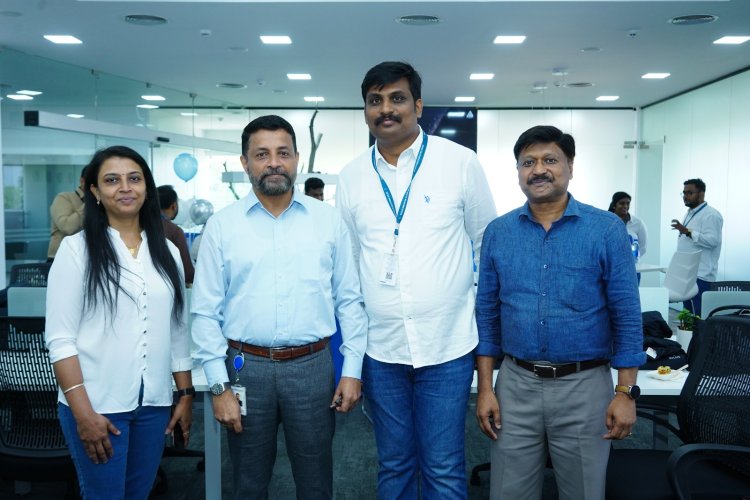
The occasion gave the founders a setting to discuss an international business. They described clients across North America, Europe and parts of Asia, and offices in the United States, Europe and Bengaluru. The additional Kerala office belonged to that larger operating picture. An address on a technology campus can be a local event with an international working week attached.
Management also spoke about creating more than 100 jobs through opportunities in artificial intelligence and ERP. That number described an ambition. The office expansion was the tangible step already taken. Reading the two together gives the moment its proper scale: a business adding capacity and outlining the work it hoped to pursue.
Jobs management said it aimed to create through AI and ERP opportunities in March 2024.
A stated plan, not a verified hiring total.
The photograph brings the partnership into focus. Gokul holds the CEO role; Kurup holds the COO role. Both are founders. Any account of his career at Socius needs room for that shared authorship. Company-building has a habit of acquiring a single face in the telling, even when the registration, leadership team and opening-day photograph contain more than one.
Bengaluru adds a research address
A separate corporate milestone arrived on 14 August 2021, when Sociusigb Research and Development Private Limited was incorporated in Bengaluru. Gokul became its managing director, and Kurup a director. The same two names appeared in a new entity, this time associated explicitly with research and development.
Socius describes Bengaluru as its research branch. Its public material places research alongside the platforms and services offered to clients. For Gokul’s career, the useful fact is the additional organizational commitment. He is associated with both the consulting business and a registered research company, rather than simply an occasional project carrying a research label.
The geography also helps explain the shape of the enterprise. Kerala operations, a Bengaluru research branch and U.S. business addresses create several points at which work must be coordinated. The software being integrated is only one part of that arrangement. Delivery depends on people being able to exchange information across the organization as well.
The Ann Arbor chapter
Gokul’s public LinkedIn profile now places him in Ann Arbor, Michigan. In April 2026, Socius announced an expansion of its North American operations and a stronger presence in the city. Its stated focus was ERP with AI capabilities, including automation and integrated business systems for small and mid-sized organizations.
The announcement described a delivery model combining U.S. leadership with international technical teams. That makes Ann Arbor part of the operating structure, alongside the Indian offices and research branch. It also gives a specific setting to Gokul’s current role: leading a business whose clients and technical work extend across borders.
AI has become a more prominent part of the company’s present-day pitch. The older integration work supplies a useful context for it. A forecast or automated task still belongs to an actual process, with a person expected to use the result. The company’s manufacturing examples keep that context concrete: a design, a production workflow, a report someone has to read.
There is an earlier chapter to that AI emphasis. The company’s preserved 2018 website already discussed artificial intelligence, machine learning, deep learning and data science alongside ERP. It also described predictive analysis for forecasting. The vocabulary has a history inside the business; it did not first appear with the Ann Arbor announcement.
For Gokul, that chronology puts the current expansion within a longer sequence of company decisions. The 2015 addition concerned mobility. The 2018 presentation included AI and analytics. The 2026 announcement brought AI-enabled ERP into a North American expansion. These are documented changes in what the business chose to emphasize, rather than evidence that every proposed service produced the same result. They give his founder story a clearer shape than any single launch announcement could provide.
Return to the website announcement of 2016 and the career becomes easier to see. A founder was explaining a business in motion. The later milestones add offices, a research entity and a different market emphasis. The recurring subject is the work between those announcements: organizing people and technology so that a company can deliver what it offers. Gokul’s business lives in those connections.
Follow the work
Nathan Gokul on LinkedIn ↗ Socius company website ↗ Manufacturing project portfolio ↗ Socius research and development ↗ Technopark office-opening coverage ↗ April 2026 expansion announcement ↗ Watch: Socius accounting-product video ↗The video is a company product presentation.