Narasimha Rao Vadde remembers enjoying the school exercise called “match the following.” Years later, the exercise acquired salaries, deadlines and consequences. A manager had to decide who should do which job. The convenient answer was whoever happened to be free. Vadde became interested in a more demanding question: what would happen if the work were arranged around the person’s strengths?
It is an unusually revealing place to begin a founder’s story. There is no garage, no napkin with a valuation scribbled on it, no conveniently cinematic lightning strike. There is a schoolroom puzzle, followed by the discovery that adults are rather harder to match than columns on an examination paper.
Today, Vadde is founder, CEO and managing director of Bilvantis Technologies. His working world includes cloud data engineering, artificial intelligence, digital engineering and the older systems on which businesses still depend. His recurring subject, however, is the person doing the work. Software can have an architecture diagram. People tend to object to being reduced to one.
An education that opened the first door
Vadde grew up in Nukulampadu, a village in Telangana. In his account of his childhood, an entrance examination for APRS, a residential school, changed the possibilities ahead of him. Admission brought a state-supported education. He credits the school collectively, rather than selecting one teacher for the starring role.
He remembers sports, the competitive company of children with different abilities, and the experience of developing values while living away from home. The opportunity that followed was work in information technology. He describes its effect in terms of the family’s circumstances and the opportunities available to later generations.
That is the background to his question about building a business: how many other people could it create an opening for? Employment, in this telling, extends beyond the individual appointment letter. A family’s next set of choices can change with it. The ambition gives his interest in developing employees a personal starting point.
Cards before the cloud
His education includes a Bachelor of Technology from Jawaharlal Nehru Technological University, Kakinada, with study listed from 1999 to 2003. His career subsequently took him through established technology services businesses. Wipro, VIT, Capgemini and Kanbay all appear in the account of his professional background accompanying his 2021 entrepreneurship interview.
Credit card processing and mainframes were part of that working education. His ITCrats author biography identifies experience in VisionPLUS, the card processing platform, alongside delivery, programme, people and customer management. These are fields in which the unglamorous details have a way of becoming the entire story. A payment system earns its keep by working when someone needs to pay.
That background helps explain the breadth of Bilvantis’s offering. Its present service menu puts “Heritage” alongside AI and cloud work. The word is almost genteel: somewhere between a country house and a database that absolutely must keep running. For a leader formed in card systems, the continued importance of established infrastructure is familiar territory.
Vadde’s move into entrepreneurship also included ITCrats and ValueText. Corporate records list his ValueText directorship from June 2019. Bilvantis dates its journey to 2019; its later private limited company was incorporated in February 2024. The business story and the legal entity’s date are different markers along the same developing enterprise.
The person who happens to be free
By April 2020, Vadde was writing about how managers assign work. His essay began with that childhood matching exercise and moved directly to a familiar organisational habit: a task appears, and someone asks who is available. It is an efficient way to fill a calendar. Whether it fills a person with enthusiasm is another matter.
He proposed paying attention to interests, aspirations, satisfaction with outcomes and the work that excites an individual. He also described using Gallup’s CliftonStrengths assessment to refine how roles were assigned. The purpose was to identify talent and develop it into a usable strength.
The revealing detail is his own sense of having benefited from earlier leaders who gave him roles he enjoyed. His management argument grows out of receiving that consideration himself. A useful assignment can improve both the result and the experience of producing it. The organisation gets the work; the individual gets a reason to care about it.
“Each of us have natural talents.”
Narasimha Rao Vadde
This is a practical preoccupation for someone running a services business. Clients buy an outcome, while employees encounter the work as a succession of particular tasks. The manager stands between those perspectives. Vadde’s writing asks that manager to know something more about a colleague than the date on which their current project ends.
A fortnight to earn some trust
Bilvantis faced the ordinary difficulty of a young services company: persuading clients to trust a business with a limited record. Its response included a free, two-week proof of concept. A prospective customer could see a piece of work before committing to a larger relationship. The company continues to display a two-week POC invitation on its website.
The arrangement is easy to understand. Introductions can get a meeting; a demonstration gives the meeting something to discuss. It places the first test in the work itself. For a founder whose career centred on delivery, that is a recognisable choice.
A 2024 account of Bilvantis described growth from five people to more than 200, with offices in the United States and Australia. It also detailed an Informatica migration assignment: seven team members tested code conversions for 250 workflows within two months. The figures offer a more concrete picture than the usual collection of adjectives attached to digital transformation.
Bilvantis’s proof-of-concept offer gives prospective clients a practical introduction to its work.
In August that year, Bilvantis received the Outstanding Achievement in Digital Transformation award at the Growth Stories Summit at T-Hub. Recognition supplies a public milestone. The more interesting operating question remains the one posed by the trial: what can the team demonstrate while a customer is still deciding?
Learning gets a place in the diary
Vadde describes Bilvantis’s culture with three verbs: learn, implement and celebrate. Each employee, he says, has an Individual Development Plan. The learning is expected to reach client work, and a monthly open house recognises both the people acquiring skills and the colleagues teaching them.
Remembering the teachers is a particularly useful touch. Organisations are fond of asking experienced employees to share what they know. The request can become an invisible second job unless somebody remembers that teaching takes time. Recognition makes that contribution visible to the rest of the company.
He says the team helped formulate the company’s vision in a workshop. He also describes checking how quickly bad news reaches him, with a target expressed in days. The two practices belong together: invite participation in the plan, then leave room for an awkward report about how the plan is going.
There is something pleasantly undramatic about this version of culture. It has a development plan, a monthly gathering and a question about communication. The office wall is spared the burden of doing all the management.
Back in front of a classroom
On 22 October 2025, Vadde spoke with MTech students at IIT Hyderabad about entrepreneurship and the evolving role of AI. He described the visit as a full-circle moment: he had once aspired to study at institutions such as the IITs and was now there to discuss his own journey.
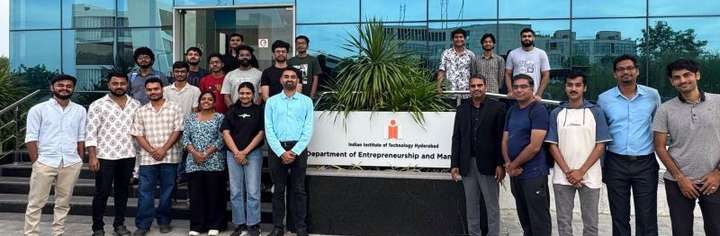
The discussion covered Bilvantis’s development from 2019 to 2025, networking, adaptability and the role of technology in building a venture. The products discussed included P2X, DBPilot, NeoAI and VoiceIQ. He also spoke about making space for hobbies, travel and social interaction alongside leadership.
Another student audience, at IBS Hyderabad, heard a more commercial vocabulary. Vadde discussed knowing yourself, your customer, your customer’s customer and your competitor. He covered the distinction between finding new business and developing existing relationships, and between a salesperson and a client partner.
The IBS session also addressed credibility, reliability, intimacy and the Ideal Client Profile. These are fairly specific things to bring into a guest lecture. They make the conversation about the daily mechanics of a business relationship: whom to approach, what they need, and whether they have reason to believe you. Students considering technology careers could hear the commercial questions that sit behind a delivery assignment. A project has a client, and that client has a business to run.
Those subjects bring the biography back to its central habit. Whether he is considering an employee’s strengths or a customer’s customer, Vadde keeps extending the frame beyond the immediate transaction. The person in front of you has interests, obligations and a context. Understanding them is work in its own right.
His 2021 appearance on The Guiding Voice had already explored the move from corporate leadership into several ventures. Years later, his classroom subjects still carry the marks of that transition: credibility, relationships, practical technology and the responsibilities of leading people. The founder has acquired more subjects to teach. The old matching exercise remains on the desk.