Long before Naaz Ali arrived at a South San Francisco biotech startup, her work happened across counters. A gym reception desk. A Bank of America teller window. The member-facing side of SF Fire Credit Union. Counters are useful schools for an operator: the queue is visible, the stakes are immediate, and every process ends with a person waiting for it to work.
Ali's career would eventually carry her through enterprise software, workforce development, beauty services, autonomous driving and genetic medicine. The industries are strikingly different. The craft connecting them is not. She notices the handoff, the welcome, the record that must be right and the meeting that must begin without drama. Her public title at SonoThera is Experience Operations Manager and Executive Admin to the CEO and CSO. It is a long title for a simple mandate: help a complicated place feel considered.
Chapter oneThe education of a generalist
In 2015, Ali entered Year Up, the workforce program that combines technical instruction, professional skills and workplace experience. She studied information technology and project management while also attending City College of San Francisco. The program became more than a line on her résumé. It gave her an on-ramp into Salesforce and, later, a community to which she returned as a volunteer and organizer.
At Salesforce, Ali worked in partner operations, managing the practical machinery around licenses, orders and contracts. She also coordinated the launch of an application intended to make order entry smoother. Later roles moved her toward talent development, where courses, rooms, speakers and schedules had to meet at exactly the appointed minute. Software may scale through code, but learning programs scale through logistics. Someone still has to make the calendar tell the truth.
“Optimism, attention to detail, and eagerness to stretch her skills.”A former Salesforce colleague, describing Ali
A colleague from that period remembered Ali volunteering to manage a large graduation party when funding, catering and entertainment were all in danger of falling through. She kept working until the pieces landed on time and under budget. The same colleague recalled that she was afraid of public speaking, so she joined Salesforce Toastmasters and volunteered to speak in front of large groups. This is a telling pair of details. The first shows composure when a system buckles. The second shows a willingness to enter the part of the system that made her uncomfortable.
A career built by carrying the skill forward
Chapter twoThe founder detour that was not a detour
In 2017, Ali left corporate technology work to study client care through cosmetology and started Cater2me Spa & Salon. The mobile business drew inspiration from her family's connection to Fiji and incorporated Fiji-made products. Its central idea was convenience with atmosphere: bring a carefully designed personal-service experience to the client instead of requiring the client to travel to it.
“I want people to feel like they are escaping into a mini vacation,” she said when Year Up featured the venture. The line reveals her operating instinct in miniature. A service is not only the thing delivered. It is how the recipient feels while it is happening. The insight travels well beyond salons. An office, an onboarding process and an executive meeting all have an experience layer, whether anybody has designed it or not.
Cater2me earned Ali startup funding and mentorship through Sky's the Limit, a Year Up partner that connects young entrepreneurs with volunteer business advisers. In Year Up's 2019 annual report, she described the value in plain terms: a mentor gave advice, and the continuing community made her feel supported. Entrepreneurship added ownership to her toolkit. When every customer impression, supply decision and scheduling problem comes back to the founder, there is nowhere for a handoff to hide.
Chapter threeReturning as the person who opens the doors
Ali did not treat Year Up as a ladder to pull up behind her. She served as a project development manager for its Bay Area alumni community and led the first reunion spanning class cycles one through twelve in June 2018. She also listed projects involving alumni meetups, graduation celebrations and supplies for people in downtown San Francisco.
Her volunteer record follows the same pattern. She helped coordinate event details for Tandem, supported activities at Presidio Middle School, packed more than a thousand school lunches with Directions for Youth & Families, and assisted with a patent event featuring Salesforce co-founder Parker Harris. The settings change. Ali keeps appearing where a gathering needs to become an experience rather than a head count.
The experience layer
Operations lives where people, systems and timing overlap. Ali's résumé keeps returning to that intersection - in a classroom, an office, an event and now a laboratory company.
Chapter fourStartup speed, twice
In 2019, Ali joined Phantom AI, an autonomous-driving software company. Her work combined office management with recruiting: vendors, contracts, facilities, candidate coordination and executive support. A startup compresses the distance between the mundane and the consequential. A delayed shipment can stall a team. A vague interview schedule can lose a candidate. A poorly negotiated vendor agreement becomes tomorrow's constraint.
By 2022, she had moved to SonoThera. The company's work is scientific; Ali's work makes the organization around that science usable. A public job listing for an operations and IT specialist reporting into her team makes the remit unusually concrete: welcome guests and new hires, help meetings run, maintain supplies, update internal records, coordinate onboarding communications and support company events. Read quickly, the list looks ordinary. Try removing it for a week and the office would tell a different story.
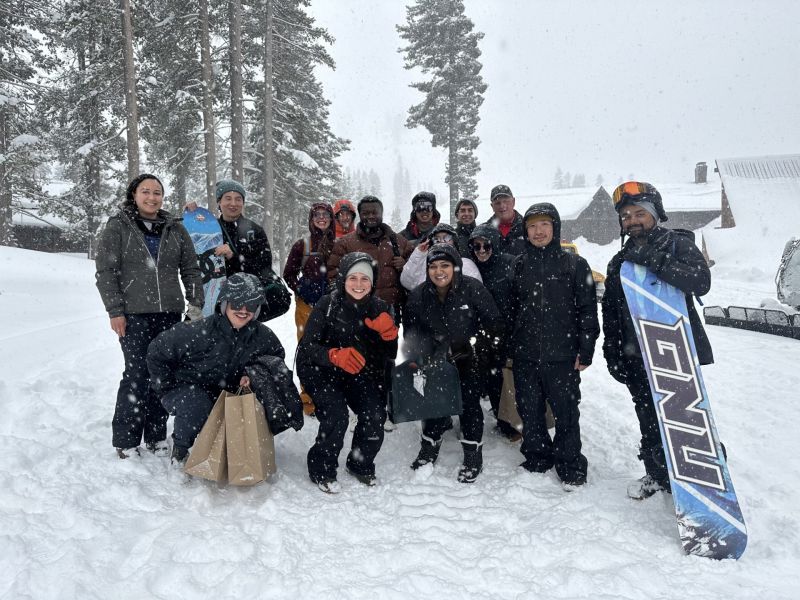
In April 2024, Ali posted photographs from a SonoThera offsite in North Tahoe. There was skiing, snowboarding, tubing and enough snow to make every logistical assumption negotiable. Her reflection focused less on the itinerary than on the result: colleagues swapped meaningful stories, handled hiccups together and became closer. “I truly feel fortunate to be surrounded by such fun and dedicated colleagues at SonoThera,” she wrote.
The post is cheerful, but it also reads like an operator's field note. Culture is easier to discuss as a value than to create as a memory. The useful parts often appear sideways, while people wait for a ride, solve an inconvenience or laugh at a plan being revised in real time. A good offsite is not an escape from work. It is a different stage on which a team learns how it behaves.
Chapter fiveMaking work work
SonoThera announced a $125 million Series B in June 2026, a financing that sets the company up for a larger and more demanding chapter. Funding stories naturally center on investors, founders and technical plans. Growth, however, arrives at the office as people, equipment, calendars, permissions, visitors and a multiplication of dependencies. Capital expands the possible. Operations makes the possible survivable on a Tuesday morning.
Ali's career offers a practical model for that work. Precision came from banking. Technical fluency and a professional network came through Year Up. Salesforce supplied scale and cross-functional coordination. Cater2me made experience design personal. Phantom AI supplied the compressed tempo of an engineering startup. None of these chapters predicts the next in a neat straight line. Together, they explain why she can occupy the junction between executive attention and employee experience.
The operating habitTurn experience into a curriculum
Ali has also made a habit of naming the skills behind the work. In June 2022, she completed courses in operational excellence, human resources and the role of HR as a business partner. The timing is notable because it sits beside her move from Phantom AI to SonoThera. After years of learning by doing, she was adding a formal vocabulary for systems, employee support and organizational partnership.
That pattern began with Year Up's blend of information technology, project management, business communication and professional practice. It continued with Agile training and Toastmasters. Ali's route has not depended on one credential that explains everything afterward. It looks more like a stack: learn what the next environment asks for, practice it in public, then carry it into the next role. Even the languages listed on her profile, English and Hindi, fit the wider picture of an operator accustomed to moving between contexts. Range is useful only when it can become translation.
The operator's product is the day everyone else gets to have.YesPress
There is wit in the fact that the most effective operations can look like nothing happened. The video call connects. The new hire has a laptop. The visitor is expected. The document is where it should be. Calm appears, suspiciously, as if by nature. Behind it sits somebody who anticipated the snag, made the call and checked the list twice.
Naaz Ali has spent more than a decade learning that craft in public-facing roles and behind-the-scenes ones. She has been the trainee and the alumni leader, the employee and the founder, the recruiter and the person making sure the room is ready. Her story does not need a grand theory of reinvention. It has a smaller, sturdier idea: take responsibility for the handoff, then make the next person feel expected.