An org chart is a soothing object. It puts everybody in a box, draws a few confident lines, and suggests that responsibility moves through a company as neatly as water through new plumbing. Monita Dukhia has spent roughly thirty years learning where that picture lies. The boxes can be staffed by intelligent people. The lines can be approved by a committee. The dashboard can glow a reassuring green. Then an inspection, a launch or a late handoff arrives, and five departments discover that they have been using the same word to mean five different things.
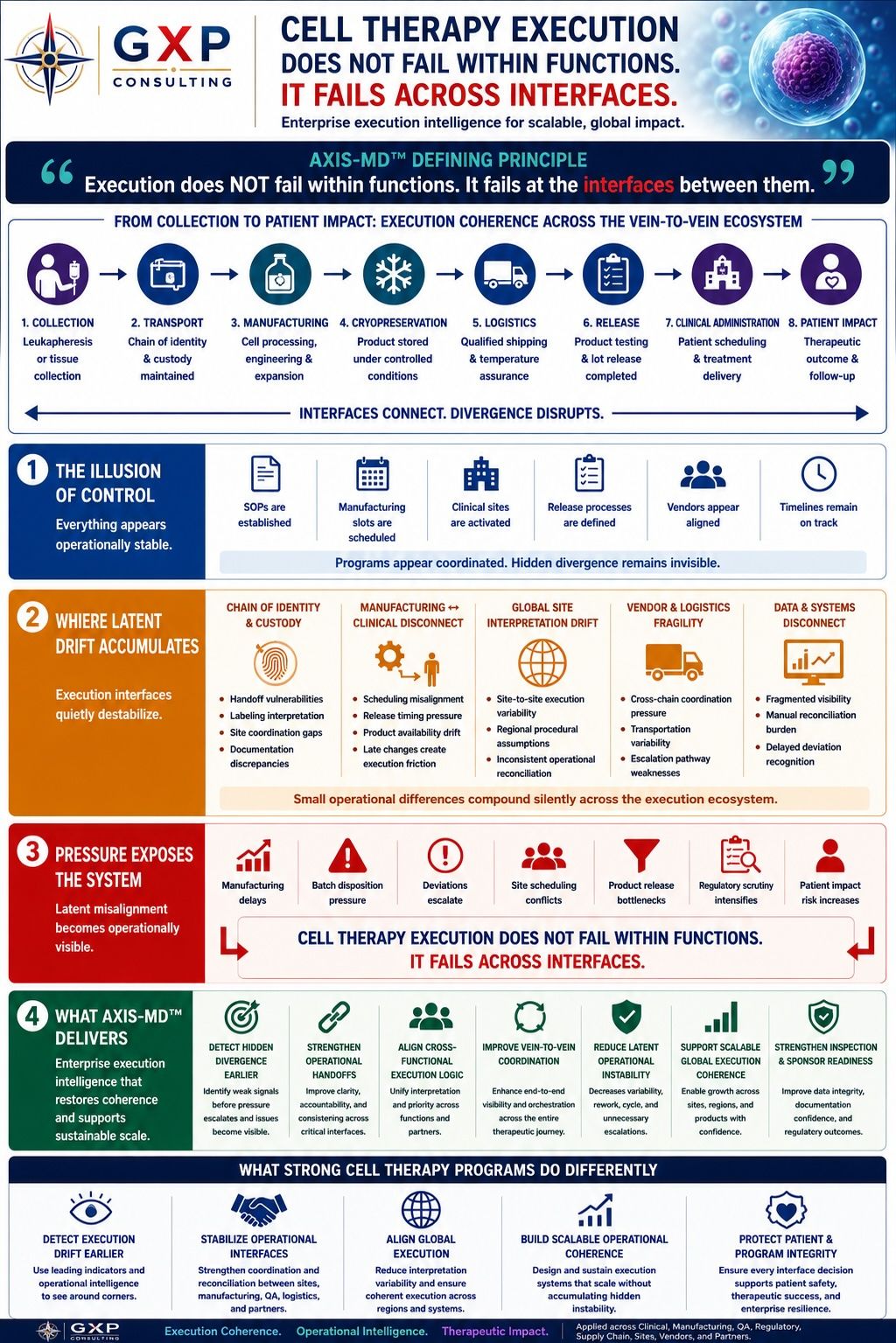
Dukhia's word for the missing quality is coherence. Her argument is that complex organizations often do not break because a single function is incompetent. They break at the interfaces - the place where manufacturing passes work to quality, where a clinical site meets a vendor, where global strategy becomes a regional instruction. One team says a program is ready. Another hears that the paperwork is complete. A third thinks the material is available. Everyone leaves the meeting satisfied. Reality, meanwhile, has not signed the minutes.
This is not a theory Dukhia arrived at from a weekend with sticky notes. Her path began in 1996 and traveled through the disciplined, unromantic country of pharmaceutical quality: quality-control supervision at Apotex, regulatory compliance at Novartis Vaccines and Diagnostics, and global GxP quality assurance at OXiGENE. Each job placed her close to the point where a company's claim about itself had to survive contact with records, evidence and regulators.
The chemist learns to read a company
Before she learned the dialects of executive meetings, Dukhia studied chemistry and biochemistry at McMaster University. The degree matters because chemistry is a practice of conditions and interactions. A component can behave one way alone and another way in a system. The same is true of organizations, although people are less considerate than molecules about declaring every variable.
Her early roles formed a progression from examining the work to examining the system around the work. Quality control asks whether a result meets a specification. Regulatory compliance asks whether the organization can demonstrate that it knows what it is doing. Global quality assurance asks a more difficult question: can it keep knowing across sites, functions, vendors and time zones?
By 2010, GXP Consulting had been filed in California, with Dukhia holding the central corporate roles. A decade later she was speaking publicly as chief executive of ClinPro Trials, a San Francisco contract research organization. ClinPro's proposition was deliberately broad: remain with a sponsor from the concept stage through commercialization, and bring inspection readiness into the work before the inspection calendar begins to menace everyone.
“Inspection readiness is not built during an inspection. It is revealed long before regulators arrive.”Monita Dukhia
That distinction contains her operating philosophy in miniature. A company cannot improvise coherence when an inspector walks in. It can tidy a room, rehearse an answer and locate a missing binder, but the relationships between decisions have already been made. The inspection is less an act of construction than a bright lamp.
The distance between green and good
In Dukhia's recent writing, the villain is rarely spectacular. It is drift. One interpretation separates slightly from another. An escalation path slows. A site adapts a procedure in good faith. A vendor meets the letter of a request while missing its operating purpose. These are tiny movements. They accumulate politely, without alarms. The dashboard stays green because dashboards are very good at counting the things they were told to count.
Then pressure enters. A technology transfer accelerates. A supply disruption removes the slack from a schedule. An inspection requires several teams to explain one decision in the same terms. Suddenly the accumulated distance becomes visible. The organization that looked coordinated is forced to reconcile itself in real time, which is rather like repairing an umbrella after it starts raining.
The AXIS-MD diagnostic
What outcome was intended?
Where can meaning diverge?
What is actually happening?
What produced the drift?
The movement is investigative, not decorative: from shared intention to the handoff, from the handoff to observed work, and from observed work to the cause.
Dukhia has organized this concern into AXIS-MD. Its four prompts are alignment, interfaces, execution and source. What outcome did the organization expect? Where do people, sites or systems touch? What is happening outside the presentation deck? What produced the difference? The framework is less a grand formula than a method for asking obvious questions early enough to be useful.
Her repeated line is sharper: “Execution does NOT fail within functions. It fails at the interfaces between them.” The capitals carry the insistence of someone who has watched accomplished departments protect their own logic while the whole operation grows less logical. It is possible to quibble with the absolute wording. Functions do fail. Her more durable point is that conventional management tends to notice those failures while overlooking the joints.
A career of crossings
The idea of interfaces also fits Dukhia's own public life. She is a scientist by education and an executive by occupation, but that is only half the ledger. She is also an author. Her listed books include Out of the Miry Clay, published in 2007, and The Return of the King, published in 2011. Public nonprofit records name her in connection with Lion of Judah Ministries in San Francisco, which received tax-exempt status in 2011.
The corporate and ministry work should not be collapsed into a tidy parable. They operate in different worlds and make different claims. Still, both reveal a person unusually comfortable speaking in the register of conviction. Dukhia does not publish like a detached management theorist. Her professional prose repeats central phrases, names consequences and presses for alignment. The style is closer to a refrain than a white paper.
That persistence has moved into a new phase. In 2026, she filed applications around terms including Enterprise Execution Intelligence, Interface Intelligence and EEI Understanding Engine. California records also show newly formed EEI entities for which she is the registered agent. An application is not a finished service, much less proof of market adoption. It is, however, a directional signal. Dukhia is working to turn a career's recurring observation into a named body of consulting, training and software concepts.
Begins a career that moves from pharmaceutical quality control into compliance and global quality leadership.
GXP Consulting is filed in California, with Dukhia occupying the company's principal executive roles.
As ClinPro Trials CEO, argues for a CRO relationship extending from concept through commercialization.
Develops and protects a vocabulary around enterprise execution, operational interfaces and AXIS-MD.
The arrow deserves an owner
There is a quiet rebuke in Dukhia's work for the cult of individual excellence. Companies like to recruit stars, certify departments and reward visible output. Interfaces are harder to praise. Nobody puts “made sure two groups meant the same thing” on a trophy. Coordination belongs to everyone in theory and, with depressing frequency, to no one in practice.
Her approach asks leaders to treat the connection itself as an operating object. Define what passes across it. Establish who can interpret it. Notice how a change on one side alters the obligations on the other. Test whether the people involved share a meaning before a deadline tests it for them. This sounds basic. So does fastening a bridge at both ends.
The ambition now appears larger than clinical compliance. Dukhia applies her language to manufacturing, supply chains, oncology programs, cell therapy, organizational growth and enterprise governance. The common subject is scale. As a company adds people, partners, systems and regions, the number of relationships grows faster than the org chart suggests. Complexity lives in the multiplication of arrows.
“Align the Intent. Reconcile the Execution. Control the Outcome.”Monita Dukhia
There is good sense in leaving a little room for humility. No framework eliminates conflict, and not every operational surprise can be detected in advance. The useful part of Dukhia's thesis is not the promise of perfect control. It is the demand for better observation. A system can look healthy from the altitude of a quarterly review while people at its edges spend each day translating around contradictions.
Her career has been a long movement toward those edges. From the quality-control result to the global system, from the regulatory file to the sponsor relationship, from the department to the interface, the field of view keeps widening. The work asks executives to look away from the clean boxes for a moment and study the untidy lines.
That is where the organization is making its promises. It is also where those promises can quietly become something else.