The first question was about somebody else’s money. On June 23, 2019, My First Million published an interview with Suli Ali, whose career ran from a Microsoft salary to selling TinyCo. The title supplied the promise: here was a person who had crossed a financial distance, and perhaps he could explain the route. Sixteen days later, Sam Parr appeared as a guest to discuss making money from an email newsletter. Soon, the guest would become part of the product.
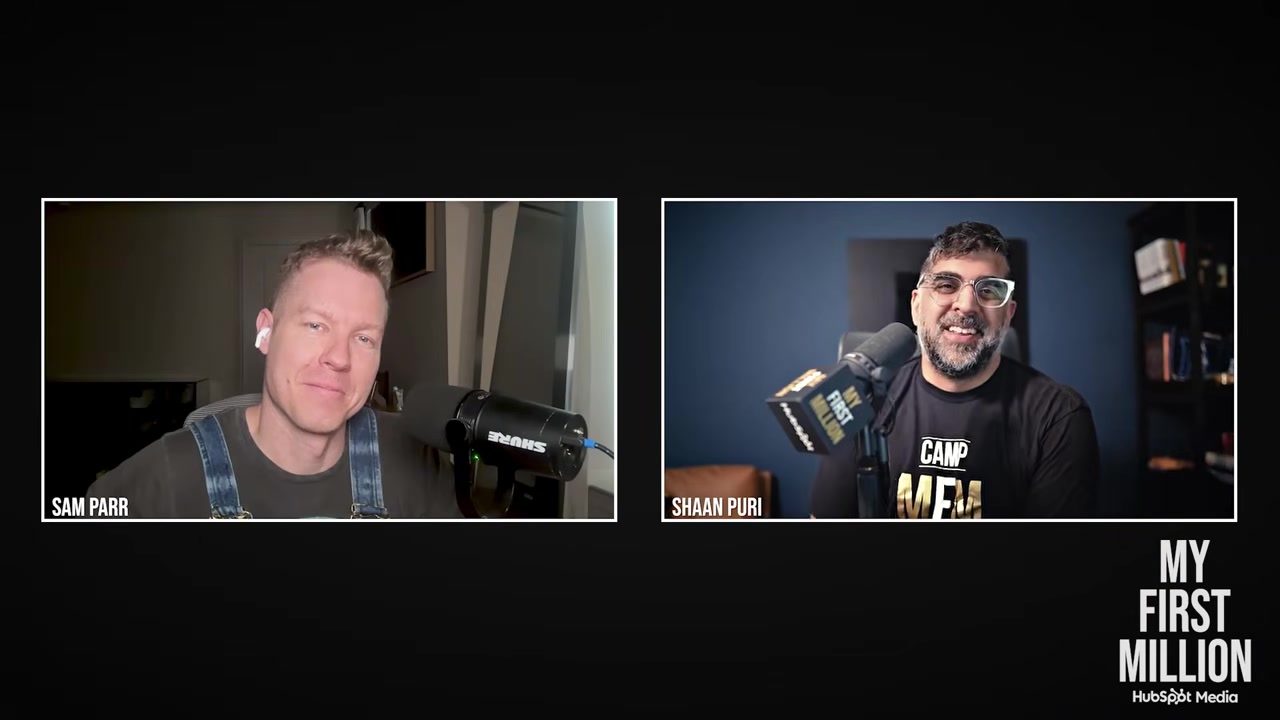
Today, Parr and Shaan Puri trade business ideas, dissect companies and interview people who have built things. The show belongs to HubSpot Media. Its central attraction is hearing an opportunity take shape while two experienced entrepreneurs argue about it. A listener gets the conversation before the tidy conclusion.
- Free business brainstorms, breakdowns and founder interviews.
- Created by Shaan Puri; co-hosted with Sam Parr.
- Published inside HubSpot Media, with commercial promotions.
- Best used to find a question you can test with a customer.
The launch had its own business problem: distribution. In a Mixergy interview, Puri recalled approaching Parr, whose Hustle newsletter already reached entrepreneurs. Parr worried about expense, talent and distracting his team. Puri proposed supplying the audio while The Hustle supplied promotion, with revenue divided 50/50. His pitch asked the publisher for no upfront production spending. That made saying yes easier.
This arrangement is the first useful lesson. A good product needs a route to its customer. Puri found a partner with the route already built and offered something that made the partner’s existing product more useful. Copying that bargain requires a willing publisher, a relevant audience and content worth putting in front of it.
Drone shows are a perfectly serious subject
By October 2019, an episode called Million Dollar Brainstorm paired Puri and Parr around drone light shows, tiny houses, no-code tools and website plugins. The subjects sounded like the contents of an eccentric shopping basket. Their common feature was economic: each suggested a need, a buyer and a possible way to charge.
The earlier interviews had offered completed journeys. Brainstorming added unfinished possibilities. That distinction gives the show its character. Listeners can hear a premise being stretched, questioned or abandoned. A strange business becomes interesting when somebody asks where the customers come from, what delivery involves and whether the numbers survive a second look.
There is no reason to call the interview format a failure. Interviews remain part of the show. The observable change is that the hosts’ thinking became a recurring attraction alongside the guests’ achievements. For a founder, that is a useful editorial experiment: watch which part of the work people return for, then give it room.
The expertise comes from experience on both sides of the microphone. Parr built The Hustle; Puri sold a startup to Twitch. Their different histories give them material to challenge each other. The informality helps carry the detail. Someone who would never read a report about website plugins might happily listen to an argument about who makes money from them.
Free listening has paying customers
My First Million sits in the market for entrepreneurial attention. Acquired, How I Built This and other business shows compete for the same walk, drive or spare hour. MFM’s particular proposition is a recurring idea session, mixed with interviews and company breakdowns. Its audience includes aspiring founders, working operators and people who simply enjoy finding out how an unfamiliar business earns a living.
The main audio and public video episodes cost nothing to consume. Commercial promotions appear in the episode notes, including offers from Somewhere, Mercury and beehiiv. Sponsors get a way to reach business-minded listeners. HubSpot gets a media property whose interests overlap with the entrepreneurs and growing companies it wants to serve.
The connection became formal in 2021. HubSpot announced its acquisition of The Hustle in February, then included My First Million in its inaugural podcast network in May. Puri has described HubSpot owning the podcast’s intellectual property while the hosts retained creative control and financial upside tied to growth. That arrangement helps explain why the show still sounds like its hosts.
Audience trust can also travel. In a 2021 Sacra interview, Puri said investors in his separate rolling fund came from people following his Twitter account or podcast. That capital belonged to the fund. The interesting point for the show is how hearing somebody think, repeatedly, can become a reason to trust them elsewhere.
“Niche down until it hurts.”Darren Clarke, MFM executive producer, in HubSpot’s podcast guidance
The experiment you try afterward has its own budget.
Take one idea out for a test drive
The catalogue keeps moving. In September 2026, Tony Hawk joined a conversation covering skate parks, video games and investing. On October 7, episode 869 featured Jeff Harmon discussing the marketing behind Squatty Potty and Poo-Pourri. The range is amusing, but it also widens the listener’s idea of what counts as a business worth studying.
The show even turned the microphone on itself. A May 2026 strategy episode discussed clips, newsletters, possible events, dinner clubs and guests. These were proposals being debated, rather than a list of products already delivered. Making the discussion public exposes a familiar operating problem: a successful format still needs decisions about where to spend its next hour.
A useful way to listen is to write down three things: the customer, the irritation and the cheapest experiment that could reveal demand. After an episode, ask a prospective buyer how they handle the problem today. Price the labor, software or inventory required to deliver a solution. Try to get a commitment before building an elaborate version.
That is an application of the show’s questioning habit, rather than a promise from its hosts. A plausible market estimate can fail in your town. An attractive margin can disappear into sales costs. A business suited to an experienced operator with contacts and capital may be a miserable first project for somebody without either.
My First Million is useful when it sharpens attention and prompts a test. It is less useful when another episode replaces that test. The practical payoff arrives at the moment a listener pauses the conversation, writes down one question and takes it to somebody who might actually pay.
Keep the conversation going
Explore the episode archive, listen on Apple Podcasts, or watch the YouTube channel. For a conversation about the podcast business itself, watch the Acquired crossover interview.
Follow the show on LinkedIn, X, Instagram and TikTok. Read the producers’ podcast-building advice for a closer look at the work behind the conversation.