The first Musora product was a lesson in one-handed drum rolls, filmed in a day on a family duck farm in British Columbia. Jared Falk, a drummer who had grown up expecting to join the family farming business, and his student Rick Kettner produced 1,000 DVDs. They sold every copy. They also pushed Falk's credit card to its limit. This was 2005: video streaming was awkward, online checkout still felt suspicious, and "creator economy" was not yet a phrase that could ruin a perfectly good conversation.
Twenty-one years later, the company that grew out of that DVD sells a digital membership for five instruments. Drumeo teaches drums. Pianote handles piano. Guitareo takes guitar. Singeo works on the voice. The newest arrival, PlayBass, supplies the low end. One Musora login opens all five, alongside live sessions, instructor feedback, practice tools, progress tracking and a large licensed song library.
It is tempting to call Musora the Netflix of music lessons. That is tidy and mostly wrong. Netflix succeeds when you keep watching. Musora succeeds only when you stop watching, pick up an instrument and make an ugly noise on purpose. The business is built around converting passive attention into a habit - and keeping that habit alive after the beginner's first burst of enthusiasm expires.
The useful failure came before the free stuff

Before the DVDs found an audience, Falk and Kettner built Breaksticks.com, a forum for drummers. It grew to roughly 700 members over six to 12 months. They joined other drum forums, answered questions, and let a link in their signatures do the recruiting. Breaksticks barely sold anything. What it supplied was more useful: a live map of what drummers were confused by, what language they used, and what made them return.
The founders initially put lessons behind a price. Then Kettner suggested giving them away. FreeDrumLessons.com launched in 2007 and traffic took off. The change of mind was practical, not philosophical. A free video generated a startling response in an era when useful online video was scarce. Free lessons created trust before the ask; paid products supplied sequence and depth after it. Falk has said the buying journey could take 30 to 90 days and involve 10 to 20 encounters with the brand.
“I had no idea that I could do it. All I knew is that I could try.”Jared Falk, on starting online
The cost structure was scrappy enough to become mythology. The first DVD maxed a credit card. Drum.io was offered at $50,000, so the company registered Drumeo.com for $9.99 and turned “drum education online” into a name. By 2014, the farmhouse production setup had lights attached to shower rods and cameras arranged around a furnace. Students funded the escape: a Kickstarter for a proper studio hit its goal in 24 hours and eventually raised more than C$100,000.
The early funnel, reconstructed
What Musora actually sells
The obvious answer is video. The better answer is relief from choice. YouTube can show a new pianist 10,000 ways to play a chord; it cannot easily tell that pianist which one belongs on Tuesday. Musora's Method organizes each instrument into a progressive path from first fundamentals to advanced playing. Lessons are designed as guided practice, often in short daily sessions. The app records streaks and progress. Students can slow or loop music, download lessons for offline use, join live broadcasts, ask mentors for help, and submit playing for feedback.
That human layer matters. Pure practice apps are good at detecting whether the right note arrived near the right time. They are less good at spotting tension in a singer's jaw, a drummer's inefficient motion, or a guitarist's loss of nerve. Musora uses working musicians, touring players and coaches as teachers, then supports the library with mentors and community staff. At its best, this makes the subscription feel less like a warehouse and more like a school with unusually flexible opening hours.
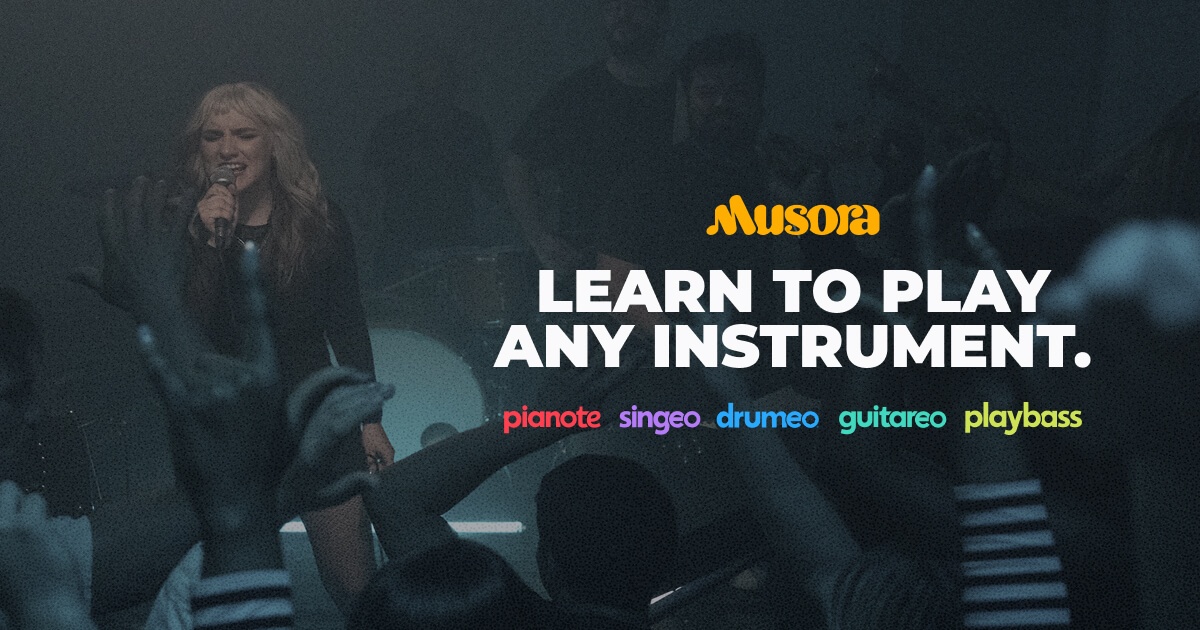
The brands remain distinct because instruments carry distinct insecurities. A singer worries about sounding exposed. A drummer worries about coordination. A returning pianist may be embarrassed by what ten idle years did to familiar pieces. Musora shares the plumbing - account, search, app, progress and billing - while each school keeps its own faces and dialect. In 2023, the company unified four brands into the Musora app without discarding the specialist storefronts. PlayBass joined in 2026.
The bundle, the bill and the awkward rights lesson
Musora is primarily a direct-to-consumer subscription. As of August 2026, the company advertises Musora+ at US$30 per month or US$279 per year after a seven-day trial. A 90-day money-back guarantee extends the runway. The base annual membership is US$229. Standalone course packs, books and gear add e-commerce revenue, while an ambassador program pays approved affiliates for referrals.
Musora base
$229/yearOriginal courses, the Method, challenges, workouts, quick tips and live events.
Musora+
$279/yearThe base library plus licensed songs, song tutorials, drum transcriptions and other third-party material.
The split exists because Musora owns its teaching but not the songs students want to play. Rights change hands, licenses expire and royalties continue. Some lifetime members learned this distinction when licensed transcriptions and tutorials moved behind Musora+. The first failure was communication: the company later acknowledged that its explanations had been inconsistent, gave affected lifetime members a year of Musora+ and made the continuing rights cost more explicit.
This is both a bruise and a useful business lesson. “Lifetime” is simple language until a product depends on assets whose owners can change the bill. Musora's base-plus-licensed structure is defensible when the boundary is visible before checkout. It becomes combustible when customers discover it only after material moves.
The thing worth stealing
Musora sits between three markets: local private instruction, free creator video, and automated learning apps such as Yousician or Simply Piano. Private teachers win on observation and accountability but cost more and require schedules. Free video wins on abundance but produces decision fatigue. Automated apps make practice legible but can feel clinical. Musora's position is structured media with people still inside it.
A five-part playbook
- Start painfully narrow. One drum technique was enough to find the first paying audience.
- Use free content as proof. Teach something complete before asking for the subscription.
- Charge for sequence, not scarcity. The internet already has videos; customers pay to know what comes next.
- Keep the niches legible. Share infrastructure, but let each audience hear its own problems described accurately.
- Add a human checkpoint. Feedback, live contact and community catch the doubts that software metrics miss.
The company itself learned the danger of expansion without focus. In an earlier interview, Falk described sidelining a recording brand and simplifying around Drumeo and Pianote. His observation was blunt: every time the company simplified, it made more money. The later portfolio worked because each new instrument received its own curriculum, teachers, marketing and community - not a search-and-replace version of the drum business.
Government support now gives that machine more room. In January 2026, Pacific Economic Development Canada committed C$5 million through March 2029 for platform upgrades, market expansion and faster marketing. This is a government contribution, not a disclosed venture round, and no reliable public valuation is available. It arrives after two decades of product sales, subscriptions and audience building - capital aimed at scale rather than proof of demand.
When the model works - and when it does not
It works when
The student can practice regularly, values multiple instruments or deep course variety, and will use mentor feedback instead of silently collecting unfinished lessons.
It falls short when
The learner needs hands-on physical correction, ensemble experience, external scheduling pressure, specialized conservatory preparation, or only one narrow skill already covered by a cheaper teacher or free resource.
No subscription can practice for its customer. An adult who opens the app twice in January has bought an aspiration, not an education. Musora's breadth can also become its own distraction: the bargain of five instruments is less useful if bouncing among them prevents fluency in one. The strongest fit is a self-directed beginner or returning player who wants a plan, appreciates recognizable songs, and uses the community when momentum slips. A child requiring close supervision, a vocalist with pain, or an advanced applicant preparing for an audition may be better served by a local specialist.
Still, the company's central diagnosis is sound. Starting music is exciting; staying with it is hard. Musora has spent 20 years moving the sale away from “watch this expert” and toward “come back tomorrow.” The duck farm, the free lessons, the inexpensive domain, the crowdfunded studio and the five-brand bundle all point to the same instinct: remove one excuse at a time. The remaining variable is the person holding the sticks.