There are two rooms in American life where a Muslim character can be written. One has committee tables, staff memos and a clock that counts down to a vote. The other has whiteboards, cold coffee and a clock that counts down to a locked script. The Muslim Public Affairs Council Foundation has spent nearly four decades learning how to enter both.
This is the useful way to understand MPAC. It is legally a nonprofit, not a conventional company, and its beneficiaries do not buy seats or software. But it still makes products: a policy brief that a congressional aide can use before a hearing; a cultural note that can save a showrunner from a cardboard villain; a fellowship that lets a young Muslim see public service from the inside; a security bulletin that tells a mosque leader whether an online threat deserves attention.
The organization began in 1986 as a public relations committee at the Islamic Center of Southern California. In 1988 it adopted the MPAC name and created the Foundation. The origin matters. Public relations was not decoration around the mission. Public understanding was the mission's first machinery.
Write the rules
Research, legislative tracking, government briefings, coalition letters, toolkits and leadership programs.
Rewrite the role
Script review, on-set advice, writer access, screenwriting labs, inclusion presentations and media commentary.
The bridge is the product
MPAC describes its work through policy, advocacy, leadership development and coalition building. Those labels are accurate, but a little bloodless. What the organization really supplies is translation. Muslim communities know what a discriminatory policy or a lazy stereotype feels like. A senator's office needs a recommendation that survives legal and political scrutiny. A writers' room needs a note that improves the scene rather than stopping the story. MPAC turns lived experience into something each room can use.
That makes its customer map unusually wide. American Muslims, mosques, young leaders and local organizers are the central users and beneficiaries. Policymakers, agencies, journalists and civil-rights coalitions use its analysis and community relationships. Producers, directors, screenwriters and studio executives use the Hollywood Bureau's consultations, presentations and introductions. They are not all paying customers. They are participants in a donor-funded public-interest network.
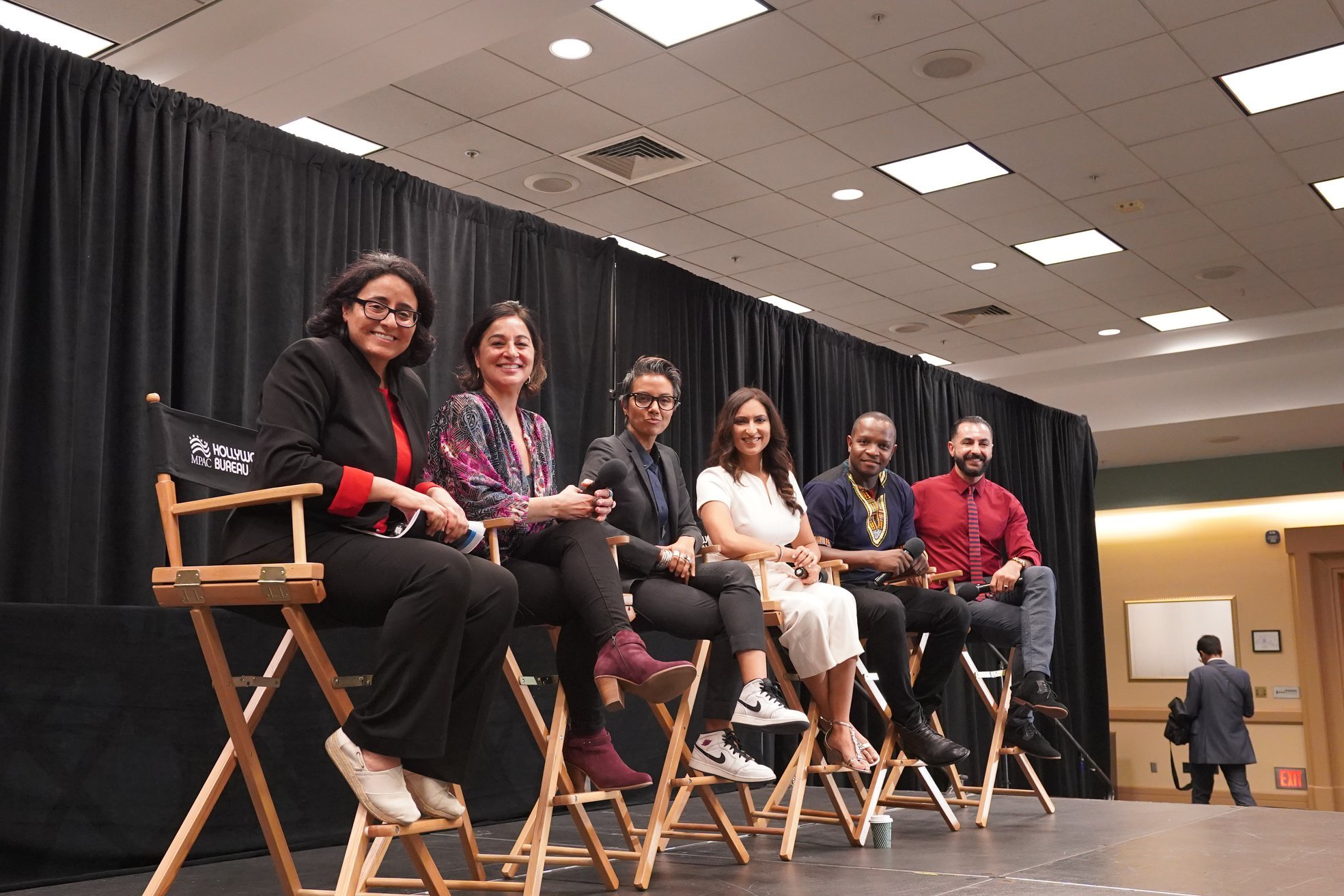
The Hollywood Bureau, launched in 2011, is the clearest expression of this method. Its experts review scripts, give pre-production and on-set notes, and advise on subjects ranging from Islamic practice to family life, law and foreign affairs. It also connects emerging Muslim creatives with institutions including CAA, UTA, the WGA, DGA, SAG-AFTRA, Film Independent and YouTube. The bureau says it has consulted with companies and networks including Disney, Paramount, Amazon, Hulu, CBS, NBC, Fox, FX, National Geographic, Starz and BBC1.
“Good stories can change hearts; changed hearts can change minds; and changed minds impact our values and can galvanize us into action.”Sue Obeidi, Senior Vice President, MPAC Hollywood Bureau
Its most portable product may be the Obeidi-Alsultany Test, created by Obeidi and scholar Evelyn Alsultany. The framework asks five practical questions. Is the Muslim character in an original context? Is a Muslim writer involved? Does the character possess a life beyond religion? Does the character matter to the plot? Does the portrayal reflect the racial, ethnic, gender and cultural range of Muslim life? This is not a score that guarantees good art. It is a way to catch familiar failure before it becomes expensive footage.
Access, after access failed
The most revealing early setback came in 1999. Salam Al-Marayati, MPAC's co-founder and president, was appointed to the National Commission on Terrorism. The nomination was withdrawn after political opposition. An organization with a thinner theory might have concluded that the door to federal institutions was performative or permanently closed. MPAC kept knocking.
In 2002, Al-Marayati testified before the Senate Judiciary Committee on terrorism financing and the shutdown of Muslim charities. In later years MPAC briefed officials, engaged presidential administrations and worked with partners ranging from Brookings to interfaith coalitions. The first failure did not change the destination. It refined the method: access cannot rest on a single appointment; it has to be distributed across staff, evidence, allies and repeated encounters.
The same widening happened in media. MPAC had presented an inaugural media award to Morgan Freeman in 1992, long before the Hollywood Bureau had a name. By 2011, the institution had moved from applauding a portrayal after release to advising creators before the script was fixed. That shift - from reaction to participation - is the quiet strategic turn in the story.
What the work costs
The Foundation's public filings make the economics unusually concrete. In fiscal 2024 it reported $4.25 million in revenue, $3.32 million in expenses and $5.95 million in net assets. Contributions supplied 75.7 percent of revenue; investment income contributed 19.2 percent. Program-service revenue was only 3.3 percent. This is not a consulting firm hiding inside a charity. Donors and invested reserves carry most of the load.
A public-interest business model
The cost is therefore more than the annual expense line. It is the slow accumulation of credibility. Policy staff must know which recommendation is timely. Community organizers must retain trust when compromise looks suspicious. Cultural consultants must tell a studio that a scene is false without turning the note into a lecture. A bridge organization pays maintenance on every shore.
Now the threat moves in real time
MPAC's newer Center for Security, Technology, and Policy adds a third instrument: data. In 2026 the center published incident tracking, legislative monitoring and monthly security bulletins. It says it monitors legislation, media coverage, social platforms and public discourse, then turns those signals into alerts and briefings for decision-makers, journalists and advocates.
The change is practical. A policy paper can explain a decade. A security bulletin has to explain Tuesday. In September 2026, MPAC was also working with the Shoulder to Shoulder Campaign and other faith partners against anti-Muslim rhetoric, recruiting interns across Washington, Los Angeles and Chicago, and preparing its Empowering Voices gathering. The public-facing organization now ranges from a one-step message to Congress to a threat report to a film-festival convening.
The parts worth copying
A script consultation before production and a policy brief before a vote both beat criticism after the outcome is locked.
Five questions, a one-page guide or a legislative tracker travels farther than a general request to “do better.”
Appointments disappear. Staff change. Durable access comes from coalitions, alumni, creators, analysts and community trust.
Community experience sharpens the analysis; institutional encounters reveal which community resources are actually useful.
There are conditions attached. The method depends on being invited early enough to matter, trusted enough to hear the unvarnished problem and specific enough to offer a usable answer. It is weaker when a policymaker wants only a photograph, when a studio wants a cultural blessing after production, or when the community sees engagement as surrender. Translation works only if the translator is still credible to both sides.
That tension is not a flaw at the edge of MPAC's model. It is the center of it. The organization occupies the disputed space between protest and participation, between correcting the record and helping write the first draft. Other groups litigate, organize elections, publish research or fund artists. MPAC's distinct market position is to connect those worlds and stay in the room long enough to make the connection useful.
The result is not easily measured by a single election, show or headline. It appears in smaller edits: a provision challenged, a young leader introduced, a mosque warned, a writer hired, a character permitted to be ordinary. One room changes the rules. The other changes what the audience imagines is normal. MPAC's wager is that American pluralism needs both edits at once.