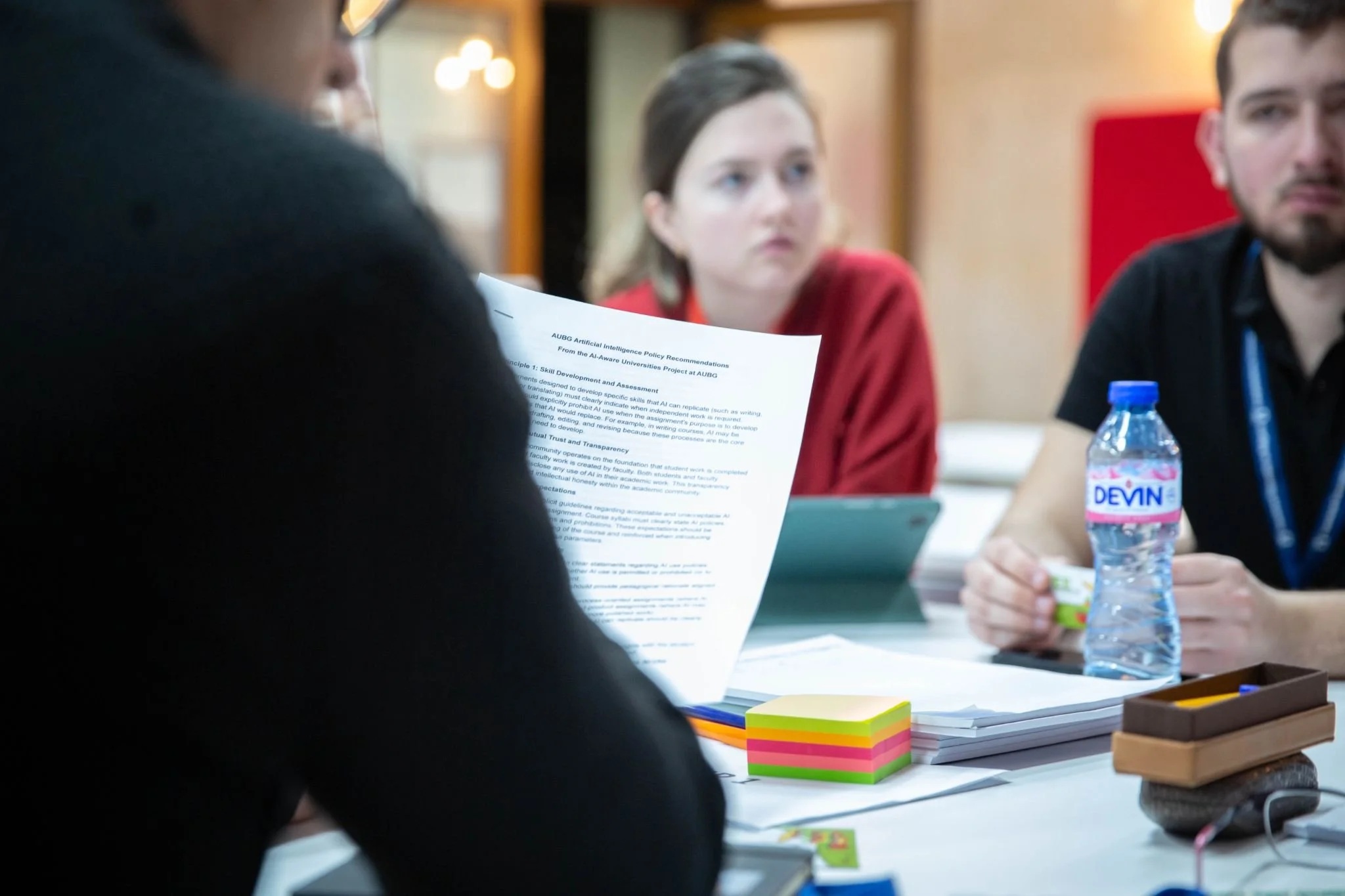
Two cards can change a meeting. In a project bringing students and faculty together to write university AI policies, professors tended to speak more while students held back. Organizers gave each participant two cards. Speak, turn one over. Use both, and wait. Even expertise had to take its turn.
The episode appears in a September 2026 account of AI Aware Universities, supported through People Powered’s Digital Democracy Accelerator. Six European universities took part. The exercise captures the nonprofit’s territory: the practical arrangements that determine whether an invitation to participate gives people any influence.
People Powered helps governments and civil society organizations design participatory budgeting, citizens’ assemblies, policy consultations and other ways of sharing decisions. It assembles resources, trains practitioners, matches mentors and runs accelerators. A city official trying to open a budget to residents and an advocate trying to win that opening can both find a starting point.
Plenty of reports. Who could actually use them?
The organization emerged from a familiar professional frustration. At its 2020 launch, it described a field rich in research and conferences but short on accessible guidance, practical support and shared direction. Local champions were working on related problems without enough help connecting their efforts.
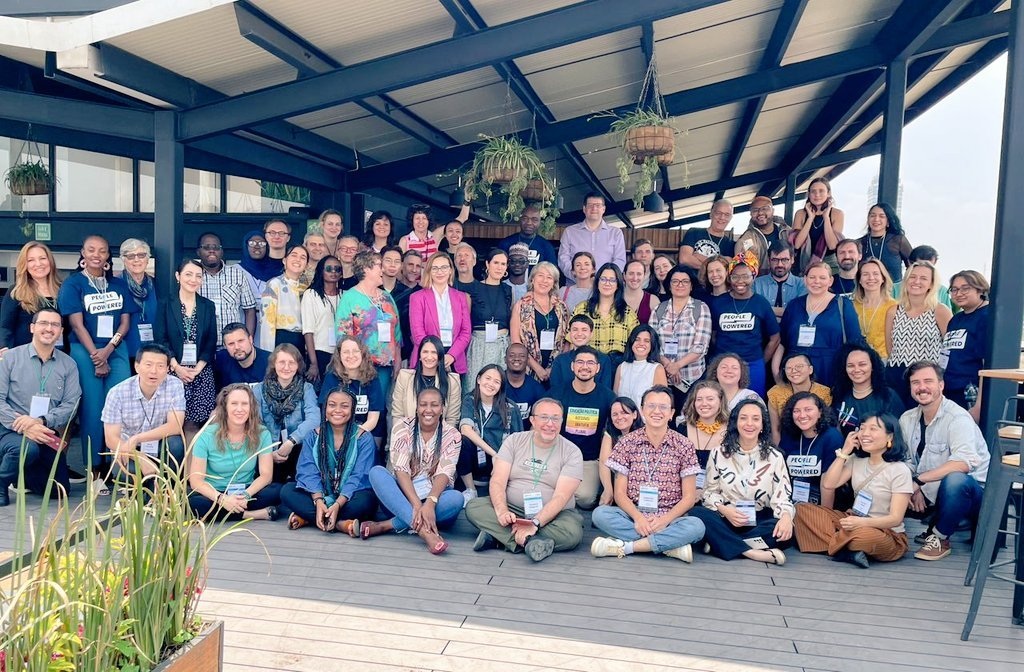
Its predecessor, the Global Participatory Budgeting Hub, began in 2019 under the fiscal sponsorship of the US nonprofit Participatory Budgeting Project. In 2020, 58 democracy practitioners from 28 countries helped decide the broader organization’s mission, values, name and priorities. People Powered launched that July.
The expansion mattered. Budgeting was one route into public power; communities also needed help with policies, planning and deliberation. The organization’s original Global PB Hub described recurring problems including limited participation, laborious coordination and slow delivery of winning projects. Getting people to vote on an idea did not guarantee that anyone would build it.
That history explains its place in the market. People Powered supplies shared expertise to a field whose implementers are often small organizations and public servants. Democratic Society and other participation specialists also design and facilitate processes. People Powered’s distinctive combination is a global membership community, reusable public resources and support for the people implementing programs locally.
A choose-your-own-adventure for public decisions
The Participation Playbook is its most tangible invitation to begin. Publicly launched in September 2023, the free online guide asks users about their needs and helps them develop a personalized plan. People Powered built it with 60 partners, translating practitioner knowledge into questions and options.
A user can work on participatory budgeting, in which residents decide how to spend a portion of public money, or a citizens’ assembly, where a representative group learns about an issue and develops recommendations. Legislative theater gives communities another way to identify problems and develop support for policy changes. The methods ask different things of organizers and participants.
The tool’s authors had to learn a new vocabulary themselves. When consultants talked about software wizards, legislative theater specialist Katy Rubin recalled asking: “Wizards?! Where are the witches then?” Turning experience into branching questions proved more demanding than writing another report.
“Wizards?! Where are the witches then?”
Katy Rubin, Participation Playbook contributor
Testing exposed a real design problem: some users wanted less information while others wanted more. Rubin found the choices could feel overwhelming. The team’s response included pairing the Playbook with mentorship. Contributor Rocío Annunziata also described adjusting expectations after seeing contexts where participation could initially be advisory rather than binding. Practice complicated the preferred model.
The guide comes with people
Rising Stars, the mentorship program, matches advocates, policymakers and program managers with experienced practitioners. Matching considers the participation method, language, location and challenge. The current offer provides up to five calls over six months. A civil servant can bring a specific implementation problem instead of searching an entire literature for a comparable case.
The accelerators add a more structured cohort experience. Participants work with mentors, take training, learn from peers and develop action plans using the Playbook. Different programs address climate policy, inclusion, digital governance, youth participation and embedding participation across institutions. Selected participants can also receive implementation funding.
The digital resource center tackles another expensive decision: choosing software. Its ratings cover 30 participation tools, assessed across six sets of criteria, including AI use. Accompanying guidance considers buying an existing service, adapting open-source software or developing a tool. That breadth makes the resource useful before a team commits to a vendor.
An illustrative pathway through the resources and support, not a universal program sequence.
Training goes beyond operating a platform. Courses cover outreach, user support, accessibility and combining online tools with in-person activities. Other courses address barriers faced by women, young people and displaced people. Custom training lets partner organizations build learning around a particular group’s needs.
The drains were there. The waste still blocked them.
A project in Semarang, Indonesia, shows why local knowledge matters. People Powered’s June 2026 account describes repeated coastal flooding despite public investment in drainage. Maintenance problems and inadequate waste management left drains blocked. The policy’s apparent subject was water; residents also needed officials to pay attention to garbage.
PATTIRO Semarang joined the climate accelerator, developed a social-audit plan and received seed funding. After securing government engagement, it trained community and civil society representatives and consulted 60 residents, including members of households headed by women. Officials subsequently committed to increasing waste-management spending. The reported result is a budget commitment, not proof that the flooding ended.
This is the division of labor worth noticing. PATTIRO brought local relationships and governance experience. People Powered supplied additional climate knowledge, mentoring and planning support. The work depended on a local organization able to bring residents and officials into the same process.
The price of putting participation into practice
For the 2026 climate accelerator, the published offer is six months of support and a $10,000 implementation grant after program requirements are completed. Five top action plans can receive another $15,000. The grant goes to an eligible nongovernmental organization; government applicants need a civil society partner.
The application deadline was July 3, with onboarding scheduled for September. Applicants needed an established organization, financial documentation and a government partnership, among other requirements. The funding supports implementation of a planned participatory process. It is neither an unrestricted personal award nor the full cost of a community’s climate transition.
Implementation grant after requirements are completed; additional award for five top action plans.
People Powered finances its own operations through grants, contracts and donations. Membership contributions are voluntary: suggested annual organizational amounts range from $50 to $500, depending on budget, while individuals are invited to contribute $10 to $150. Ability to pay is not a membership requirement.
In February 2023, three foundations announced roughly $3 million of support. Waverley Street Foundation committed nearly $1.8 million for climate work over three years, Open Society Foundations provided $700,000 for digital policymaking, and Hewlett renewed support with $500,000. These were grants for nonprofit work, with purposes and time horizons attached.
The US entity’s 2024 tax filing records $954,953 in revenue and $2,306,817 in expenses. It finished the year with $950,218 in net assets. Those figures describe one entity and accounting period; the annual gap alone does not establish why spending exceeded recognized revenue or the organization’s present financial position.
Reported annual totals. Bars share a common scale.
Members get a vote on the money
People Powered also applies participation internally. Members propose ideas, refine spending proposals and vote on projects for a shared funding pool. The funding page reports $705,000 allocated to prioritized projects. These allocations are a specific pool, separate from total organizational spending.
In September 2026, the organization described exporting that experience. With Digidem Lab, it helped the European Partnership for Democracy design YDC Participates for the Youth Democracy Cohort. The process used Decidim to gather ideas, develop proposals and let members choose priorities.
The practical lessons were refreshingly mundane: learn the platform before launch, start outreach early and leave more time for proposal development. The intermediate work of turning an idea into something others can vote on needed attention. A vote at the end could not compensate for a hurried process beforehand.
An invitation needs somewhere to lead
There are limits to the model. A 2022 study of People Powered identified barriers including uneven internet access, restrictions on digital tools, complicated visas and English’s dominance in discussions. An international network can reproduce the exclusions it wants to address unless those practical obstacles receive sustained attention.
The wider lesson for someone copying this approach is to begin with a decision that can actually change. Clarify who has authority, recruit people affected by the issue, budget for facilitation and establish what happens to the outcome. A process with no route into implementation risks asking participants to spend their time on a promise.
People Powered is now applying its own lessons about continuity. Founder Josh Lerner stepped away from executive leadership in July 2026 to write a book, with Greta Ríos continuing as Executive Director. The organization reported more than 300 members that month. Its next chapter will be tested in the plans those members carry home, the officials willing to act on them, and the people who finally get a turn to speak.
Open the toolbox
Start with the Participation Playbook, explore Rising Stars mentorship, or visit the People Powered website and newsroom.
Watch the Participation Playbook launch and demonstration or browse People Powered on YouTube.