A mentor is a peculiar product. The best ones give away the thing you cannot manufacture: their time. Everwise, the workplace development company founded in 2013, asked volunteers to spend roughly ten hours over six months with a rising professional. The fee paid for everything around those hours - finding the right person, making the introduction, setting goals, keeping both people engaged, and telling an employer whether the arrangement worked.
- Everwise sold employers structured mentoring for employees and managers.
- Its managed program cost about $1,800 per mentee, according to its product team.
- Customers wanted a less expensive way to run larger programs themselves.
- By May 2019, software had reportedly grown from 33% to 70% of Everwise revenue; the company joined Torch in 2020.
That price had a certain logic. In the early service, a participant completed a questionnaire, drew on a LinkedIn profile, spoke with Everwise staff and received a match from outside their company. A relationship manager checked in as the pair worked through a six-month advisory cycle. Matching was only the opening move. Anyone who has watched an earnest coffee meeting become a cancelled calendar invitation knows why the follow-up mattered.
The customer was usually an HR or learning team. The user was an employee newly managing people, seeking a promotion, or trying to navigate a workplace that offered plenty of training material and too few frank conversations. At launch, employers including Hewlett Packard and Direct Energy paid for their people to use the service. Later customers included Gilead Sciences, Best Buy, T-Mobile, Zendesk and Genentech. Everwise was selling access to judgment as much as it was selling software.
A matchmaker with a clipboard
Co-founder Mike Bergelson had his own reason to care. Earlier in his career, a promising mentoring relationship at Cisco ended when the mentor left. In later interviews he recalled how useful an experienced sounding board might have been while he fought internal battles. With Maynard Webb, he built Everwise around the premise that people should not have to wait for a lucky introduction.
The first product resembled a matchmaker with a clipboard. Everwise used profile information and questionnaires to identify complementary experience; staff screened and supported the people involved. Mentors volunteered. Many came from different firms and industries, which meant a participant could ask questions without turning every conversation into office politics. The company described its matching method as informed by experience with tens of thousands of mentoring relationships. Its own 2013 pitch charged about $150 per month per protégé.
“We think people are accountable to people, not to software.”Mike Bergelson, Everwise co-founder, 2015
That sentence is the useful tension in the business. An app can introduce two people and remind them to meet. It cannot tell a new manager, with any conviction, that a difficult conversation with a colleague should happen tomorrow. Everwise's human staff filled that gap. Their presence also made a large rollout expensive. At $1,800 per mentee, a 100-person program implied $180,000 before anyone counted the employer's own time.
The price of making it repeatable
By late 2015, Everwise had widened the experience beyond one-to-one mentoring. Participants could receive curated books and talks, join peer groups, set development goals and track their progress. Some employers licensed the software to run programs themselves. A reported 100 companies used Everwise that year. In 2016, the company raised a $16 million Series B led by Sequoia Capital and presented a broader learning platform; it said its mentor community spanned 70 countries and 170 industries.
The decisive product brief came from customers who liked the outcome but could not justify the managed program for large populations. Sasha Tamarina, a design lead on Everwise's mentoring software, described the problem plainly: the service was valuable, yet $1,800 per mentee limited scale. Employers wanted to operate the program themselves at a lower price. That request changed the shape of the company. Instead of only finding mentors, Everwise had to package the backstage work so an HR manager could perform it.
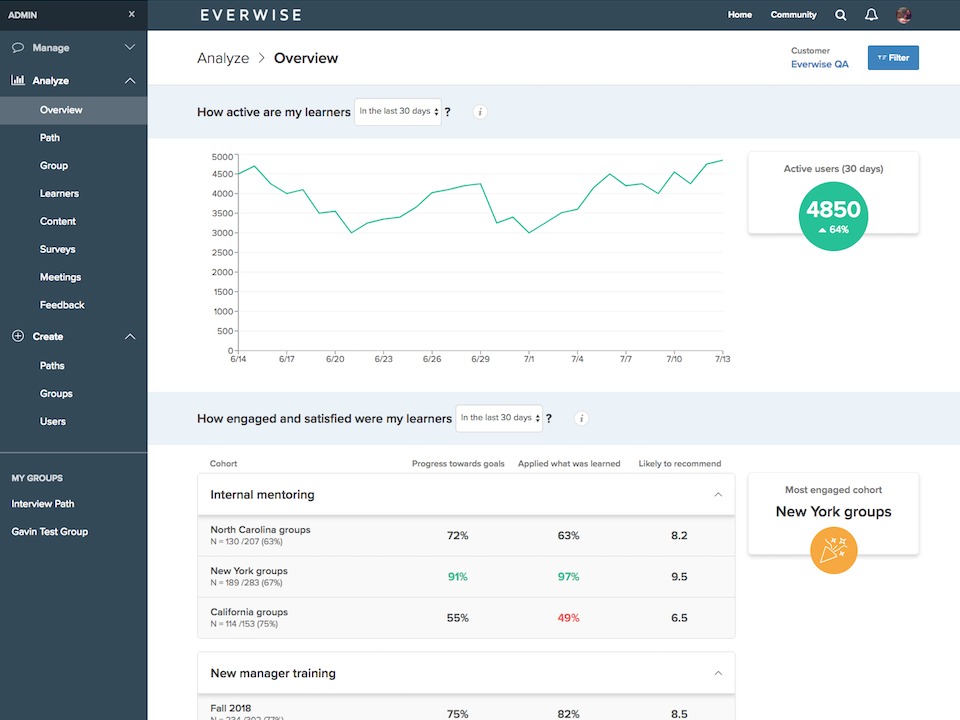
The software team did not merely remove the concierge. It built choices. Administrators could approve matches, let mentees express preferences, or permit self-matching. They could run multiple cohorts against a shared pool of mentors. They could set up programs, view participant histories and check progress reports. Each feature answered a fairly unromantic question from an actual buyer: Who belongs in this intake? Which mentors are available? Has anybody met? The questions were mundane. At enterprise scale, mundane is where the budget goes.
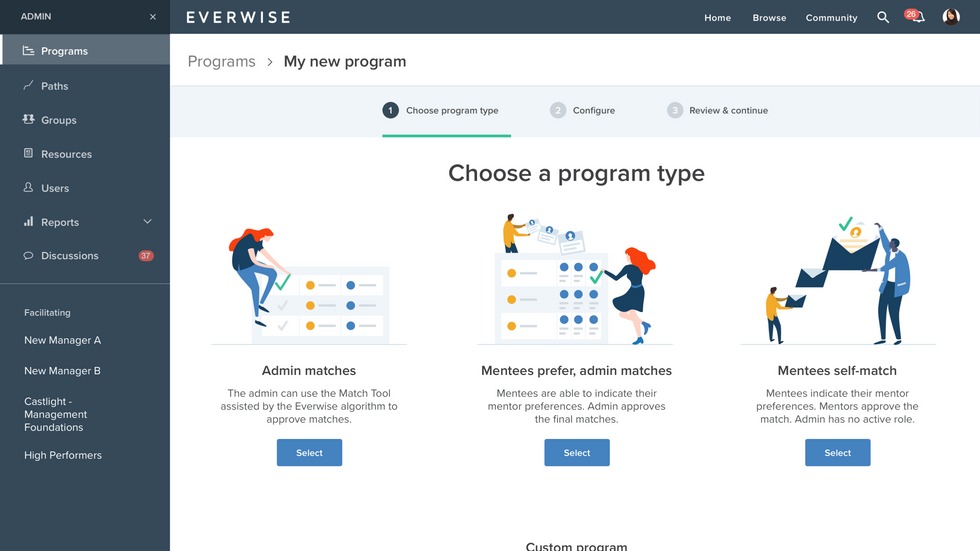
Tamarina reported that software's share of revenue rose from 33% to 70% by May 2019. The figure says more about the company's change of operating model than it does about its total size. It shows that employers bought the machinery. It does not tell us whether every mentee got a better conversation. That distinction matters when the product is a relationship.
The outsider advantage
Everwise had a particular use for its network beyond generic management training. EverwiseWomen paired midcareer women with mentors at other companies and added peers, events and learning resources. The separation was deliberate: participants could discuss ambition, uncertainty or office dynamics without the awkwardness of a colleague overhearing at the cafeteria table. In 2016, Sequoia noted that the program had worked with more than 40 companies since its launch the previous November.
Sequoia later used Everwise in Ascent, a program for technical women at portfolio companies. The first class matched 50 women with 50 senior mentors elsewhere; the next doubled the total participant pool. The program included peer groups and events, and Everwise staff checked in with pairs. It was a good demonstration of the company's distinction: the relationship was external, while the structure was designed for an employer's specific group.
There were alternatives. A company could build an internal buddy scheme, buy a learning platform, hire executive coaches, or use specialist mentoring software. Everwise occupied the middle: more guided than a directory, less costly than giving every rising employee a private coach. Its early pricing reportedly ranged from $10 to $40 per user annually for basic software modules to roughly $150 a month for the higher-touch offering. Different buyers could purchase different amounts of human help.
Two ends of the same ladder
In March 2020, Everwise merged with Torch and the combined business took the Torch name. Torch brought executive coaching; Everwise brought mentoring, digital learning and a community of more than 6,000 mentors. One had gone deep with senior leaders. The other had learned to spread support farther through a workforce. Joining them made strategic sense without requiring a claim that every employee needed the same kind of help.
The funding record is easy to muddle because the names overlap after the merger. Everwise's reported financing included an $8 million Series A and a $16 million Series B. Torch's $25 million Series B in February 2021 belonged to the combined company under the Torch name. A profile that folds that later round into Everwise's independent history tells a neater story than the facts permit.
The part worth copying is the sequence. Begin with a service that reveals what actually keeps a mentoring relationship alive. Ask buyers which parts they need to control. Turn those repeatable operations into software: matching rules, cohorts, shared pools, check-ins and reports. Keep an option for human support where the conversation is sensitive or the stakes are high. This approach depends on willing mentors, a clear program owner and time for relationships to develop; a dashboard cannot supply those ingredients on its own.
Everwise's best insight may be that access to advice has two costs. The first is the mentor's time. The second is the work of making that time count. The mentor may volunteer. The machinery still has to be built.