A piano on a beach is an invitation to practical objections. There is sand. There is salt. There is the small matter of getting the instrument there. Murray Hidary had imagined a concert on Santa Monica Beach, but a 700-pound piano and an ocean breeze were hardly natural business partners. Then there was the audience. How would anyone hear the quieter passages without turning the shoreline into a public-address system?
His solution was an electric grand piano and wireless headphones for everyone listening. The music could arrive directly in each person’s ears while the beach remained a beach. An additional benefit, he later explained, was easier park permitting. The sublime occasionally depends on a municipal application.
It is a useful scene through which to understand Hidary, a composer who has spent much of his working life building companies. He spots a desired experience, encounters an awkward delivery problem, and starts rearranging the equipment. At iAmplify, where he was co-founder and CEO, that equipment helped authors and publishers distribute paid recordings. At MindTravel, his ongoing musical project, it allows an audience to sit together without being confined to rows.
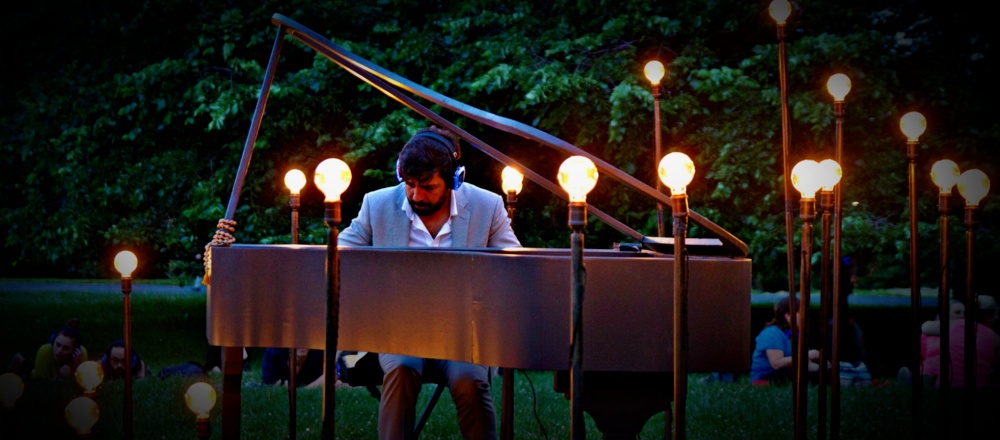
From outside the headphones, a performance can look puzzling: a pianist playing for people who appear to be enjoying the quiet. For the participants, the arrangement makes immediate sense. They can listen closely and still look at the sky. The concert has acquired something most concerts ration carefully: permission to move.
Before the piano went public
Hidary grew up in Brooklyn and started playing piano at five. By high school, he wanted to compose. He went on to study music and composition at New York University. The business career that followed did not require him to acquire a musical interest later. The music was already there, waiting through the meetings.
His family supplied a separate education. His father worked with his brothers; Murray would eventually work with his older brother Jack. In 2011, he recalled selling clothing at flea markets in Brooklyn and Queens at fifteen, earning hundreds of dollars on Sundays and learning how a negotiation actually feels. A customer declining a snowsuit is a fairly clear performance review.
At eighteen he also took time away from NYU to travel by bicycle through countries including Thailand, Malaysia, New Zealand and Australia. Years later, he would describe the trip as an education in handling unfamiliar circumstances. There is a connection between the bicycle and the outdoor piano: both make the world harder to ignore.
In 1994, Hidary co-founded EarthWeb with Jack and Nova Spivack. The company worked in the young commercial internet and developed into an information business serving technology professionals. On November 11, 1998, it went public on Nasdaq. The flotation placed the brothers inside the era’s exuberant experiment in giving new internet businesses a public price.
The familiar career summary would put a dividing line here: technology first, art afterward. His chronology refuses to cooperate. Composition continued alongside entrepreneurship. The question was how much space each pursuit would get, and what one might teach him about the other.
co-founded
IPO
gathering
at MASS MoCA
An audience beyond the book
With Vista Research, co-founded in 2001, the brothers worked on another kind of connection: bringing industry expertise to investment professionals. Standard & Poor’s acquired the business in 2005. iAmplify then addressed a more audible problem. Authors, experts and media companies had knowledge and audiences. They needed a way to sell and deliver recordings across the web and onto portable devices.
The platform combined publishing, payment and distribution. A provider could offer a subscription, individual downloads or packages, and sell through a branded store or an embedded widget. Photon was the technology partner behind its Media Factory platform. The names involved included HarperCollins and Martha Stewart’s media business. Hidary’s job was to make a commercial route between the person speaking and the person prepared to listen.
In March 2006, he demonstrated iAmplify’s publishing tools on a panel alongside Brightcove founder Jeremy Allaire, Meetup co-founder Scott Heiferman and Myspace executive Shawn Gold. The discussion concerned the changing role of producers as people gained tools to create and distribute their own material. These were practical questions about who could reach an audience, who controlled the transaction, and where the money would come from.
By 2007, an audiobook industry program listed him on a panel called “New Ways to Reach Listeners.” The title could almost serve as a recurring appointment in his diary. The devices and business arrangements would change; the listener would remain.
That history gives MindTravel an interesting antecedent. Hidary had already worked on taking recorded voices out of fixed formats and delivering them where people wanted them. Later, he would take a live performance out of its fixed seating plan. Across these ventures, he kept working on a route between a creator and someone ready to listen.
A concert with an exit from your chair
The first MindTravel gathering took place in his living room in 2013. He invited people to hear his improvised piano compositions and asked afterward about their experience. Their responses encouraged him to take the idea further. The scale was domestic; the essential arrangement was already present. A musician would make something in real time, and listeners would bring their own associations to it.
The outdoor format followed. A first silent concert on Santa Monica Beach in 2014 gave the concept a setting that could change around the music. Today, people attend with blankets or chairs, but neither is a binding agreement. They may stand, lie down or walk while continuing to listen. The pianist stays at work; the audience gets some latitude.
“It feels like I’m playing just for you,” Hidary has said. That is the peculiar bargain of the headphones. Each person receives a close, individual sound while remaining visibly among other listeners. Someone walking a short distance away has changed their view without leaving the performance.
The music is improvised rather than a repeated program delivered identically each night. Hidary responds to the moment and the surroundings. A sunset is therefore more than a picturesque place to put a keyboard. It gives the performance an external clock, a changing field of light, and an audience looking at something besides the performer.
He has also described the less visible work that keeps this happening. Producer Joanna Bowzer has been a longstanding collaborator across his endeavors; he has credited her with balancing his weaknesses through her strengths. The public image may be one person at a piano. Getting that person, instrument and listening equipment into place is a collaborative occupation.
“It feels like I’m playing just for you.”
Murray Hidary
Sixty players, twelve points on a clock
His composing extends beyond the outdoor solo format. For Distanced Together at MASS MoCA in January 2023, he arranged sixty musicians into twelve string quintets around a circle. Audience members could move around and through the ensemble. David Bloom directed the live performance, which brought members of Contemporaneous together with musicians from the North Adams area.
The arrangement resembled a clock. Instead of accepting a single acoustic perspective from a numbered seat, listeners encountered different parts of the score as they moved. The room made a proposition about hearing: your position affects what comes forward. Two people can occupy the same work and have different accounts of it afterward.
When the live players departed, sixty speakers could take their places, each carrying a musician’s part. The installation preserved the relationship between a moving listener and a distributed ensemble. It also returned Hidary to an old professional preoccupation: how an experience travels after its original makers have left the room.
Photography supplies another route into his musical thinking. As a teenager, he received a camera as a graduation present and imagined working for National Geographic. He later recalled photographing a tree at the Brooklyn Botanic Garden with an interest in conveying how it felt to look at it. Recording its appearance was only part of the ambition.
His abstract photographs also feed the projected imagery in indoor MindTravel performances. Algorithms animate and combine the images in response to live music. Sound, image and software occupy the same piece. A background in internet businesses seems rather less incongruous when the piano is accompanied by a responsive visual system.
This is where the labels start to become cumbersome. Entrepreneur, photographer, composer: each describes work he has done. None quite explains why the work keeps crossing into the next room.
12 quintets.
5 players each.
One moving audience.
MASS MoCA, January 2023
The next place to put a piano
Hidary’s musical credits include the score for REM, Tomas Koolhaas’s documentary about architect Rem Koolhaas. His work has also entered Miami’s Frost Planetarium, where an immersive production continued into a six-month residency. The settings invite different kinds of attention: a film directs the eye, a dome surrounds it, an open-air concert lets it stray.
His current plans include an opera based on Hermann Hesse’s Siddhartha. It is a fitting project for a musician drawn to questions about how a person decides what matters. An opera also promises an altogether different set of practical complications from a headphone concert. There will be more voices to accommodate.
Meanwhile, the touring continues. The published November 2026 calendar moves through California, Arizona, Texas and Florida, including Encinitas, Santa Monica, Tucson, Phoenix, Houston and Austin. The next performance is still a date, a location, a collection of equipment and a group of people deciding to turn up. Any philosophy attached to the evening has to survive those arrangements.
The MindTravel Foundation supports access for people facing financial barriers. Its public program includes pay-what-you-can concerts. That detail matters to the form: an invitation to gather has a different meaning when the price leaves some room for circumstances. Access is another design choice, alongside where to place the piano and how to carry the sound.
Hidary’s official mission for MindTravel is to move people toward greater purpose through music. That is a large ambition for an evening with a keyboard. Its more tangible expression is modest enough to picture: give people time, make the listening clear, and allow them to decide what to do with the experience.
The beach problem was solved by putting the sound into headphones. The more enduring decision was to let the listeners wander. After years spent helping information find its audience, Hidary has built a performance in which the audience can go looking for its own view. He supplies the music. There is still room to choose where to stand.
Keep listening
Performances, photographs and the next gathering.