A publisher wants to take its books to China. It sounds like a translation assignment. In Magic EdTech’s account of one American PreK-12 publisher’s expansion, the actual assignment included a bilingual platform, offline access, local data requirements and an AWS China deployment. The book was only one item in the suitcase.
- Magic Software Inc. sells specialized technology services and software to education and financial-services businesses.
- MagicBox lets publishers distribute learning content under their own brand.
- Its useful lesson: design for the journey from finished content to actual use.
That gap between having something valuable and making it usable is a good place to understand Magic Software Inc. Its education business, Magic EdTech, works on the content, platforms, accessibility and integrations behind digital learning. The parent also points to Magic FinServ, which tackles financial software and structured and unstructured data. Different customers; a related practical problem.
01 A textbook needs a passport
The China engagement makes the work unusually concrete. Magic customized its proprietary MagicBox platform to carry the publisher’s branding, supported Mandarin and English, and used infrastructure in China. Online and offline delivery were both requirements. It also created a revenue-sharing arrangement. The assignment joined product design, deployment and commercial terms.
Magic reports testing more than 80 apps and 100 eBooks, alongside a 30% year-over-year cost reduction. Those are the vendor’s figures for this engagement. They describe one project’s results; they do not establish a standard saving for every publisher.
Online + offline
Rights + access
The transferable idea is straightforward: treat the destination’s requirements as part of the product. Translation alone would have left hosting and access unresolved. A reusable platform helps when it can accommodate those conditions. When it cannot, the remaining engineering work belongs in the buying decision.
02 The name behind the publisher’s name
MagicBox occupies an interesting position in the classroom. A learner may encounter a publisher’s identity while using software supplied by someone else. White-label delivery allows the publisher to retain that relationship without building every component itself.
The platform combines eBook distribution, licensing, digital rights management, assessments and analytics. Its eBook offering supports offline downloads, notes and highlighting, with multimedia content and access across different devices. The buyer gets a system for delivering a catalog. The student gets a book that opens.
Magic’s product page reports more than seven million MagicBox users and names customers including Encyclopaedia Britannica, Human Kinetics, Savvas Learning and Larson Texts. In a separate digital-library case study, Magic describes converting reading titles to ePub3 and delivering three customized mobile and web apps for more than 500,000 users.
The competitive argument is about assembly. A publisher can commission software, connect separate tools, or buy a configurable platform. Magic’s proposition combines an existing product with people who can adapt it. Whether that reduces effort depends on how closely the buyer’s requirements match what is already built.
Consider what the publisher keeps: its catalog, its branding and the customer-facing experience. What it buys is the machinery around that catalog. This division matters because a publishing team can know exactly what it wants learners to read while needing outside help to deliver it across school systems and devices.
03 Software, with people attached
This is a business-to-business operation. Publishers, education companies, districts, universities and workforce-learning teams are customers; their learners use the resulting experiences. Magic EdTech also sells engineering, content production, accessibility and testing services. The software and the services can address different parts of the same delivery problem.
Its current portfolio extends that approach. MagicSync connects learning systems, rostering and single sign-on. EdDataHub brings education data into a managed foundation in the customer’s cloud. FlexPro supplies specialist talent for learning projects. Those offerings sit beside MagicBox rather than asking one application to do everything.
MagicBox’s commercial page asks buyers to request a quote and ties packages to selected capabilities and active user numbers. That makes feature selection and expected usage meaningful purchasing decisions. A sensible evaluation would include content migration, branding, integrations, hosting and ongoing support in the scope being priced.
“My only hesitation in endorsing Magic is that I want them all to myself!”
Jay King, StudySync COO
Customer testimonial published by Magic EdTech
Solmark’s involvement helps explain the product-and-services combination. In October 2014, Magic announced an investment and operating partnership with the fund. Founder Vimalendu Verma described plans to increase product development and expand in North America and Europe. The parent website now states that Solmark owns the company fully.
04 A school made entirely of test data
Another engagement reveals the detail behind the expertise claim. A higher-education analytics company needed realistic student-information and learning-management data for development and demonstrations. Actual institutional records required approvals. Generic mock data failed to reproduce important relationships, identifier mismatches and uncommon outcomes.
Magic’s response was to specify the required entities and relationships, generate connected synthetic data, and validate the results. It reports provisioning a 10,000-student institution with more than 500,000 records in approximately two minutes, without processing real student records in that generation environment.
used in the synthetic generation environment described in Magic’s case study.
The reusable lesson is the sequence: define what realistic means before generating data, then make validation a condition of the build. The approach depends on a faithful specification. Incorrect assumptions would simply produce repeatable mistakes faster. Teams still need to establish how well the synthetic environment represents the systems they intend to support.
That same attention to relationships appears in Magic’s usage-reporting work. For an educational reference publisher, it traced measurement through collection, processing and account attribution. The audit identified logic affecting more than ten million events. Its proposed roadmap used the client’s existing Databricks and Power BI stack. The recommendation focused on making existing measurements trustworthy before adding another analytics platform.
05 More AI, same delivery problem
Magic’s newer direction includes AI-assisted learning and content workflows. It announced Google Cloud collaboration in April 2024 and an AWS partnership that September. Its MagicBox promotional interface shows question generation alongside captioning, summaries and evaluation tools.
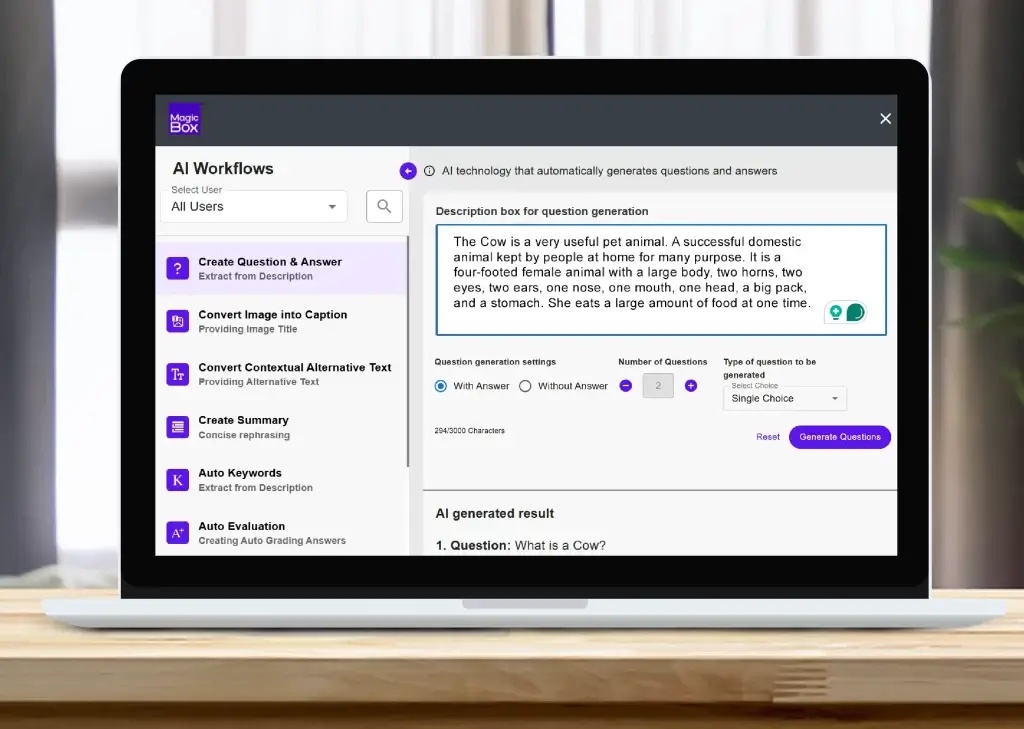
In September 2026, MagicBox announced a Tech & Learning Back to School award in Secondary Education. Recognition supplies a useful marker of activity. A buyer still has to establish whether the product fits its content, users and delivery requirements.

The next sensible step is a demonstration using the buyer’s own material and an awkward real-world constraint: an offline reader, an existing roster, a difficult content format. That is where Magic’s proposition becomes testable. The textbook has somewhere to go. The software has to get it there.