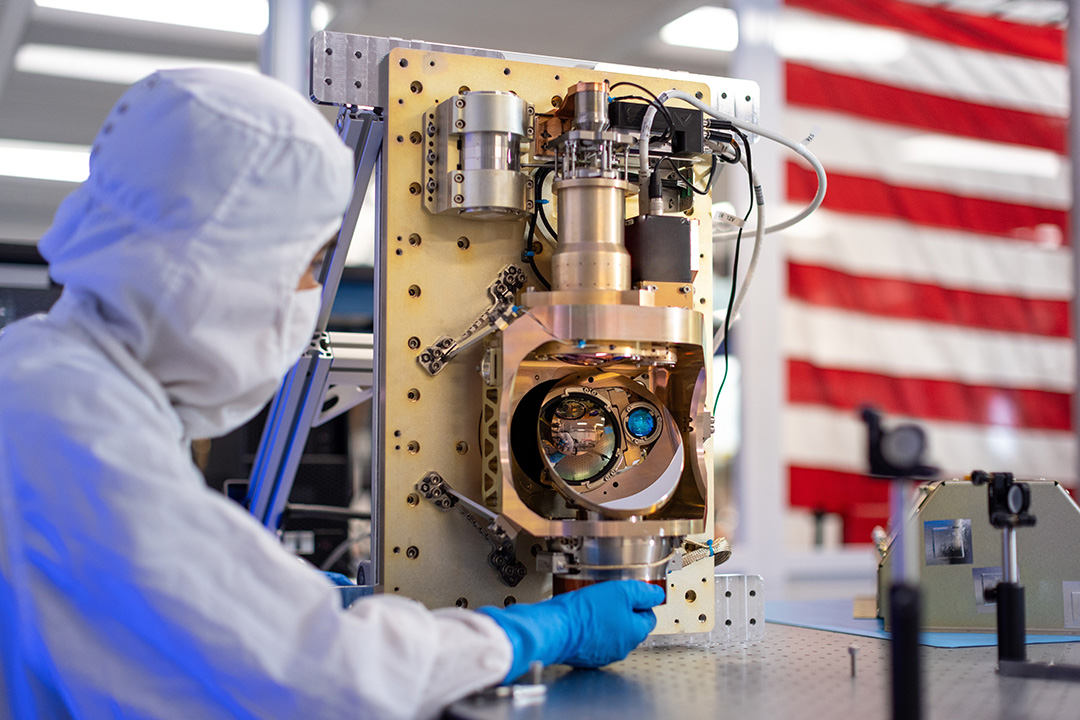
It is just past sunrise in California, and somewhere over the Pacific, a refrigerator-sized box is taking the temperature of the Earth. Pixel by pixel. Every twenty minutes. The box belongs to a five-year-old company in Mountain View. The box is named FireSat. The company is named after a subatomic particle.
This is Muon Space at work - quietly, from low Earth orbit, doing the kind of thing aerospace used to take fifteen years and a Senate appropriations bill to attempt. The team is about 210 people. The cleanroom is off Charleston Road. The mission is unglamorous and enormous: build satellites that produce data the rest of us can actually use, faster than anyone thought possible, for problems no one is going to solve from the ground.
The problem they saw
Earth observation is a strange industry. We have spent sixty years putting cameras in orbit, and the data they return still arrives late, expensively, and via institutions that were not built for urgency. A wildfire in Oregon does not care about your revisit rate. A typhoon does not wait for a tasking committee. By the time most satellites notice something is on fire, the news helicopters already have.
The founders of Muon - Jonathan Dyer, Dan McCleese, Pascal Stang, Reuben Rohrschneider - had each spent a career watching this gap and being, by their own polite admission, mildly annoyed by it. Between them: thirty-plus remote sensing missions at JPL, Skybox Imaging, Ball Aerospace, Loft Orbital, Apple, Google. They had built the satellites. They had watched the data arrive too late to be useful. They had seen, with the special clarity of people who have done it the slow way, exactly how the slow way could be sped up.
The founders' bet
The bet, when they made it in 2021, was unfashionable. Build the entire stack. Not the bus and outsource the payload. Not the payload and rent a bus. The entire vertical: spacecraft, software, simulation, operations, data pipeline. Sell it as a single thing. Call it a mission.
Aerospace orthodoxy says this is how you go bankrupt. Software orthodoxy says it is the only way to ship anything good. Muon - founded in Silicon Valley, staffed by people who had worked at both kinds of company - chose the software answer and bet that the rest of the industry would, eventually, follow.
The product
The thing Muon actually sells is called Halo. Halo is a platform - and "platform" is the kind of word that makes a defense reviewer narrow their eyes, but in this case it is accurate. It bundles four things that, in legacy aerospace, would be four separate contracts with four separate primes.
First, MuSat: a modular spacecraft bus that scales from sub-ESPA class up through 500 kg, kW-class missions. (Translation: small, medium, large, all running the same plumbing.) Second, MuSat XL: the new 500 kg bus, announced in 2025 with Hubble Network as the first customer. Third, MuOS: a data-centric onboard middleware that lets the satellite run software the way a Kubernetes cluster does - swap payloads, route data, do compute at the edge of the atmosphere. Fourth, MuSim: a digital twin where the whole constellation gets rehearsed before anyone bolts a real screw to a real flight unit.
It is, in other words, a stack. Aerospace people call it integration. Software people call it Tuesday.
Milestones / The first five years
The proof
A satellite startup can claim almost anything until something is in orbit. Muon has been quietly losing the right to be doubted. MuSat-2 went up in March 2024. MuSat-3 followed in August. The FireSat Protoflight launched in March 2025, and three months later released first-light imagery: urban heat islands in Sydney, lava fountains at Kilauea, a gas flare at Sarir, and a small fire in Oregon that no other satellite had noticed.
The funding tells the same story. The pattern is the one investors like to see and rarely get: each round larger, each round oversubscribed, each round adding strategics rather than just chasing FOMO.
Funding by round / cumulative climb
From seed to Series B extension - the slope investors describe as "the right kind."
Sources: Muon Space press, Crunchbase, PitchBook. Bar widths scale to the largest round.
Then came October 2025, and the $44.6M Space Force SBIR Phase III OTA - the kind of contract that takes the climate-startup label off your back and adds a defense-prime label next to it. The same Halo platform, the same FireSat-derived infrared payload, now repurposed to serve DoD meteorology and oceanography. Three more spacecraft. Operational by 2027.
The mission
It is tempting to describe Muon as a climate company. It is also tempting to describe it as a defense company. Both are correct and both are slightly off. The truer description is duller and more interesting: Muon sells continuous, high-quality knowledge of the planet. What you do with that knowledge - put out a fire, route a Navy ship, plant a windbreak, evacuate a county - is the buyer's problem.
Earth Fire Alliance and Google.org want it to spot wildfires. The Space Force wants it for environmental intelligence. Hubble Network wants it for connectivity. The interesting trick of Muon's platform is that it does not have to choose. The bus is the bus. The middleware is the middleware. The instrument swaps.
Why it matters tomorrow
Climate change is, among other things, an observation problem. We cannot manage what we cannot see, and for most of the planet, most of the time, we cannot see. The forests of central Africa burn unmonitored. The methane plumes of Turkmenistan vent unmeasured. The ocean warms in places no buoy floats. Muon's bet is that this is fixable, and fixable by the same kind of small, fast-moving, vertically integrated team that fixed search and payments and ride-hailing.
The defense bet is the same bet, dressed for a different meeting. Adversaries also benefit from poor observation. Allies also want better data, faster. The technology is dual-use because the planet is dual-use - the same atmosphere holds the storm and the satellite.
Sunrise, again. The refrigerator-sized box is still over the Pacific. A small fire flickers near a logging road in Oregon. Sixty seconds later, on a server in Mountain View, a first responder gets a ping. Five years ago, this did not happen. Now it does, every twenty minutes, all day long. Muon Space built the box. The box does the rest.