The most revealing object at Mount Rushmore may not be a sixty-foot face. It may be a receipt. Buy a history book, a presidential bobblehead or a rental audio tour, and a sliver of that transaction begins a quiet trip back into the place you came to see. It can reappear as a seasonal ranger, a Junior Ranger booklet, a Lakota cultural program, a theater seat or a rope technician inspecting granite above George Washington's eye.
That loop belongs to the Mount Rushmore Society, a Rapid City nonprofit created in 1930 while the sculpture was still under construction. The Society is neither the National Park Service nor an ordinary souvenir operator. It is the connective tissue between them: a fundraiser, retailer, publisher, event producer and patient source of capital for jobs government budgets do not always reach.
The business hiding behind the postcard
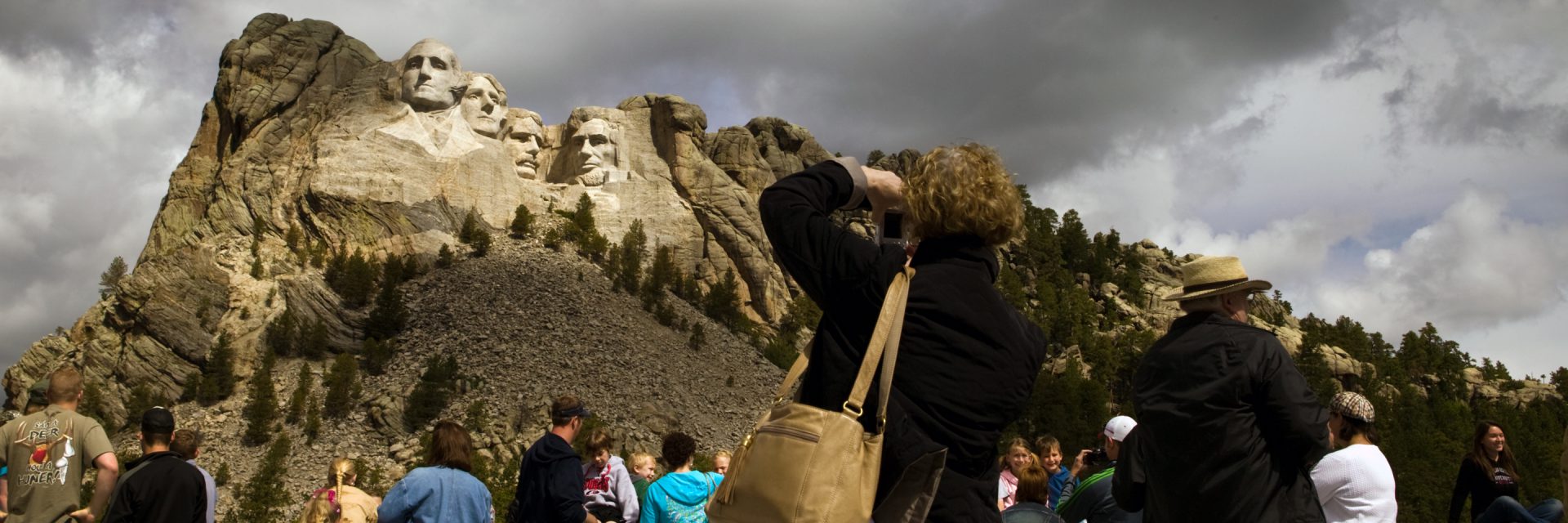
The Society's customers are tourists, online shoppers, donors, members and gala guests. Its users are broader: everyone who benefits from a better visit. In 2025, more than 1.8 million people came to the memorial. The Society says its stores and website served more than 86,000 guests and sold 225,000 items. Gross retail sales reached $1.5 million, with more than $950,000 generated through retail to support the mission.
The audited picture is more textured. Total 2025 support and revenue was $4.02 million: $964,098 in contributions, $931,014 in net educational and product sales, and $2.07 million in investment return, plus smaller event, rental and membership lines. This is not a charity waiting for one annual check. It is a portfolio of cash flows attached to a single place.
The products are unusually literal. A $6 audio tour mixes narration, interviews, music, sound effects and archival voices. An $8 multimedia version has 29 GPS-enabled stops, images and video. It is translated into Spanish, German, French and Lakota, includes audio description for visitors who are blind or have low vision, and folds in a Junior Ranger game. The store sells objects. The better product is context.
A parking garage with a very long fuse
The Society's real specialty is time. In the 1950s, it repaid more than $750,000 in congressional appropriations used for visitor facilities. In 1989, a $2 million state matching challenge helped launch a nationwide preservation campaign. The Society raised $25 million; the resulting redevelopment totaled $56 million. Its largest single piece was a $17 million parking facility. The nonprofit financed it, operated it for 20 years, and transferred it to the Park Service debt-free in 2016.
This arrangement solves a recurring public-land problem. Federal agencies must plan through appropriations, contracts and staffing rules. Visitors do not arrive on a congressional timetable. The Society can raise restricted gifts, stock stores, host events and accumulate credibility between capital campaigns. The Park Service supplies authority and professional stewardship. Each side does what the other cannot do quickly.
“Because partnership filled the gaps.”
In 2025 those gaps were literal. The Society reported that staffing at the memorial fell 40 percent during a hiring freeze. It responded with $361,000 for interpretive and educational work, $82,000 for preservation, and a much larger investment in new film and theater infrastructure.
The old movie had to know when to leave
In 1986, the Society produced The Shrine, a visitor-center film that ran for decades. Another Society-backed film, Freedom: America's Lasting Legacy, joined the Evening Lighting Ceremony in 2000. Both became successful enough to create their own problem: the technology aged, the theaters aged, and the way a national audience expected history to be told changed.
The Society launched a $2 million movie campaign in 2018 and transferred nearly $1.4 million to the Park Service for production of two films. Harpers Ferry Center, the Park Service's media operation, managed creative direction and government contracts. Donor money also helped renovate projection, sound, seating and the visitor-center theaters.
Mount Rushmore: Carved in Stone premiered over Memorial Day weekend in 2025. Voices of America followed in the outdoor amphitheater in May 2026, funded by Society donors and the South Dakota Department of Tourism. The newer films make room for multiple perspectives on the sculpture and the country around it. That is not cosmetic. A memorial stays fixed by changing the conversation conducted in front of it.
The store that did not survive
Long histories become suspicious when every experiment is described as destiny. Here is the miss: Mount Rushmore Memories opened in Hill City in 2013 and closed in 2015. The Society did not stop selling. It concentrated on channels closer to visitor intent - the park bookstores, an airport location won by contract, a Main Street Rapid City store, and ecommerce.
The distinction is useful. A mission can improve a product's meaning; it cannot manufacture foot traffic. The physical shops that endure sit along an existing visitor journey. Online retail catches people after they leave. The 2020 pandemic produced the same lesson in another form. With its 90th-anniversary gathering impossible, the staff made it virtual, raised more than $18,500 and reached donors across the country while producing the event from quarantine. Distribution changed; the purpose did not.
Borrow the mechanism, not the mountain
There is a tempting but wrong lesson here: find a famous landmark. The portable idea is smaller. Put earned revenue at the moment when appreciation is highest. Make the purchase reinforce the experience. Give the margin a specific, visible destination. Let a credible public partner define real needs. Publish audited results. Then keep showing up long enough for a $6 rental to belong to the same story as a $17 million garage.
The conditions matter. This model weakens without high visitor volume, mission-aligned products, a public partner willing to share a plan, transparent accounts and enough reserve capital to survive bad seasons. It also cannot replace government. Philanthropy can fund the ranger who tells a story; it should not quietly become an excuse to abandon the institution responsible for the park.
Mount Rushmore is designed to make permanence look effortless. The Society's contribution is to reveal the opposite. Granite moves. Film dates. Theater seats wear out. Rangers need salaries. Trails need repair. Permanence, it turns out, is a recurring expense - and sometimes the person paying a fraction of it is walking away with a coffee mug.