Consider the most ordinary sentence in corporate news: a company is moving. The verb suggests a truck. What it usually means is months of anxious nouns - labor, lease, licenses, taxes, training, utilities, schools, commutes and the person at city hall who knows why a form has not moved since Tuesday. A chief executive may choose the county. The company still has to survive the choice.
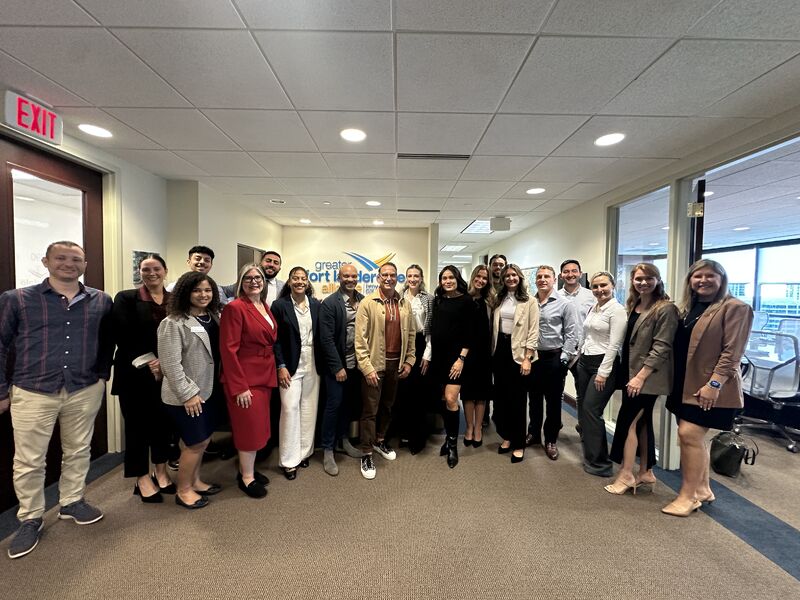
The Greater Fort Lauderdale Alliance lives in that gap. It is Broward County's official public-private economic development partnership, a nonprofit with roughly four dozen employees and an address on East Broward Boulevard. Its customers are companies deciding where to put the next office, plant or headquarters, along with local employers trying to keep the operation they already have. Its product is less visible than a building and often more useful: a shorter distance between a question and the person empowered to answer it.
In fiscal 2025, the Alliance reported helping more than 150 companies. Seventy-two were local businesses. Twelve expansion or relocation projects crossed its finish line, meaning the services were delivered and the company certified its expected jobs and investment. Those 12 projects promised 716 new direct jobs, retained 211 more and committed $139.2 million in capital. Economic-development numbers are promises about a future, not coins already in a jar. The careful reader keeps that distinction. Still, promises become comparable when the rules for counting them are stated plainly.
The concierge with a spreadsheet
The Alliance's service menu sounds modest: site selection, permitting help, research, business contacts, financing referrals, incentive guidance and connections to labor programs. That list hides the real expertise. A company rarely needs one answer. It needs five answers that agree with one another. The building must be large enough, the workers must exist, the municipality must permit the use, the training program must match the hiring calendar, and any incentive must survive its eligibility rules.
The useful sequence
One move, five coordinated handoffs
A conventional consultant can research locations. A city can explain its own rules. A workforce board can describe grants. The Alliance's distinction is that it bundles those fragments across Broward's 31 municipalities and combines them with a network of county officials, educators, real estate people and private employers. It does not control all the pieces. It knows the pieces and can convene their owners.
The Alliance does not sell sunshine. It sells the probability that a company can open when the spreadsheet says it should.The operating idea, stripped of the brochure
Twelve projects, not one trophy
The 2025 portfolio is revealing because the projects are not alike. Transpire Bio announced a $100 million pharmaceutical manufacturing facility in Pembroke Pines and an estimated 200 high-skill jobs. VSE moved its corporate headquarters from Northern Virginia to Miramar, joining its aviation operations in a $3.4 million project expected to create and support 350 jobs over five years. CTS Engines expanded in Coral Springs. A graphics producer took 43,000 square feet in Fort Lauderdale and promised six jobs.
Six is not 350. Yet a durable local economy is not a trophy shelf. It is a portfolio. Aviation maintenance, pharmaceutical production, logistics, headquarters, marine businesses and technology each require different labor and real estate. The Alliance chooses targeted sectors, then works both ends of the market: recruit outsiders and keep incumbents. The latter is less cinematic. It is also where an unanswered permit question can cost a community an employer it assumed would stay.
The cost side is unusually legible. For fiscal 2025, the organization reported $2,215,724 from local government and $3,553,701 from private investors, both unaudited, plus $1,128,240 in administrative costs. This is not a clean return-on-investment equation. The Alliance shares credit with counties, cities, workforce agencies and the companies writing the checks. Its decade-long impact figure - $8.4 billion annually from direct, indirect and induced activity - is an economic estimate, not revenue delivered to the organization. The honest case is simpler: coordination is infrastructure, it costs money, and the output should be tracked project by project.
The moment the map got wider
The organization began in 1963 as the state-created Broward Economic Development Board. It became a county partner in 1978, changed from board to council in 1991, became The Broward Alliance in 1998 and took its current name in 2010. That history suggests a quiet change of mind. The institution that once sounded like a government committee gradually came to present itself as a market-facing alliance, and it borrowed Fort Lauderdale's better-known name to sell a county.
Its remit widened too. Six Pillars Broward, launched in 2011, became the Prosperity Partnership a decade later. The revised agenda included housing, transportation, resilience, racial equity, economic mobility and homelessness alongside industry growth. This was not mission drift so much as an admission. A company cannot recruit nurses, coders or mechanics if those workers cannot find a home, reach a job or see a future in the place.
There are limits. The model depends on public officials willing to cooperate, private employers willing to disclose plans, and enough genuine regional advantage to reward the coordination. It is less useful when a project brings low wages, no durable local base or demands subsidies larger than its likely benefit. It also cannot solve expensive housing or congestion through introductions alone. Convening reveals a bottleneck; policy and investment still have to remove it.
A playbook worth stealing
In 2025 the Alliance took more than 100 Broward leaders to Boston. They compared two coastal regions across housing, transit, culture, education, life sciences and resilience. The trip's most telling feature was not Fenway Park or Symphony Hall. It was the premise that civic leaders should occasionally leave home together, observe the same problems in another place and return with a shared vocabulary.
Five moves another region can copy
- Create one front door for companies, even when many agencies own the answers.
- Define a completed project before counting it, then publish jobs, investment and costs.
- Treat retention calls with the same seriousness as recruitment announcements.
- Build around existing clusters and their workforce, not whichever industry is fashionable.
- Put housing, transport and training in the economic-development conversation early.
The latest work follows that pattern. In September 2026, the Alliance announced a $125,000 state grant, paired with $37,500 in local matching support, to study how Broward's established maritime companies could serve unmanned-vessel and defense customers. Days earlier, it announced that GXO Logistics would put a 35,000-square-foot regional operation in Fort Lauderdale's FAT Village. One project asks an old cluster to find a new market; the other brings a global operator into a redeveloping neighborhood. Neither begins with a ribbon. Both begin with the same, unfashionable question: who needs to be in the room?
That is the Alliance's place in the market. It is part regional sales force, part research desk, part civic switchboard and part project manager. Competitors can copy an incentive and purchase an ad. The harder asset to reproduce is a trusted network that answers the phone. After 63 years, the Greater Fort Lauderdale Alliance has made that network into a product - one introduction at a time.
Go further