A drink sold on an airplane looks like a small transaction. A passenger chooses. A flight attendant taps a screen. A card meets a reader. Yet that moment belongs to several systems at once: the airline’s stock records, its payment processor, its crew workflow and, sometimes, an internet connection that has disappeared. MOST has built a business in the space between those systems. Its subject is the ordinary sale under unusually awkward conditions.
- The job: connect onboard sales, payments and the stockroom.
- The method: modular software plus hardware designed around crew routines.
- The shift: help airlines operate their own retail programmes.
01 / Start with the hand holding it
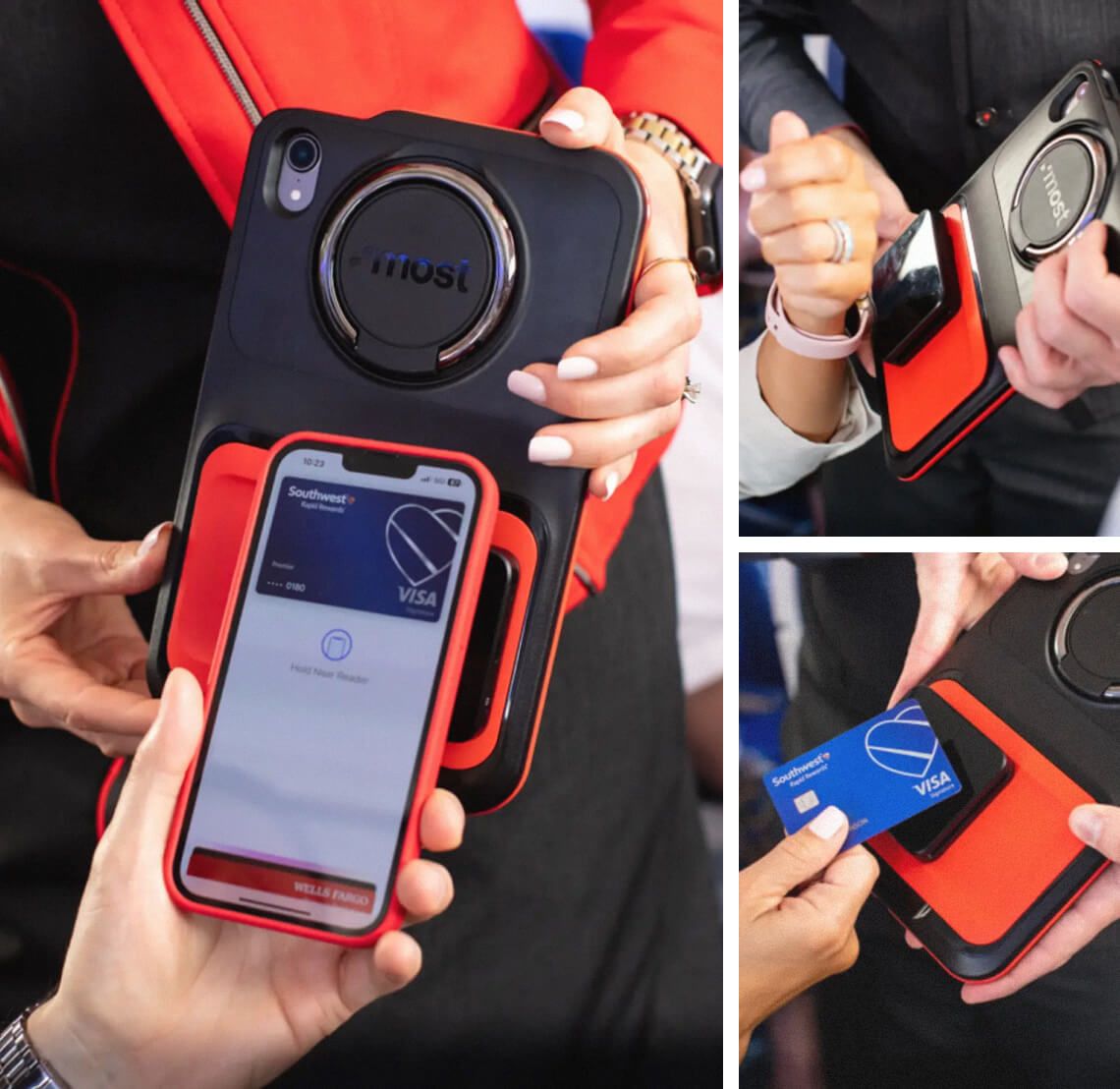
Consider Southwest. MOST’s case study describes a deployment for 25,000 flight attendants, built around the iPad mini and an application called OrderUp. A purpose-built case brings the tablet and payment equipment together. Voucher scanning, onboard Wi-Fi synchronization and integration with Chase’s payment system connect the device to the airline’s operation. The checkout is a piece of equipment somebody has to carry through an aisle.
That physical fact explains why a software company would spend time on a ring holder. MOST’s hardware includes a removable payment reader called the Puck and a single charging point for connected components. The reader can move toward the passenger while the larger device stays with its operator. Grip, reach and power become design decisions with consequences for service.
“MOST’s agile development process and rapid iterations allowed us to continuously revise the application”
Ron Freer · Senior Manager Inflight Mobility, Southwest Airlines
Hawaiian Airlines chose a different arrangement. Its May 2024 announcement described a bring-your-own-iPhone strategy and a POS application called Pau Hana. Two airlines, two device approaches. MOST’s proposition accommodates the equipment and routines an operator wants to use. That flexibility is more concrete than the usual promise that business software can be customized.
02 / The sale has a return journey
MOST publicly introduced itself in September 2022. Jan Blanchard and John Vaughan, its CEO and CTO at launch, came with experience in aviation retail and payment integration. Their opening proposition divided the work into four modules: a gateway, mobile hardware services, a retail application and a recommendation engine. Customers could replace a component or adopt the connected suite.

PLAY became the launch customer for three of those products, deploying them across its fleet in December 2022. The announcement described multiple currencies, digital wallets, inventory tracking and electronic receipts. It also described custom cases in the airline’s colours. Even at the beginning, MOST was working on both sides of the screen: the transaction software and the object carrying it.
The less visible work follows the goods. Provisioning determines what gets packed. Back-office tools manage products, prices and offers. Reconciliation connects what was sold with payments and stock movement. MOST sells this software as a service, alongside gateway services, hardware and support. Its buyer is an enterprise operating a retail programme; the passenger encounters only the last few seconds.
There is an important distinction inside the offline promise. WestJet’s deployment includes deferred authorization. Recording a sale without a live connection and obtaining an issuer’s approval are separate events. For an airline evaluating the system, payment handling and the subsequent accounting deserve as much attention as the speed of the tap.
03 / A shop the airline can run
The 2026 announcements make MOST’s position clearer. In September, the company reported that Lufthansa’s onboard retail was live on its platform. Its SWISS account described an in-house Saveurs programme connecting crew iPads, the catalogue, payments and operational systems. Payment with miles and flight-level fresh-food forecasting sit alongside the ordinary work of selling lunch.
Austrian’s programme followed the same theme: direct airline control, with MOST supplying the technology. The interesting AI question here is wonderfully specific. How many sandwiches should be loaded onto this particular aircraft? A forecast earns its place when it helps someone make that decision. The stockroom gives the algorithm a job description.
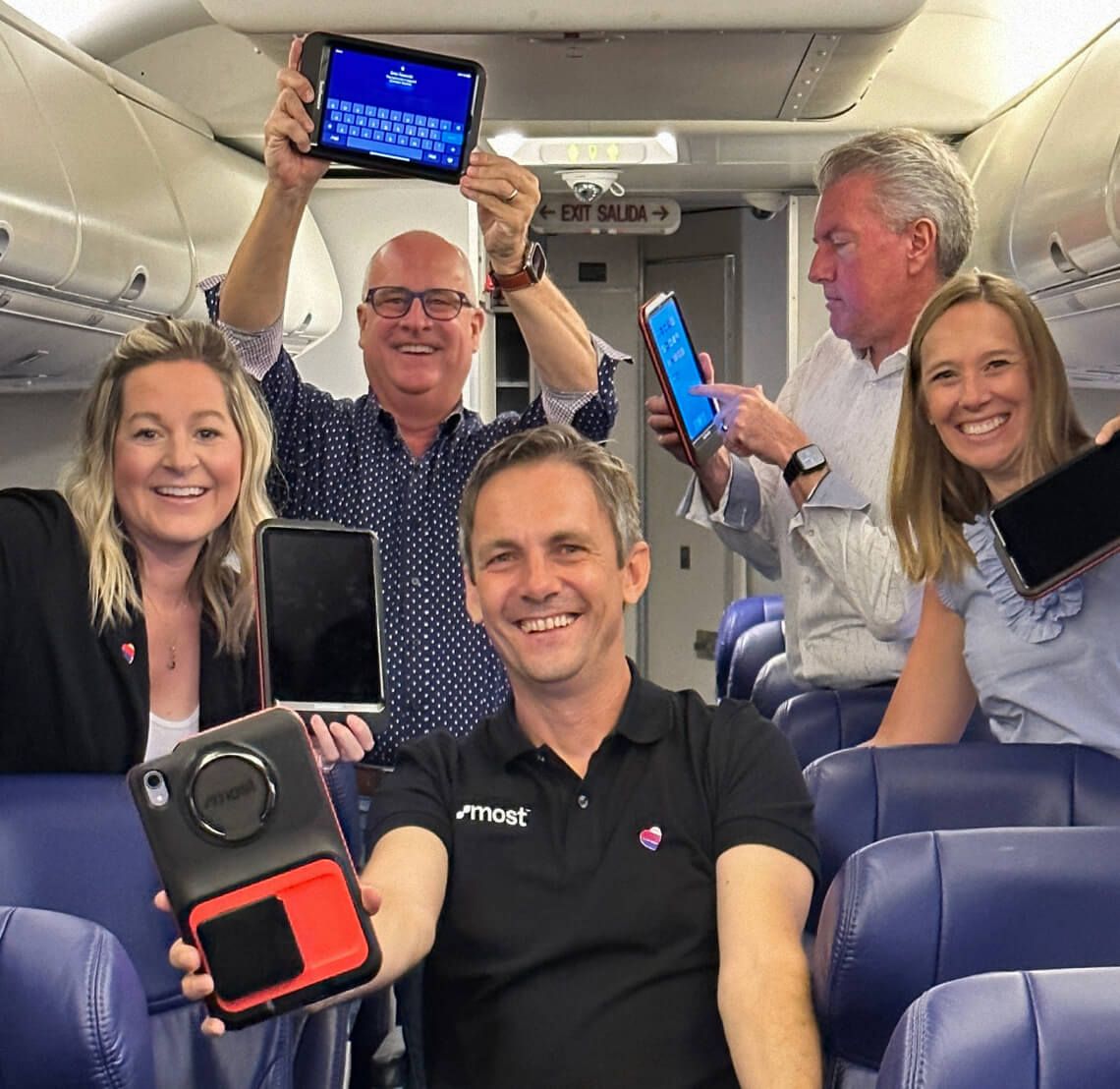
WestJet’s July 2026 deployment account supplies an early operational measure. It reports that transaction clicks were halved and revenue leakage fell by more than half. Those are claims in a published customer announcement. They describe this deployment’s reported results; they should be read in that context.
Transaction steps were halved, according to the published deployment account. A useful measure of the work returned to crew.
04 / Read the fixes
The product changelog offers a less polished view of the machinery. The March 2025 release corrected a split-payment total cropped on smaller screens. October’s release fixed pairing and reconnection loops between the POS and payment devices, along with currency and character-handling issues. These are documented faults, followed by documented changes. They show where real usage presses against a design.
That record suggests a practical lesson: observe the full task, including the recovery from an error. Then measure the steps a worker must take. A tidy purchase flow matters less if its reader keeps reconnecting or its total disappears at the edge of a screen.
The same attention to users appears away from the device. In October 2026, MOST gathered clients at the Foynes Flying Boat Museum for its third annual customer event. The company described conversations between operators about their challenges and what had worked. For a supplier building around airline-specific routines, those exchanges offer another way to see the job from the customer’s side.
The lesson travels beyond aviation, with conditions attached. Modular equipment helps when an operator needs to change components independently. An integrated stock-and-payment system becomes valuable when teams can maintain the product records and connect their operating data. Those are implementation questions to settle before a fleet rollout.
MOST shares this market with specialists including Retail inMotion and Guestlogix, whose products also cover airline retail and payments. Its case rests on the fit of its modules, hardware and implementation work. An operator considering it needs to examine the interfaces between existing systems, the offline payment process and the equipment crews will carry. The useful test happens in the aisle, with the stock loaded and a passenger waiting.