There is a small box sitting on the counter of thousands of Indonesian shops that does something almost quaint: it talks. When a customer pays by scanning a QR code, the box announces the amount out loud so the cashier - busy, distracted, three orders deep - knows the money actually landed. That soundbox is one of the more revealing products made by cashUP, a Jakarta payments company that spent a decade learning that the hard part of digital money is not the technology. It is trust, and the thousand small frictions of a real shop.
cashUP is the new name for a company most of the region knew as Cashlez. The legal entity behind it, PT Cashlez Worldwide Indonesia Tbk, has not changed - it still trades on the Indonesia Stock Exchange under the ticker CASH, and it still holds the distinction of being the first payment-gateway firm to list there. What changed, in August 2025, was the brand, the website, the email domain, and, more consequentially, the strategy behind them.
What it doesOne box, every way to pay
At its core, cashUP is a merchant-acceptance company. It gives a business - a coffee counter, a clothing chain, a hospital cashier - a single point that can take money in almost any form Indonesians use: credit and debit cards, QRIS (the country's unified QR standard), virtual-account transfers, buy-now-pay-later installments, and e-money. The company describes its own positioning plainly: "Simplified Payments, Accelerated Growth."
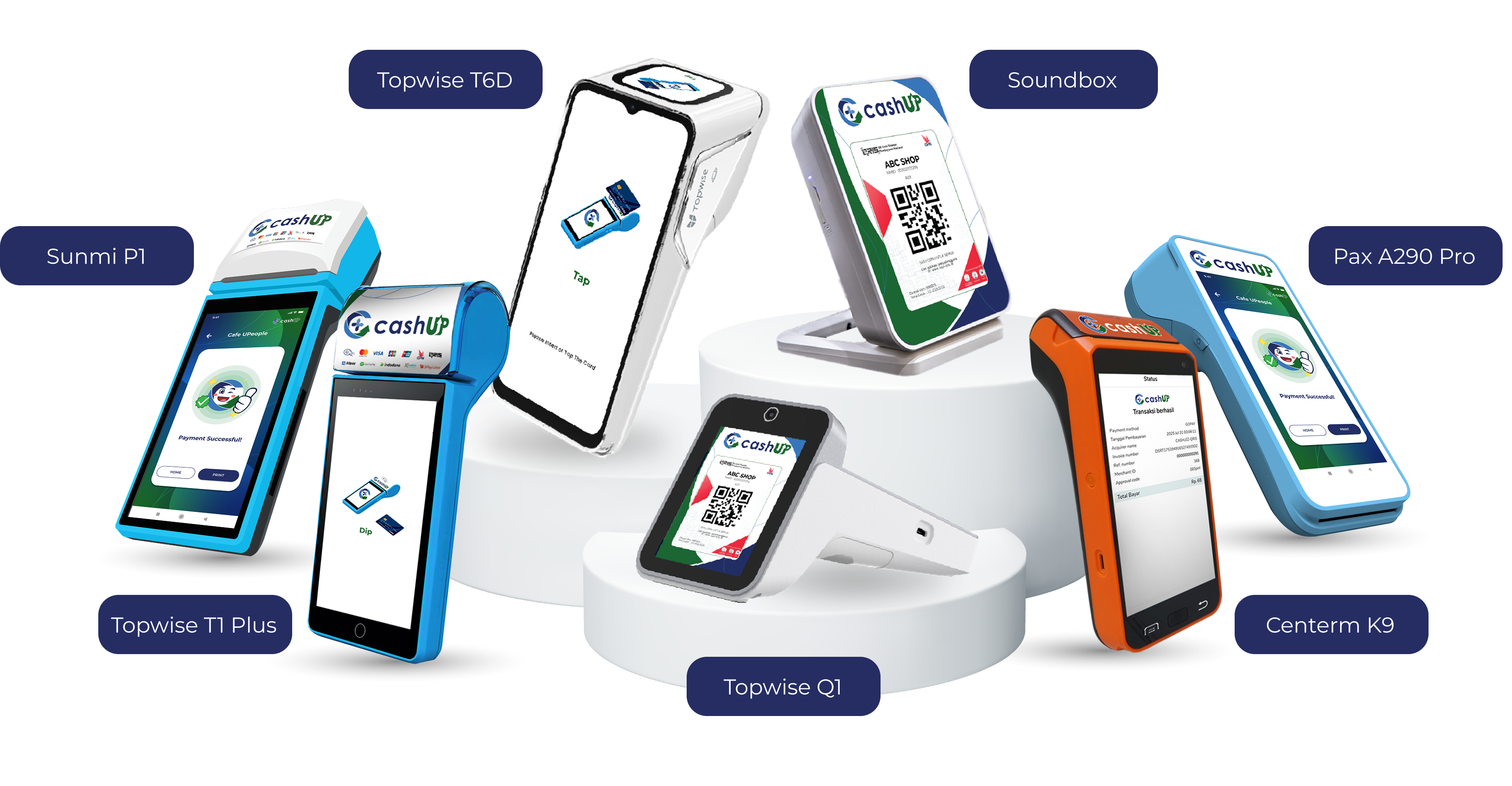
That acceptance point comes in several shapes, grouped under the cashDevice family. There is a dual-screen Android EDC that looks like a chunky smartphone with a receipt printer; a mobile card reader small enough to pair with a phone and slip into an apron pocket; portable mini terminals; and the talking EDC Soundbox built for dynamic QRIS. For merchants who would rather not carry hardware at all, cashSoftPOS turns an ordinary NFC-enabled Android phone into a contactless terminal. Behind the counter, cashPortal handles the part merchants dread - a real-time dashboard that monitors transactions and reconciles them automatically across every channel.
Who uses itFrom Starbucks counters to the corner warung
cashUP says it now serves more than 28,000 merchants across Indonesia. The roster spans the obvious and the small: recognizable brand counters in food, beverage and retail, fitness studios, hospitals and hospitality venues, alongside thousands of independent shops. The design philosophy - and it is a real one - is that scale should not change the checkout. The same rails that clear a payment at a national retailer should clear one at a single-owner reflexology parlor. That is a deliberately unglamorous ambition, and it is the whole point.
The problemWhy merchants juggle machines
Walk into many Indonesian shops a few years ago and you would find a small graveyard of devices on the counter: one machine for cards, a printed QR sticker taped to the register, a phone for checking whether a transfer had cleared. Each payment method arrived through a different provider, settled to a different place, and had to be reconciled by hand at the end of the day. The friction was not in accepting money. It was in accounting for it.
cashUP's answer is consolidation. One device, one dashboard, one reconciliation. The talking soundbox is the clearest expression of the philosophy - it solves a genuinely human problem (did that payment go through?) with a genuinely simple fix (say it out loud). And the payment link the company lets merchants share over WhatsApp solves another: how do you bill a customer who is not standing in front of you?
The moatThe advantage that reads like paperwork
In payments, the least exciting slide in the deck is often the most important. cashUP holds a Bank Indonesia PJP Level II license, a QRIS Acquirer license secured in 2023, and security certifications in ISO 27001 and PCI DSS - both upgraded to their latest versions in 2025. These are not marketing badges. They are the reason a large merchant, or a bank, is willing to route real money through a mid-cap fintech. Regulatory standing and a clean security posture are slow to earn and hard to copy, which makes them a quieter, sturdier moat than any single feature.
How it differsThe one that kept the hardware
Most of Indonesia's well-known payment names - Xendit, Midtrans, DOKU, iPaymu, Faspay, NicePay, OY! - built their businesses around the online checkout, the API call that sits behind an e-commerce cart. cashUP went the other way. It leaned into offline acquiring and physical terminals, positioning itself as a pioneer of the offline payment-gateway aggregator model in Indonesia. That choice looked unfashionable during the e-commerce boom. It looks more durable now that the interesting frontier is the tens of millions of physical merchants who still ring up most of the country's transactions.
Being both online and offline is the differentiator cashUP now leads with. A merchant can take a tap at the counter and a payment link over chat with the same account, and see both settle into the same dashboard. Its competition on the offline side is not really the fintech startups - it is the plain bank-issued EDC terminal, and cashUP's argument against that is integration: the bank machine takes a card, but it does not run your inventory, share a payment link, or reconcile your day.
The businessHow the money moves
cashUP makes money the way acquirers do: a small fee on the transaction volume it processes across cards, QRIS, virtual accounts, BNPL and e-money. Layered on top are device sales and rentals, subscription-style software for the dashboard, reconciliation and POS tools, and merchant financing through cashAdvance, which extends working capital based on a merchant's own transaction history. Increasingly, there is a fourth engine: distribution. Rather than sell every terminal directly, cashUP is signing partners who can put its hardware in front of merchants it would never reach alone.
The clearest example arrived in September 2025, when cashUP signed a strategic agreement with Bank Muamalat to market its EDC and EDC Soundbox terminals to sharia-compliant merchants. It is a template for the B2B pivot: let a bank's relationships do the selling, and let cashUP's rails do the processing.
The expertiseA banker takes the wheel
The strategy has a face. In January 2025, Willy Chandry was appointed President Director - the CEO role - succeeding Irianto Kusumadjaja. Chandry is not a founder; he is a career payments-and-banking operator, with prior stints that read like a tour of the industry: merchant sales leadership at Visa in Indonesia, digital-banking roles at DBS and Bank KB Bukopin, and marketing leadership at a transaction-services firm. That resume is a signal in itself. A company that wants to sell to banks and enterprises hired someone who has spent his career inside them. The three co-founders - Warren Alexander de Souza, Teddy Tee and Steven Samudera - built the product; the new chapter is being run by a distribution mind.
The timelineTen years, three founders, one IPO
Where it fitsA veteran in a still-forming market
Indonesia's payment market is large, fast-growing and still fragmenting - hundreds of millions of daily transactions split across cards, QRIS, wallets and transfers, with no single winner in physical acquiring. cashUP's position is not to own any one rail but to be the box that plugs into all of them, sitting between the merchant and the tangle of banks and wallets behind the scenes. It is a smaller, listed veteran rather than a headline-grabbing unicorn, and its recent moves - the rebrand, the B2B focus, the bank partnerships - read like a company choosing depth over noise.
Whether that bet pays off will be decided merchant by merchant, terminal by terminal, in shops where the most advanced piece of technology on the counter is a little box that still, helpfully, says the number out loud.