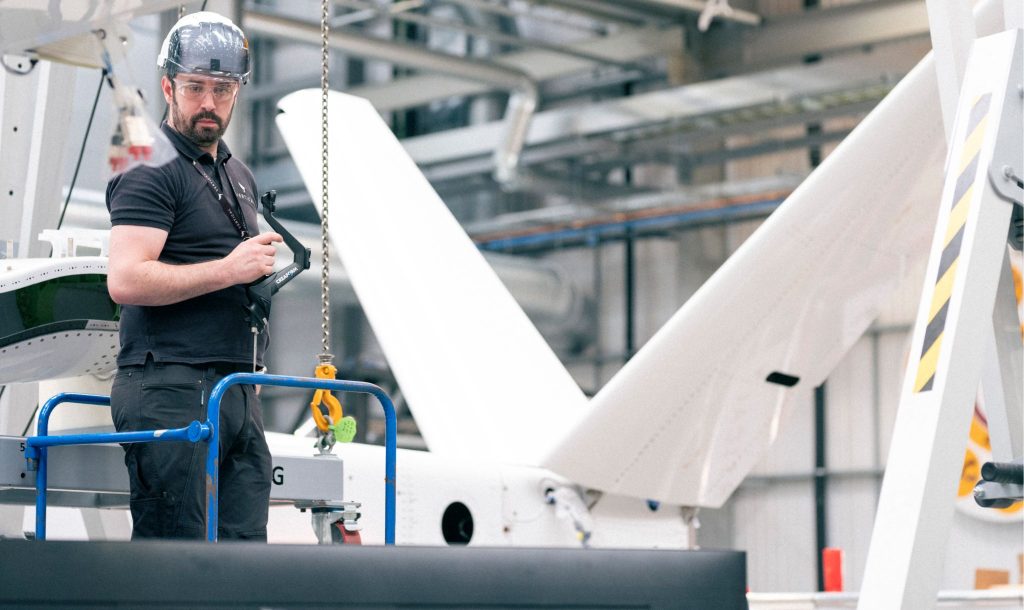
The engineer in Morson Projects' Vertical Aerospace photograph is holding a scanner beside the white tail of an electric aircraft. It is a tidy image of a messy business. The aircraft is still being developed; the parts must meet one another precisely; equipment has to help assemble, disassemble, move and reassemble it safely. An exciting machine depends on a collection of less exciting machines. That is Morson's favourite territory.
Founded in Manchester in 1979, Morson Projects made its living where a drawing encounters a factory, a construction site or a control room. The company supplies multidisciplinary engineering and project delivery to aerospace and defence, nuclear energy, rail, industrial plants, buildings, marine programmes and technology transformations. Its catalogue includes mechanical and structural design, stress analysis, tooling, BIM, electrical controls, SCADA software, technical documentation, asset care and project management. This is business-to-business work with steel-toe-capped shoes.
Why “Projects” became “Praxis”
In 2025, Morson Projects became Morson Praxis. The new consultancy gathered five legacy businesses - Morson Projects, control-systems specialist Ematics, built-environment consultant Waldeck, Orange Solutions and aerospace specialist Astraeus - under one banner. Praxis is a rather bookish word for practice, or knowledge put into action. Here, at least, the etymology earns its lunch.
The rebrand says what the operating model is supposed to do. Engineering, building consultancy and technology consulting sit together. Around them is the wider Morson Group: Edge recruits talent, Vital deploys workers and Nexus trains people. A client can therefore buy a specialist study, a managed work package or a broader combination of advice, people and delivery. The firm describes itself as a consultancy that remains accountable to the result. The less polished translation is better: do not throw the specification over the wall and disappear.
That matters because the first thing to fail on a large programme is often not a beam, cable or line of code. It is the handoff. One team makes an assumption; another inherits a document but not the reasoning; a site condition changes; a schedule keeps moving. On energy projects, Morson points to clogged information flows and unclear accountability as frequent causes of drift. Its answer is continuity - carry early decisions further into design, construction, commissioning and, when necessary, decommissioning.
The product is not a clever slide. It is technical intent that survives contact with delivery.Morson's proposition, in plain English
Three jobs explain the whole company
Start with Vertical Aerospace. The VX4 programme needed tooling for aircraft assembly and transportation while moving quickly through development. Morson's jig-and-tooling group worked with Vertical's engineers to design and manufacture a suite of equipment to locate major components and let the aircraft be assembled to drawing. Vertical's programme manager called the support “invaluable to the rapid development of the VX4.” More revealingly, both sides describe a close, trust-based relationship. Speed did not eliminate process; it made specialist process more important.
The disclosed commercial result is on-budget, on-time delivery, not the fee - contract cost has not been published. What changed Morson's mind about pursuing the work was strikingly human: associate director James Tetley said that at the first meeting his team knew it wanted in. What changed Vertical's calculation was capacity. A fast-growing eVTOL company needed a specialist provider rather than trying to invent every fixture, handling tool and transport solution inside its own walls. The copyable lesson is not “hire Morson.” It is to separate the glamorous core technology from the specialist production problems that can quietly govern its schedule.
Then there is Hinkley Point C. A legacy Praxis team joined EDF Energy's engineering framework in 2014 after earlier work on the West Burton gas-fired power station. The sequence is important: successful delivery changed the client's willingness to extend the relationship. At Hinkley, the consultants supported enabling works, design coordination, BIM integration, temporary structures and the management of engineering and construction issues. They also acted in an “Intelligent Customer” role, providing technical assurance rather than merely adding hands.
The project's publicly cited £19.6 billion figure is the historical cost of the entire power station programme, not Morson's bill. The consultancy's own price is undisclosed. Its value case is risk: on a nuclear site, a badly coordinated interface can disturb an expensive sequence of contractors, approvals and physical works. One engineer recalled aligning an excavation profile with changing building designs. The excavation already existed. Geometry had become schedule, and schedule had become money.
Finally, consider railway electricity. Network Rail wants its existing SCADA systems consolidated into the Traction Power Centralised Management System, a national platform intended to control power across England and Scotland. Appointed by Telent in 2021, the Morson control-systems team built Version 5 from the ground up. Its electrical network model calculates energisation state in milliseconds and warns operators about anomalies. A switching-schedule function automates isolation work, reducing the time needed to make lines safe for maintenance and then restore them.
distributed control rooms are intended to operate one national traction-power platform.
Here, the first failure was architectural: separate legacy systems limited a unified view. The response was not a prettier dashboard but a common model underneath it. Operators in training gave the interface strongly positive feedback, according to Network Rail's subject-matter expert. The practical idea others can borrow is to consolidate the representation of a system before automating its actions. Automation on top of fragmented truth merely moves confusion faster.
A consultancy built like a tool cabinet
Morson sits between giant global consultants and narrow engineering boutiques. AtkinsRéalis, Jacobs, WSP, AECOM and Arup can offer comparable breadth. A specialist may go deeper in one aircraft structure, one safety case or one controls platform. Morson's differentiation is organisational: it can reach sideways into multiple technical disciplines and outward into a group that recruits, trains and deploys people. In a market pinched by engineering skills shortages, access to capability can matter as much as the PowerPoint strategy for using it.
Its customers are correspondingly large and complicated. Public work includes EDF, Sizewell C, Network Rail, Telent, Vertical Aerospace, Leonardo Helicopters, Jaguar Land Rover, IKEA, Harrods, Prologis, Cavendish Nuclear and LSEG. A 2023 Morson publication put its team at more than 900, with over 350 deployed on aerospace and defence programmes. The current combined Praxis organisation is broader; LinkedIn places it in the 1,001-to-5,000 employee band. Exact standalone revenue is harder to isolate inside a private group, so the supplied £180.1 million estimate deserves to be treated as an estimate, not an audited scorecard.
The business earns through professional-service fees, managed work packages, long-term frameworks and delivered systems or tooling. Its 2018 expansion offers one rare price tag: Morson Group paid total consideration of £1.608 million for Waldeck, later folded into Praxis. Otherwise, the economics appear in duration and repeat work. The EDF relationship ran from West Burton into Hinkley Point C and, in May 2026, into renewed EDF frameworks and a Sizewell C contract. In consultancy, the repeat appointment is often the clearest available review.
The useful parts to steal
There are five. Put manufacturing and operations into the first design conversation. Keep a stable technical thread through handoffs. Use specialists for schedule-governing work even when it looks peripheral. Build one trusted system model before layering on automation. And leave the client with more capability, not simply more documents. None requires a 47-year-old engineering group; all require resisting the tidy fiction that disciplines and project stages behave independently.
The culture claimed by Praxis - courage, collaboration, curiosity and care - is standard corporate vocabulary. The interesting test is procedural. Aerospace offices maintain AS/EN 9100-quality systems. Nuclear work demands regulated assurance. Rail controls have to earn operator confidence. In those settings, curiosity needs a review trail and courage needs configuration control. Morson's personality is most credible when it appears as disciplined collaboration rather than copywriting.
The model has edges
- For a small, tightly scoped assignment, a multidisciplinary group may add coordination overhead that a specialist avoids.
- If the client will not share operational context or embed outside experts, the promised continuity loses much of its force.
- Where price is the only buying criterion and failure is cheap, assurance-heavy delivery can be difficult to justify.
- Breadth works only while each niche retains authority; consolidation becomes a weakness if every expert is made interchangeable.
That is the tension inside the Praxis rebrand. Combining five legacies can remove seams, or create a larger organisation with fresh seams of its own. The proof will not be the new yellow-and-black wordmark. It will be whether an airworthiness specialist, a BIM coordinator and a control-systems engineer can enter a client's problem at the right moment without turning the job into a tour of the org chart.
Morson Projects survived because vital engineering is frequently invisible. A train takes power, a platform component fits, a temporary structure holds, an aircraft can be moved to its next test. Praxis now gives that work a more declarative name. The company is selling practice: designs that can be made, systems that operators can use and advice that remains in the room when reality starts editing the plan.