Three minutes and sixteen seconds is an awkward length for a revolution. Too short for a leisurely cup of coffee, long enough for an engineering team to learn something it could never establish with a drawing alone. On March 27, 2025, at Roland-Désourdy Airport in Bromont, Quebec, test pilot Ric Webb lifted a modified Robinson R44 into the air. Hydrogen fuel cells and a battery supplied its electric propulsion system. Mikaël Cardinal’s team had an aircraft that flew.
The duration deserves to stay attached to the achievement. It tells us exactly what happened: a brief demonstration, with a pilot aboard, of a different way to power a helicopter. The work ahead would involve longer flights, more maneuvers, more data, and the demands of certification. A stopwatch is a wonderfully impolite instrument. It records what you have done and leaves your ambitions out of it.
Duration of the first piloted hydrogen-electric R44 test flight
Cardinal, vice president of program management at Unither Bioelectronics, works in the space between that modest measurement and a much larger engineering objective. His career has given him experience with aircraft design, integration, and certification. In Bromont, those disciplines have converged around a machine that must persuade its designers repeatedly, under changing conditions, that its many parts can cooperate.
A drawing has very good manners
Before the R44, there was Zénith Altitude, the aerospace company Cardinal co-founded and led as CEO. Its work included designing aircraft and integrating and certifying systems for specialized aerial operations. Those three activities make a revealing combination. Design allows an idea to take shape. Integration introduces it to everything else it must live with. Certification requires a case that someone outside the project can examine.
Cardinal’s formal preparation came at the Université de Sherbrooke, where he studied mechanical engineering with an aeronautics concentration and completed a master’s degree. Co-op placements brought him into business aviation projects while he was still an undergraduate. Systems integration and certification were already part of his working vocabulary. He encountered the profession through assignments involving actual aircraft and clients, alongside the university curriculum.
That early exposure matters to the shape of his later work. A student can solve a problem whose boundaries have been drawn in advance. An aircraft program brings together problems that share boundaries and occasionally dispute them. Cardinal would go on to build a career in that crowded territory, where a successful component still has to become part of a successful whole.
The boy with the Harrier drawings
He grew up in Quebec City, fascinated by aircraft and particularly by the Harrier’s ability to rise vertically. By about ten, he was drawing airplanes. His childhood also included fifteen years of classical piano. Computers attracted him before a college visit to Bombardier helped redirect his interest toward aeronautical engineering. He entered Sherbrooke in 2007.
The artistic interest survived the choice of profession. He has described technology as a form of art, an unusually comfortable pairing for someone whose work also involves certification. It offers a useful glimpse of how he thinks about making things: imagination belongs inside the technical process, even when the finished work must answer to requirements.
“And for me, tech is art in some way.”
Mikaël Cardinal
In 2018, Cardinal joined United Therapeutics. His new role brought him into a network of aviation development projects. The work connected a Quebec engineering base with aircraft developers elsewhere, including BETA Technologies. He had moved from running his own aerospace business into coordinating development within a larger organization, with partners whose expertise would need to fit together.
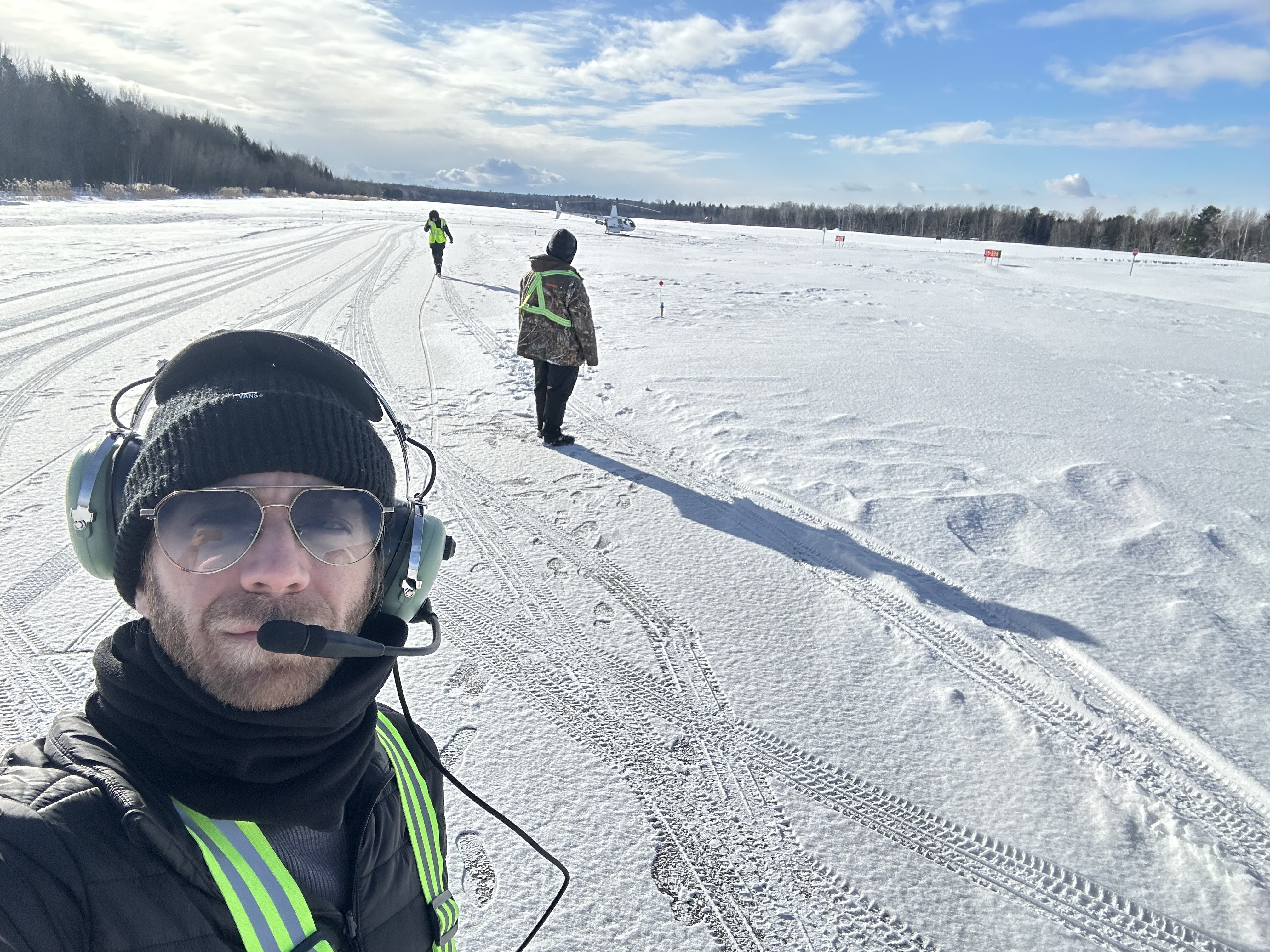
Keep the helicopter. Change the argument.
Project Proticity took a recognizable aircraft and gave it an unfamiliar power system. In August 2024, Unither and Robinson Helicopter Company announced a collaboration involving hydrogen-powered versions of the R44 and R66. Robinson would contribute engineering, technical, and regulatory expertise. The intended approval path involved both Transport Canada Civil Aviation and the United States Federal Aviation Administration.
Starting with an established helicopter puts the new technology in a concrete setting. A rotor still needs power. Weight still counts. Cooling still has to work. The demonstrator gives the team a place to investigate those demands together. Anyone can admire a promising power source on a bench. An aircraft is a rather more demanding host.
The R44’s original piston engine was removed. In its place came a propulsion arrangement using hydrogen fuel cells, an electric motor, and a battery. A gaseous hydrogen tank sat beneath the tail boom. Cooling equipment occupied side-mounted nacelles. The outward changes were visible; much of the consequential work was in how the system managed its energy.
Two electrical sources, coordinated to meet a changing power demand.
For Cardinal, that collaboration also meant a program with an explicit destination beyond the demonstration. In announcing it, he described a commitment to a fleet with zero operational carbon emissions. The distinction between a stated objective and an approved aircraft is central to this story. The agreement brought experienced partners into the process of closing that distance.
The battery gets a supporting role
During the first flight, roughly ninety percent of the energy came from the fuel cells. The battery covered brief increases in demand and finished with more than eighty percent state of charge. That division of labor was deliberate. Fuel cells respond more slowly to sudden changes in power demand, so the battery provided an additional source when the aircraft needed it.
The team had spent substantial time refining its control software before takeoff. Its state-machine algorithm managed power sharing between the two fuel-cell stacks and the booster battery. When Webb made significant anti-torque pedal inputs, the system called for battery power to meet the transient demand. Cardinal’s description of the test emphasized stable output and the performance of that coordination.
Here the program becomes personal in a useful way. Cardinal’s earlier work in integration and certification meets a task that depends on both. A helicopter with two electrical sources needs rules for their cooperation. The program leader has to help turn a collection of capable technologies into behavior that can be tested, understood, and demonstrated again.
One lap, several new questions
On April 10, 2026, Webb flew the hydrogen-electric R44’s first circuit of Roland-Désourdy Airport. A circuit sounds ordinary because pilots fly them routinely. For an experimental propulsion system, it carries a demanding sequence: hover, maneuver near the ground, climb away, fly forward, and return to land. Each phase makes a different request of the power system.
Cardinal emphasized the importance of consistent performance across those demanding phases. Thermal management was one of the particular challenges in hover, where forward motion supplies little or no airflow to assist cooling. An airport lap therefore offered more than a longer flight path. It let the team examine an interconnected set of operating conditions within one flight.
First piloted test flight
Hover and maneuvering with hydrogen-electric propulsion.
First airport circuit
A linked sequence of takeoff, forward flight, and landing.
The appeal of these milestones lies partly in their specificity. They resist the temptation to treat a first flight as a completed product. Cardinal’s team can point to a maneuver, a measured response, or a test condition. The development story advances when those details expand the evidence available for the next decision.
The next aircraft is still a proposition
The research points toward a larger platform: a Robinson R66 using liquid hydrogen storage. Models based on the R44 flight-test data suggest a possible payload of roughly 300 to 600 pounds over a 200-nautical-mile mission with current fuel-cell technology. Those are preliminary modeling results. They describe a development direction, with the performance of the flying demonstrator providing a basis for the calculations.
For a program manager, that creates a useful discipline around aspiration. A larger aircraft introduces another set of decisions about storage, weight, and useful load. The team can use the R44 to investigate the technology while refining its expectations for what follows. Cardinal’s work therefore spans two different clocks: the immediate schedule of an aircraft being tested and the longer process of defining a successor. Keeping those clocks in agreement is part of the job.
A bigger circle of collaborators
Cardinal’s work also extends beyond the test program. In September 2024, Canadian Advanced Air Mobility appointed him to its national board alongside BETA Technologies’ Kristen Blodgett. The organization brings industry into discussions about moving new aviation technologies toward operation in Canada. For someone managing development, that is another place where an aircraft’s technical possibilities meet the practical arrangements around flight.
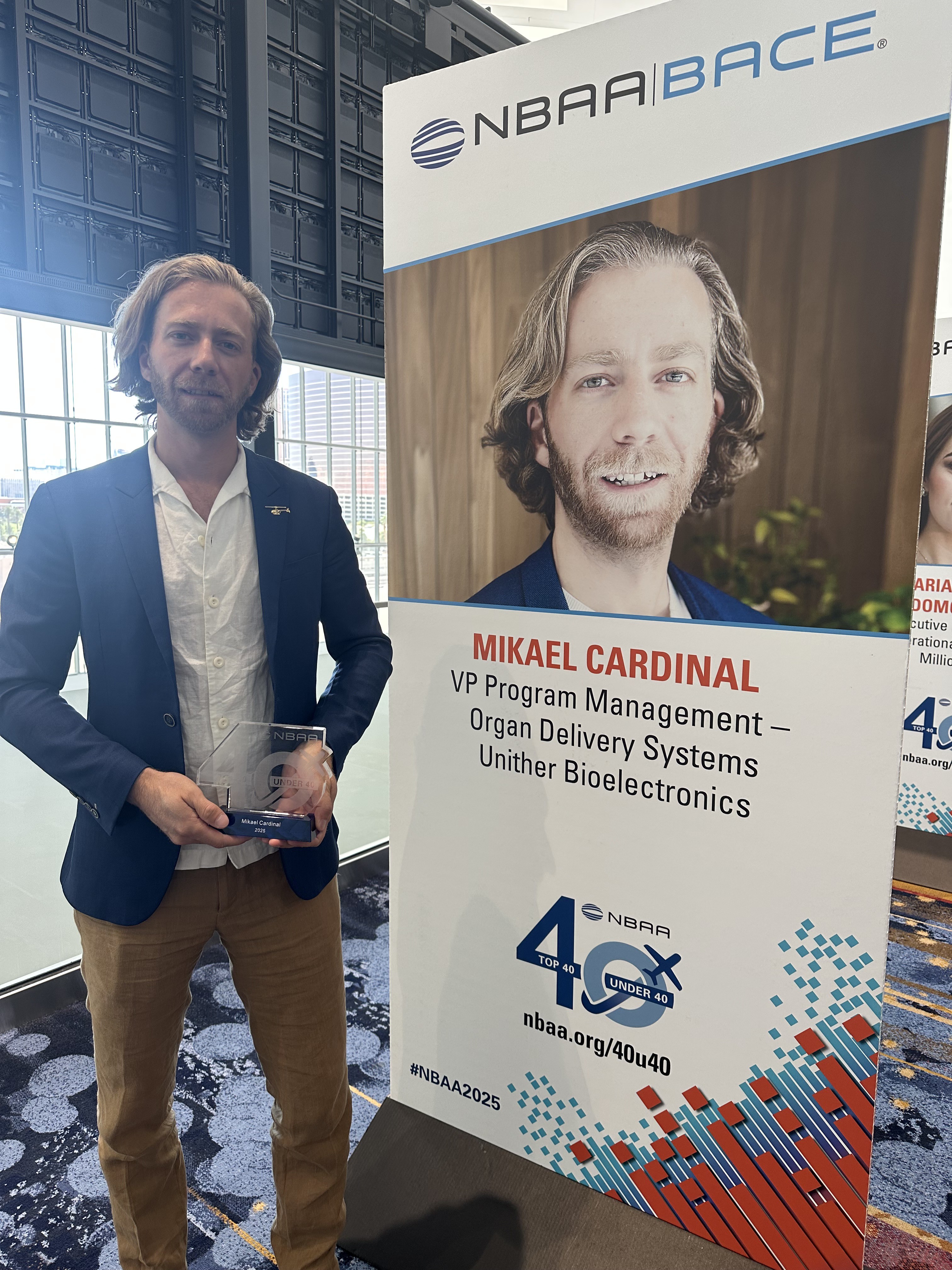
NBAA recognized him in its 2025 Top 40 Under 40, in the Innovation and Technology category. The award connects his present role to the business aviation work he encountered as a student. The thread across those stages is unusually consistent: systems, integration, and the challenge of making an aircraft project ready for use.
There is a research thread, too. Cardinal co-authored a paper on full-scale hydrogen helicopter flight tests and analysis with Yuval Enciu and other researchers. It received an eVTOL-session Best Paper award at the Vertical Flight Society’s 2026 Forum. The collaboration with the University of Maryland turned flight experience into published technical evidence, available for scrutiny beyond the people who had built the machine.
That is a fitting place to leave him: with a program still developing and evidence accumulating. The March 2025 flight lasted three minutes and sixteen seconds. It has since acquired a longer afterlife in test work, partnerships, and analysis. Cardinal’s next assignment is contained in the consequences of that first one. The helicopter flew. Now comes the work of preparing it to fly again.