Consider the school boiler. It has no place on a graduation stage. Nobody asks it for a letter of recommendation. Yet if it stops doing its job, the day’s carefully arranged lessons acquire a rather different subject: how to keep a building warm. At Monroe-Woodbury Central School District, some boilers described in its capital proposal were as much as 60 years old. An education story was sitting in the basement.
- Seven public schools serve an Orange County community.
- Voters authorized $98 million in capital improvements in 2023.
- The separate 2026-27 operating budget is $245.1 million.
- A technology internship has hosted 58 participants since 2016.
That is a useful place to begin understanding Monroe-Woodbury. The district provides public education from pre-kindergarten through high school, alongside transportation, meals, support services, sports and the arts. Its work has an obvious center, the classroom, and a much larger circumference. Families experience the whole thing. A lesson matters; so does whether the bus arrives and the computer works.
The institution itself grew out of consolidation. New York’s school reorganization record places the centralization vote in June 1951 and its first operating year in 1951-52. The vote was close: 593 in favor and 587 against. That six-vote margin is a useful reminder that a familiar public institution can begin as a very unsettled local decision.
The boiler is part of the lesson
The district’s seven schools include five elementary buildings, a middle school and a high school. A New York State transportation report lists 6,261 students for 2024-25. This is a substantial local operation, with responsibilities extending across buildings, vehicles and the people who use them. Calling it an education provider is accurate, but leaves quite a bit out.
In November 2023, officials made a fairly plain argument. Major systems had been kept going for decades. Repairs and patches were reaching their limit. The proposed response covered seven schools and five non-instructional buildings: heating, roofs, safety systems and other work that rarely appears in a prospectus for a child’s future.
On December 5, residents approved the $98 million capital project, 878 votes to 290. The interesting feature is the specificity. Boilers had exceeded their expected lives. Roofs needed replacement. Masonry needed repair. The district gave residents physical problems to consider, alongside a price and a funding explanation. That makes a large number easier to interrogate.
A big price, a particular funding mix
The proposal’s financing deserves a careful look. The district described approximately 70 percent building aid, 24 percent capital reserves and six percent retiring debt. On that basis, it presented the program as having no additional impact on the budget or tax levy. The work still had a $98 million price. The financing explained how that price would be accommodated.
Approximate shares in the district’s capital proposal. Financing mix, not a breakdown of construction work.
This distinction is useful beyond schools. Anyone presenting a substantial project can copy the sequence: describe what is wearing out, specify the work, then explain who pays and when. The conditions matter, too. Another district would need its own eligible aid, available reserves and debt schedule. These percentages are local circumstances, not a recipe available on demand.
By December 2025, the district reported completed security vestibules at four elementary schools, along with new boilers and heating upgrades at the high school and Smith Clove. In July 2026, its renovated Education Center reopened after a year of work. The former secondary-school building now supports district administration. A time capsule from the reopening is intended to wait 50 years.
Two budgets, two different jobs
Capital work is only one financial story. On May 19, 2026, residents approved a separate $245,052,094 operating budget for 2026-27, with 72.1 percent voting yes. This is the spending plan for running the district. It should not be mistaken for corporate sales, investment funding or the cost of the capital project.
Approved by residents • 1,023 yes / 395 no
The board’s proposal said it would preserve current programs and services while adding a graduation pathway and expanding extracurricular opportunities. It also included replacement buses, with state aid expected to cover approximately 71 percent of their expense. A separate ballot proposition sought up to $2.6 million for Sapphire Elementary’s roof, using reserves and remaining state EXCEL funds. That proposition passed, too.
The alumni who come back with screwdrivers
There is a smaller, more human version of the same operational story inside the Micro Computer Center. Its technology internship began in 2016. By August 2026, 58 interns had participated. That summer, a team of six worked under computer network specialists Zachery Neenan and Cody Walsh, learning systems, checking inventory, repairing equipment and upgrading devices while classrooms were quieter.
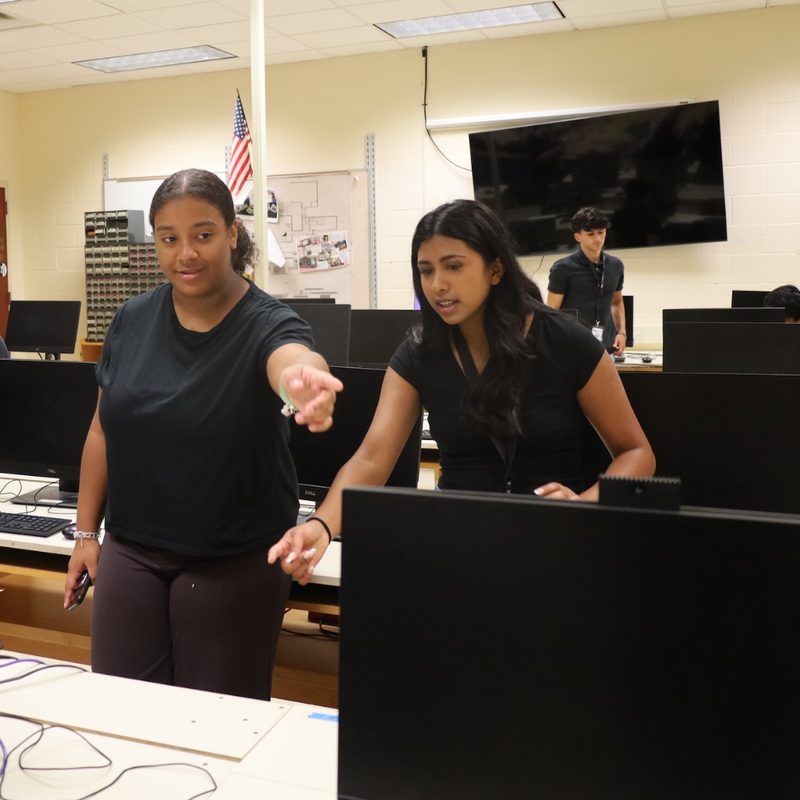
“I attended school here for 12 years, why not work here and give back.”
Pravin Jegan, MCC intern / August 2026
The observation belongs to Stony Brook sophomore Pravin Jegan. It captures the exchange neatly: former students receive practical experience, and the district receives help with necessary work. The program’s participants have studied fields including journalism, engineering and pre-med. Technical competence travels. Replicating the idea would require suitable assignments and capable supervision; the equipment alone would not create an internship.
Career preparation also reaches beyond district buildings. In spring 2026, Monroe-Woodbury senior Cameron Brown joined two Minisink Valley students on a team that won New York’s SkillsUSA Welding Fabrication competition. They represented the Orange-Ulster BOCES chapter. Their task required building a project from supplied materials and prints. It is a concrete example of what a regional education partnership can offer: a local student gains access to specialized training and works alongside students from another district.
The family is part of the system
For parents, the district is also a set of practical tools. The website connects families to the student portal, transportation information and food services. Closing notices go through direct communications and district channels, including opted-in texts and app notifications. Keeping portal contact preferences current is a small task with a very immediate payoff on a snowy morning.
Monroe-Woodbury’s place in education is defined by public responsibility and geography. Private schools and home instruction offer different arrangements; nearby public districts serve their own eligible populations. Here, the service is a connected school day for local children. Its distinctiveness emerges in the particulars: an aging boiler replaced, an alumnus repairing a device, a community asked to approve the expense. Those particulars are where an institution becomes understandable.