Momchil Kyurkchiev and Andrew First had a reasonable theory about their first customers. They were engineers. They had worked at Google. They were building a mobile A/B testing product. Surely other engineers would be interested. Then they asked. The enthusiasm was elsewhere: product managers and marketers cared more about what the software could do for their businesses. Two people trained to run experiments had received a useful result about themselves.
It is a better place to begin his story than an acquisition announcement. Leanplum eventually joined CleverTap in 2022. Before that came the less ceremonial business of discovering which assumptions deserved to survive. Kyurkchiev brought technical experience to the enterprise. He also had to develop a tolerance for being corrected, sometimes by customers, sometimes by mentors, occasionally by the calendar.
Two suitcases, three majors
His journey began in Ruse, Bulgaria, and took him to upstate New York in 2003. He arrived for college at Brockport with two suitcases. A tuition scholarship helped, while family money covered the gap. He studied mathematics, computer science and computational science, a combination unlikely to leave much room for recreational indecision.
There was also a campus cafeteria job. His shift ran from nine at night until two in the morning, making smoothies. The late hours paid an extra fifty cents an hour. He worked twenty hours a week alongside his studies. Years later, when he described the resourcefulness required to start a company, he already had a fairly practical definition.
Entrepreneurship had an earlier place in his imagination. As a child in Bulgaria, he watched an uncle run a business. The possibility stayed with him as he built a route through education and employment. A job in Silicon Valley could provide experience and opportunity. Owning a company remained part of the plan, even when the intermediate destination became rather pleasant.
A good job can be a comfortable detour
Google was a substantial education in engineering. Kyurkchiev worked on YouTube, including video advertising and testing infrastructure. First was a colleague. Their work exposed them to the relationship between small product changes and measurable differences in how people behaved. Mobile was becoming an increasingly interesting place to apply that knowledge.
While working, Kyurkchiev also studied at Carnegie Mellon, completing a master’s degree in Software Engineering and Management. A course required him to develop a startup idea and present it to an investor. The encouraging response helped restore an ambition that a good salary and interesting projects had made easier to postpone.
In 2012, he and First left Google and founded Leanplum. The promotion from employee to founder came with several occupations attached. Kyurkchiev now had to recruit, sell, support customers and raise money. Asking someone to invest was an unfamiliar task for a software engineer. Competence in one room did not exempt him from being a beginner in the next.
“Everything you do is meaningful for the business.”
Momchil Kyurkchiev, on becoming a founder
He later recalled interviewing nine candidates in a day at Leanplum. Two became its first interns. A similarly crowded interviewing day at Google had exhausted him. At his own company, the connection between a conversation and the product’s future was immediate. The work had acquired a different weight because he would live with the result.
The rival in the room
Techstars Seattle supplied another education. The founders initially believed they were first to offer mobile app A/B testing. They discovered a competitor with funding and a team already in place. Kyurkchiev remembered being crushed. The mentors laughed, then explained why an existing rival might be welcome evidence that a market existed.
“Competition Is a Gift.” That was the heading he later gave the lesson. A rival made differentiation necessary and gave investors a business category they could recognize. It did not promise success. It gave the founders something concrete to study. The alternative, being alone in an apparently empty market, could carry its own expensive misunderstandings.
The customer discovery was just as consequential. Their tool could help someone change an app and measure the response. The people responsible for business outcomes had a reason to care. Listening to those customers helped move Leanplum toward mobile marketing. The founders’ original professional identity had been a useful starting point and an unreliable guide to demand.
A and B, with doors attached
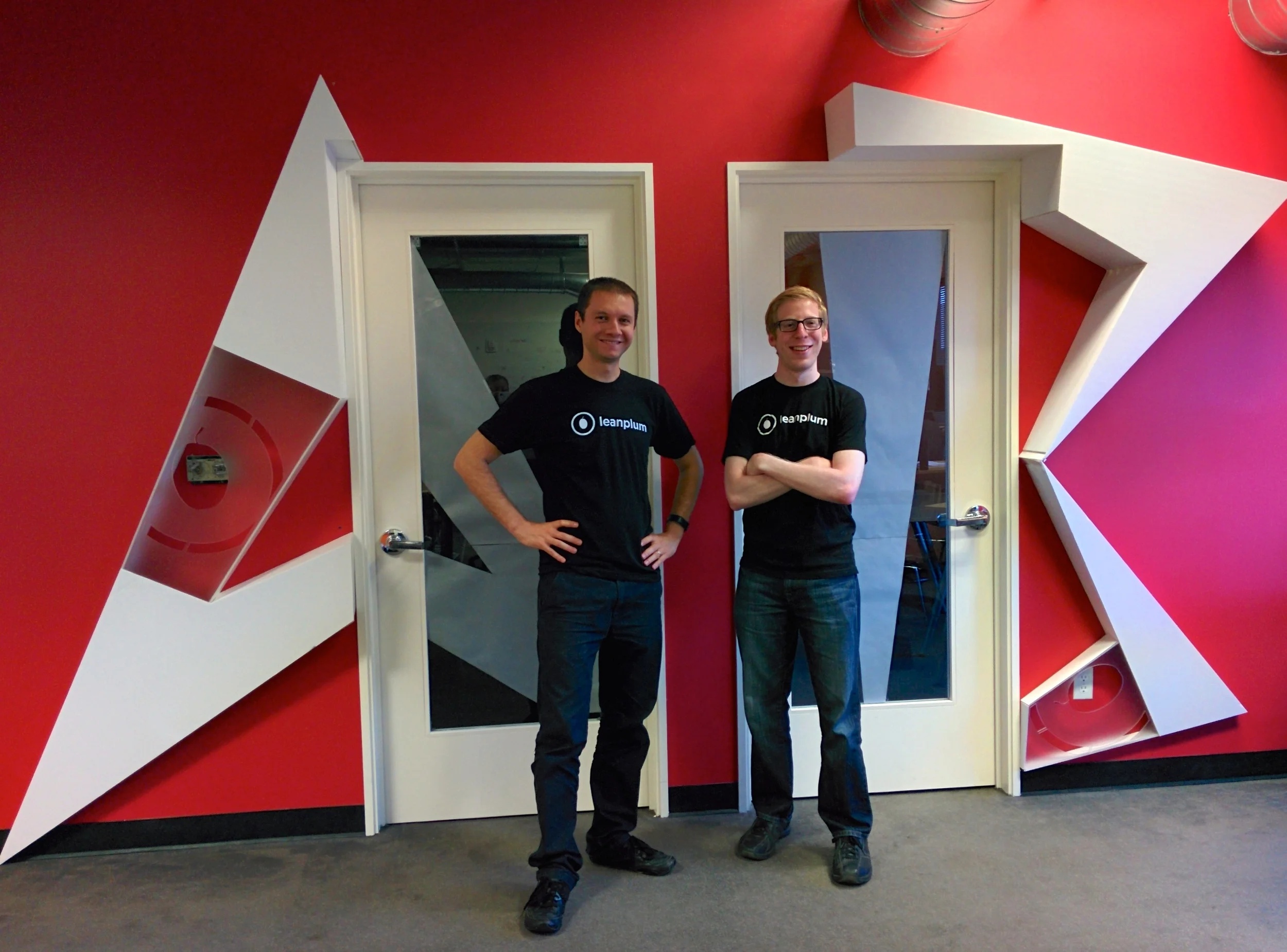
An early office photograph catches the joke neatly. Kyurkchiev and First stand in front of conference rooms named A and B. By July 2014, Leanplum had raised a $4.8 million Series A from Shasta Ventures, following an $825,000 seed round. The letters on the wall now had a financing pun available as well.
The product’s premise was practical: teams could experiment with mobile content and messaging, then learn from the response. Leanplum expanded from testing into marketing automation. That put its engineering foundations in service of people trying to make an app useful enough to revisit, and a message relevant enough to open.
Even its name carried a small account of the founders’ intentions. They chose “lean” partly for nimbleness and partly for combining capabilities in one platform. There was also the idea of a partner a customer could lean on. Software naming rarely arrives without a little explanation. Here, at least, the explanation pointed back to work the product was meant to do.
The meeting that outgrew itself
At Techstars, a weekly gathering at 11:11 gave participants a chance to share their highs and lows. Kyurkchiev remembered the willingness of people to help each other. That experience informed the kind of workplace he and First wanted to build: one where personal connection had an acknowledged place.
Eventually Leanplum passed twenty employees and the old format became unwieldy. Smaller “Big Talk” dinners allowed colleagues from different departments to have longer conversations. Kyurkchiev’s own habit of interviewing every candidate also became difficult to sustain. The company put its values into words that other people could use when hiring.
In January 2018, he took this interest to TEDxVitosha in Sofia. His talk proposed bringing personal life to work. It was a revealing choice of subject for a founder whose business depended on software and analytics. He used the stage to discuss the people doing the building, and the relationships that could make their days more rewarding.
There was a harder lesson beneath the convivial dinners. An accelerator had taught him to weigh shared working principles alongside technical ability. He later described hiring a highly accomplished person and then parting ways because their approaches did not fit. An impressive résumé could open a conversation. It could not settle every question about working together.
A company with a route back to Bulgaria
Leanplum’s geography mattered to Kyurkchiev. A San Francisco company could build an engineering presence in Sofia and offer local talent a place in a global product business. By 2015, he was already speaking publicly in Bulgaria about that connection. His own departure had created a route through which work and experience could travel back.
The company grew beyond its early testing identity. Brands including Tinder, Grab and Tesco used its customer engagement tools. During Kyurkchiev’s period as CEO, Leanplum grew beyond a hundred employees and twenty million dollars in revenue. Those numbers describe an organization with customers to support, salaries to pay and decisions increasingly made by people beyond the founders.
Techstars Seattle
Shasta Ventures
CleverTap
CleverTap announced completion of the acquisition on June 13, 2022, three weeks after announcing the transaction. Kyurkchiev joined its leadership as chief strategy officer. The plan was to combine the companies’ product capabilities and extend their reach. For the founder, a business he had helped start was becoming part of somebody else’s organization.
That transaction makes a tidy milestone. It also places the earlier years in perspective. The initial customer interviews, the competitor discovered at Techstars and the experiment with office culture were decisions made without knowing this ending. They belong to the story because they show what the founders could actually influence along the way.
The next problem is on the blackboard
His later writing continued to follow mobile businesses. In commentary on gaming, he considered subscriptions, established franchises and alternative payments. The interest remained close to Leanplum’s original territory: how digital products earn attention and make money. Product decisions still had commercial consequences, even as the technologies and distribution rules changed.
After twenty-two years in the United States, he is back in Bulgaria with his family, on sabbatical and mentoring founders. The setting has changed again. Someone who once needed help interpreting a competitor can now bring that experience to people encountering their own first uncomfortable answers.
There is a smaller, pleasingly specific connection to his student years. At Brockport, his support funds two mathematics competitions with a combined thousand dollars in annual prizes: an olympiad and an integration bee. The latter asks students to solve calculus integrals against the clock. A founder’s name on a timed mathematics contest feels appropriate. Long before the acquisition, before the rooms called A and B, there was a student learning to solve the problem in front of him.