An investor called Mohit Aron and discovered that the founder was unavailable. The money had already arrived. The product had yet to ship. Between 1:30 and 4:30 in the afternoon, Aron had headphones on and was writing code. Even the people financing the company had to wait their turn. It is a pleasingly awkward picture: a chief executive with a calendar that still belonged, for three hours a day, to an engineer.
Karan Mehandru recalled those afternoons years later. Cohesity was preparing its first generally available product, and Aron was helping build it himself. The episode captures a tension that would follow him through the company: the same technical involvement that could get a product out the door could become difficult to sustain as a business grew. Eventually, a founder has to decide which work requires his hands and which requires somebody else’s.
Aron’s career offers several versions of that problem. At Google, he helped develop a system that let many machines behave like a useful whole. At Nutanix, he helped bring computing and storage together. At Cohesity, he tackled data scattered across separate products. Now, at SciFin, he is working on the information that sits between a company’s people and its software. The boxes change. The inconvenience of keeping them separate persists.
A planned city, an unplanned career
Aron grew up in Chandigarh, a city whose streets and buildings made planning visible. His father worked in the forest service; his parents encouraged education and a life beyond the opportunities they had known. Chandigarh was an unusual setting for a future systems engineer: a city conceived with a design, rather than allowed to accumulate entirely by accident. Aron later connected that environment with his belief that a vision could be made real through execution.
Computer science arrived before any certainty about a career. At IIT Delhi, which he entered in 1991, a computer centre helped turn interest into absorption. He spent long hours programming in Unix, C and C++. There is something wonderfully unfashionable about this beginning. It involves a room, a machine, and enough curiosity to stay after everyone sensible has gone home. His bachelor’s degree in computer science and engineering followed in 1995.
The move to Rice University in Houston offered its own lessons in unfamiliar systems. Even the light switches worked in the opposite direction from the ones he knew in India. The weather was a surprise, too: America had apparently neglected to make Houston cool. These small dislocations belonged to a larger change. He was learning how to live somewhere new while learning how to ask questions whose answers had yet to be written.
At Rice, doctoral research gave him a method he would carry into business: identify a problem, develop a solution, communicate it, and repeat. He has described the distinction between acquiring knowledge and inventing it. The point was practical. A textbook can tell you what somebody already worked out. A new company asks you to work out something useful while other people are waiting for the result. Research had given him practice at that uncomfortable interval.
B.Tech.
Co-founder
Founder
Founder
Google’s machinery, everyone else’s problem
Aron worked at Zambeel before joining Google in 2003, then moved to Aster Data Systems after his Google years. Each stop expanded his education in storage, distributed computing, and the workings of a young company. He chose industry over a possible academic career because that was where he wanted to push technical boundaries. Entrepreneurship came after this apprenticeship. His route involved learning inside other businesses before accepting responsibility for one of his own.
The Google File System addressed a particular kind of scale. Its published design described storing and processing large quantities of data on inexpensive machines while tolerating failures. That last condition matters. With enough machines, something will break; a useful system has to keep working anyway. The engineering problem includes deciding how pieces cooperate, how information is protected, and how the whole can grow without demanding a new ritual every time another machine arrives.
This is the part of Aron’s story that can disappear behind company valuations. The achievement is architectural. A person using a search engine need not think about the equipment beneath it. Somebody still has to make that equipment cooperate. Aron was one of the lead developers working on GFS, part of a team rather than its lone inventor. His later companies carried a related ambition into enterprise computing: give ordinary businesses ways to manage complexity without reproducing every complexity themselves.
The second set of boxes
In 2009, Aron co-founded Nutanix with Dheeraj Pandey and Ajeet Singh and served as its CTO. Hyperconverged infrastructure brings computing and storage into an integrated system. The phrase sounds as though it ought to arrive with a warning label and three additional cables. Its appeal is the opposite: fewer separate pieces for a customer to connect, administer, and expand. Software does more of the coordination that previously belonged to distinct layers of equipment.
Aron founded Cohesity in June 2013. This time, the opportunity lay in secondary data: backups and other information that companies still needed to keep and manage. Cohesity came out of stealth in 2015 with $70 million in venture funding. Its proposed platform brought workflows together rather than leaving them scattered among specialized systems. Backups provided a concrete starting point for a broader business. A customer could buy something useful before buying into everything the founder hoped it might become.
Bill Coughran, who knew Aron from Google and backed Cohesity at Sequoia, had seen his engineering abilities before seeing his pitch. The connection mattered because the proposal depended on more than a tidy interface. It required a foundation capable of supporting several jobs. For Aron, writing some of the initial core code was part of establishing that foundation. The difficulty was that building the foundation and running the organization were now competing for the same person.
Aron often explained the platform through a smartphone. A phone can also become a camera, a navigation device, and a music player because those functions share a foundation. His argument was that a data platform should leave room for further uses. In a 2022 interview, he pointed to customers storing files and objects on Cohesity as well as using it for protection. The distinction had commercial consequences: a first use could open the door to several more.
“We need to move from systems of record to systems of reality.”
Mohit Aron · SciFin launch, September 2026
The CEO could not stay in the code
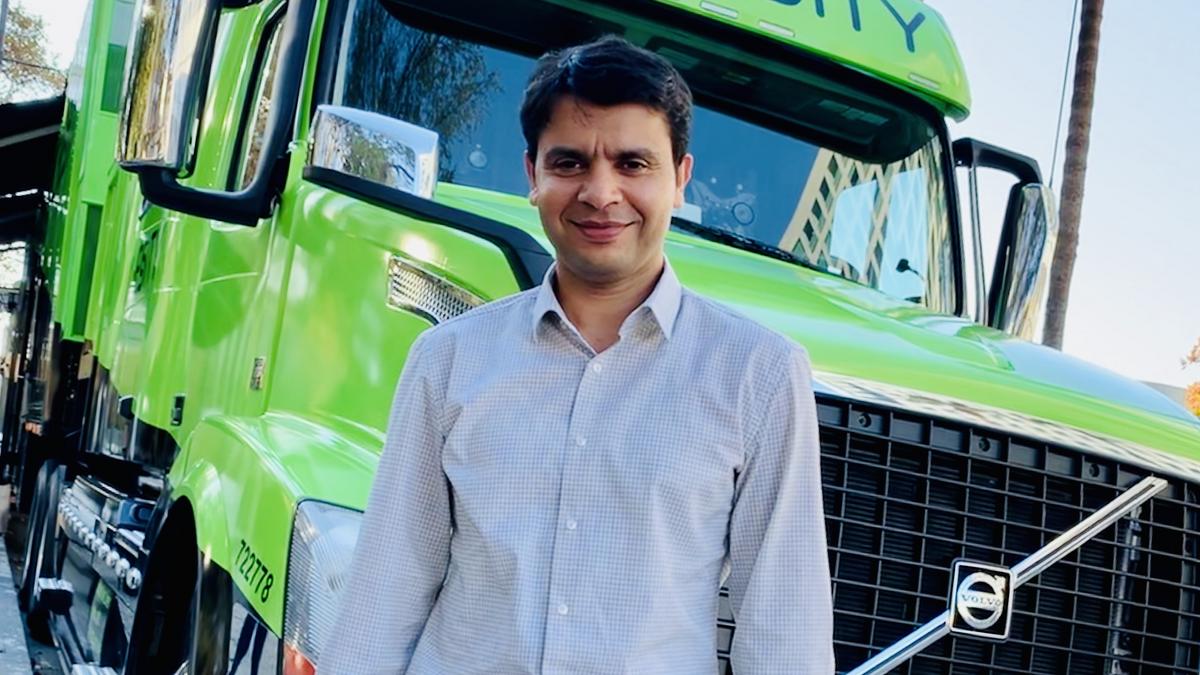
By December 2018, Cohesity had 830 employees around the world, up from fewer than 200 when it had moved into its San Jose offices a year earlier. Its ambitions were taking up more floors. A photograph from that period shows Aron beside a bright green demonstration truck preparing for a promotional tour. Enterprise software, despite its considerable abstractions, sometimes has to put on shoes and go out to meet people. In this case, it acquired wheels.
Aron had to learn that meeting people and employing them demanded different judgment from evaluating code. He has spoken candidly about being unprepared for the CEO role. Engineering encouraged deep concentration; running the business required inspection across sales, marketing, finance, and product development. An executive who vanishes indefinitely into one problem leaves other problems without attention. The afternoon coding habit makes an appealing anecdote precisely because it also illustrates a limit.
The limits were visible in hiring. Early Cohesity experienced executive turnover, and Aron had to improve how he selected business leaders and how he delegated to them. Technical skill did not automatically teach him to assess every other profession. Nor did personal familiarity with a problem make him the right person to solve it forever. This is a less glamorous achievement than a product launch, but a consequential one: learning to let an organization become larger than your own capacity.
In August 2022, Sanjay Poonen became Cohesity’s CEO and president. Aron moved into the chief technology and product officer role, retaining responsibilities that included research and development. He had approached the board about finding an experienced executive to partner with. His announcement described a desire to concentrate his time where he could contribute most. After nine years as CEO, he was changing the shape of the job rather than pretending one person’s attention could expand without limit.
Leave something for the next student
Aron’s advice to young engineers has often been to spend time learning before founding a company. That is an interesting position for somebody whose biography can easily be compressed into a string of startups. Compression removes the apprenticeship. It also removes the uncertainty, the changes of role, and the years spent discovering which mistakes were avoidable. He has encouraged students to join teams with experienced leaders and learn how good organizations actually operate.
His connection to those students is financial as well as rhetorical. IIT Delhi announced a $1 million gift from Aron in October 2021 for its computer science and engineering department. The endowment supports faculty research and helps students attend conferences, workshops, and competitive events in India and abroad. These are specific opportunities to meet ideas and people beyond a classroom. They give someone else a chance to make the sort of journey that changed his own working life.
Rice has also remained part of his life. He has served on its engineering advisory board and supported computer science. Rice recognized him with its Outstanding Engineering Alumni Award in 2018; IIT Delhi gave him its Distinguished Alumni Award in 2019. Away from institutional honors, his tastes are pleasantly concrete. He has named Sholay and The Godfather Part II among his favorite films. His workplace motto is shorter than either screenplay: “be humble and keep learning.”
The third company knows about meetings
SciFin, founded in 2024, emerged from stealth on September 1, 2026, announcing $44 million in funding. Altimeter and Madrona co-led its seed round. Aron is its founder and CEO. The company initially focuses on revenue teams, connecting information about customers, deals, forecasts, and the work around them. Its AI companion, Pixie, is intended to turn that shared picture into answers and recommended actions. The problem grew from Aron’s own experience running businesses whose information lived in too many places.
His description of the ambition is compact: “We need to move from systems of record to systems of reality.” A database can preserve what someone entered. Understanding a customer or a forecast may require information from conversations and several other systems. SciFin proposes to keep that context together. The premise is recognizable to anyone who has attended a meeting chiefly to discover what happened in the previous meeting. At least the engineer now has a personal acquaintance with the inconvenience.
There is continuity here without a guarantee of outcome. Nutanix addressed how infrastructure fit together. Cohesity addressed how data was stored, protected, and used. SciFin addresses what a business can understand from its scattered information. Each project asks a different version of a question Aron has spent years pursuing: what useful work becomes possible when the pieces cooperate? His third company will have to earn its answer from customers, one ordinary working day at a time.