A company may have hundreds of ways to record a customer and still struggle to recognize that customer when the phone rings. Billing knows one thing. An order system knows another. Somewhere else, an application has the information that would make the conversation considerably less irritating. Achi Rotem built his working life around this sort of problem: plenty of data, scattered intelligence, a person waiting for an answer.
His proposal at K2view sounds almost modest. Gather the information around the thing the business cares about. Give an individual customer, order, or other entity its own micro-database. In a field fond of immense containers and expansive terminology, Rotem’s recurring interest is the smaller package that can actually be used.
The idea has a history. It runs through telecom implementations, a company founded with Rafi Cohen in 2009, patents, outside investment, and a succession that left Rotem inside the business as president. The thread is easier to follow than the vocabulary. He kept returning to the same practical question: how does information become useful at the moment somebody needs it?
The merger behind the idea
Before K2view, Rotem worked at TTI Telecom as an assistant vice president and chief solutions architect. The job involved turning market requirements into enterprise systems at substantial scale. At Amdocs, he later led complex migrations involving business support systems, including the migration following the Sprint-Nextel merger.
A merger is a revealing place to encounter enterprise technology. The businesses can acquire a shared name while their systems retain separate habits. Bringing the information together is implementation work, with all the inconvenient particulars that the word implies. Rotem’s career placed him among those particulars before he became a founder.
K2view’s early product addressed moving data into new systems. Its organizing decision was to move the information belonging to a business entity together, rather than proceeding table by table. A customer supplied the boundary. The business could move toward a new technology while keeping attention on the unit that mattered to its operations.
That beginning gives the later platform a concrete origin. A technique for migration opened onto a larger question about how enterprise information should be arranged. Once a complete customer record can be assembled across systems, the same organizing idea has uses beyond moving it somewhere else.
A customer-sized database
Rotem and Cohen founded K2view in 2009. Their company would develop an approach in which each individual business entity has a micro-database containing its related information. The entity could be a customer, a shipment, or an order. The choice of boundary matters more than the fashionable name of the storage layer.
Consider an illustrative customer enquiry. A billing record, an open order, and a service history can sit in separate systems. Each makes sense on its own terms. The person answering the enquiry needs them together. Rotem’s organizing principle asks the technology to assemble the context before the conversation demands it.
This gives the technical story an everyday shape. Asking about one customer should not require treating every customer’s information as the immediate subject of the enquiry. The smaller package preserves the relationship among the pieces. It supplies a way to talk about a large data problem without losing sight of the person or transaction involved.
By September 2023, Rotem was describing a Data Product Platform that managed the lifecycle of these products: design, engineering, testing, deployment, monitoring, and support. It could be deployed in cloud, on-premises, or hybrid environments. The organizing idea remained consistent while the surrounding product became more elaborate.
“You need to be able to make data operational.”
Achi Rotem, 2020
Proof before a pitch
In August 2020, K2view announced a $28 million financing round led by Forestay Capital, with Genesis Partners participating. Eleven years separated the founding from that announcement. Rotem’s explanation was specific: he wanted evidence of a market and customers who could say their businesses depended on the technology before taking investors’ money.
That is a demanding kind of reference. A satisfied demonstration and a system that becomes part of daily operations carry different obligations. His stated test tied the funding decision to use in the real world. The confidence he described came from customers who had already committed their work to the product.
The capital had a job to do. Rotem outlined expansion of direct sales and marketing internationally, alongside a larger channel strategy involving systems integrators. The company had technology to sell and relationships to extend. Explaining the work to more buyers became part of the work itself.
The funding story is useful because it shows a founder’s chosen sequence. First came a product and operational customers. Later came money to widen its reach. That sequence does not describe every enterprise business, but it makes Rotem’s public account more distinctive than a list of financing milestones.
A patent you can hold
One photograph catches Rotem in a black polo shirt, holding a patent certificate in an office. There is a chair beside him and daylight behind him. The object in his hands is wonderfully literal: a paper record of an idea whose normal workplace is invisible.
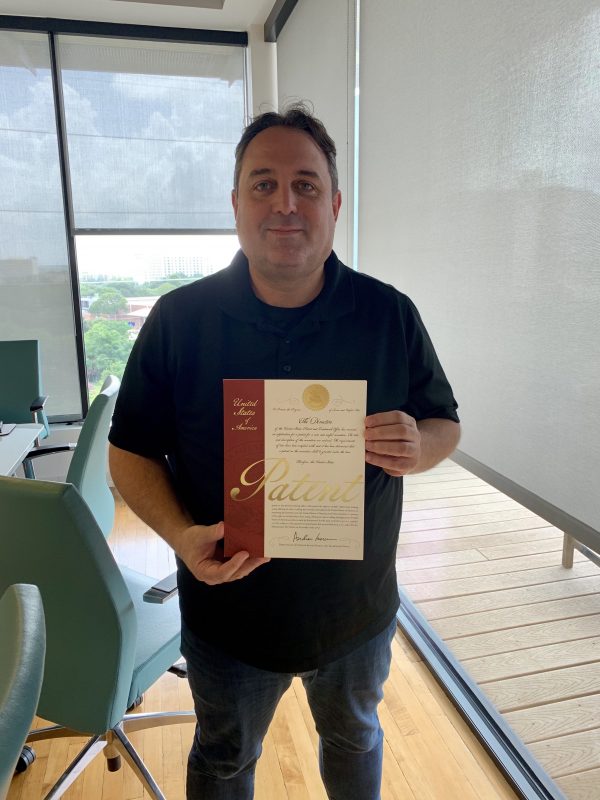
The U.S. patent for the distributed logical unit repository was issued on June 4, 2019. Rotem and Einav Itamar are the named inventors. Its subject is a database organized around a particular logical unit, bringing the associated structure and information together so that questions about that entity can be answered through that repository.
A second U.S. patent, issued in May 2020, concerns encryption-directed database management. K2view described an approach with encryption at several levels, including individual entity stores. The small unit carried implications for securing information as well as assembling it.
The distinction between those two problems matters. Information has to be available to the people and applications entitled to use it. It also needs protection. A neat organizational idea must survive both demands before it can become useful enterprise infrastructure.
Rotem’s technical writing pressed the implications further. He questioned why applications should each maintain their own isolated representation of a customer. He pictured developers retrieving or updating an entity through services, letting them concentrate on functionality. The ambition was to change the relationship between applications and the data they use.
Paying the marketing bill
The K2view name points to K2, the mountain. In the company’s naming story, reaching the summit supplies a metaphor for obtaining a broad view of information scattered across an enterprise. It is an ambitious name for a business whose central technique works by making the unit of attention smaller.
The early company identity included a stated commitment to fairness toward employees, partners, and customers. Its marketing leadership described a business that had relied on word of mouth for years. The company eventually decided it needed to explain itself more widely, following the funding round.
Rotem used the language of a marketing debt in his own account of the brand refresh. Product development and customer success had absorbed attention; public positioning now required investment. The refreshed circular logo represented continuity, microservices, and the digital entity. Even the graphic identity had to carry part of the architecture.
There is a familiar founder difficulty inside that account. Building something and making it intelligible are separate tasks with overlapping consequences. Enterprise buyers need to understand what an unfamiliar system will do inside a very familiar tangle. A product can earn recommendations while still requiring a clearer public explanation.
Three titles, one company
Rotem served as K2view’s CTO until 2020, then as CEO. In December 2023, Ronen Schwartz succeeded him as chief executive and Rotem became president. The announcement described a founder remaining involved while responsibility for leading the business passed to another executive.
Schwartz brought experience from NetApp and Informatica. Rotem welcomed his background in organizations, partnerships, and markets. The transition placed a different set of executive experiences alongside the founder’s technical and commercial history. It was a change in the allocation of work within the company.
Another part of his public record concerns the workplace itself. In a LinkedIn post, Rotem rejected discrimination and committed the company to an inclusive culture where people’s voices would be heard and respected. It was a plain statement about the conditions under which colleagues should work together.
In 2025, K2view also described Rotem joining a community event introducing girls from the Commonwealth of Independent States to technology and the company’s product. The event adds a concrete instance of participation outside the usual founder itinerary of launches, funding, and executive appointments.
The next question still needs context
Rotem’s published executive biography describes his continuing ambition to bring AI and enterprise data together, improving responsiveness and the usefulness of interactions. The company’s customer advisory board agenda has also placed him in a discussion about data architectures for generative AI. His subject has acquired a new audience.
A language model can produce a fluent response. An enterprise interaction additionally needs information about the customer, account, or order in question. The connection to Rotem’s earlier work is direct: the practical unit still needs its context assembled. New interfaces create another reason to revisit an older organizational difficulty.
In September 2026, K2view announced a patent for Broadway, its visual data orchestration engine. The company describes that engine as supporting its entity-based data products. Rotem remains listed as president and co-founder on the current leadership page. The business continues to develop around the approach he helped establish.
The customer waiting on the phone has little reason to admire any of this architecture. They would prefer an answer. That is a useful final measure for Rotem’s story. A career spent among systems leads back to the moment when their information has to make sense to somebody else.