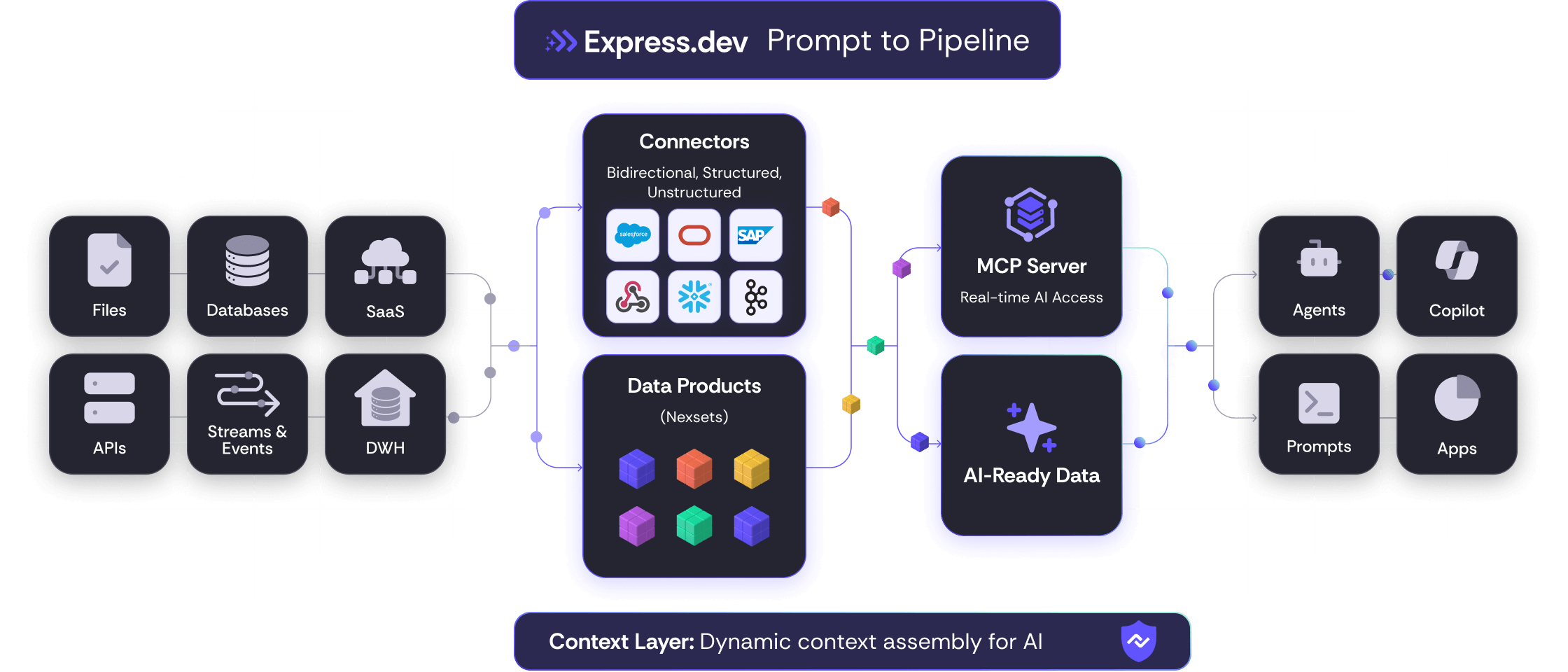
It is a Tuesday in San Mateo, and somewhere inside Nexla's platform a trillion rows of data are quietly minding their own business - getting joined, validated, masked, and shipped off to a language model that will, in a few seconds, answer a customer's question.
The plumbers of the AI era
Nobody throws parades for plumbers. They throw parades for the architects, the chefs, the bands. And yet the moment a pipe bursts, the plumber becomes the most important person in the room.
That is roughly the role Nexla has carved out for itself in enterprise AI. While the headlines belong to model providers and chatbot demos, Nexla sits one layer below, in the part of the stack where data lives in 47 different systems, half of them named things like prod_legacy_v3_FINAL, and refuses to play nicely with anything. Nexla makes them play nicely. It does this, mostly, without anyone writing code.
The result is a San Mateo company of roughly seventy people that moves more than ten trillion records a year for customers that include DoorDash, LinkedIn, Johnson & Johnson, Autodesk, LiveRamp, and American Express. The platform calls its core abstraction a Nexset - a virtual, ready-to-use data product that hides the ugliness of the source and exposes only the parts an analyst, an app, or an AI agent actually needs.
The world's most expensive scavenger hunt
The dirty secret of enterprise AI is that the models are the easy part. The hard part is finding the data, cleaning the data, getting permission to use the data, and then delivering the data to the model in a format it can stomach. McKinsey-grade studies estimate that data scientists spend most of their time on this. They put it more politely.
Saket Saurabh saw it firsthand at his previous startup, the mobile-ad-serving company Mobsmith, where small data engineering decisions had outsized consequences on what the product could actually do. Before that, he had worked on accelerated computing at NVIDIA, where the same lesson was true at a different scale. The pattern was familiar: the smart people kept getting stuck on the plumbing.
Everyone wants to be in the AI business. Almost nobody wants to be in the data-cleaning business. Nexla took the unwanted job. - YesPress
The conventional wisdom in 2016 was that data integration was a solved problem. There were ETL tools, ELT tools, message queues, lakes, warehouses, and an entire industry of consultants who knew how to wire them together. The conventional wisdom was, as conventional wisdom tends to be, wrong - or at least incomplete. Existing tools were built for the engineer who knew exactly what they wanted. They were not built for the analyst, the product manager, or, more recently, the autonomous agent that wants data on demand without filing a Jira ticket.
Three engineers, one stubborn idea
Saurabh started Nexla in 2016 with co-founders Avinash Shahdadpuri and Jeff Williams. Their bet was unfashionable at the time: that data integration should be a product, not a project. That a no-code interface, backed by serious engineering, could do for data plumbing what Stripe did for payments - hide the complicated parts behind a clean line.
It is the kind of bet that sounds obvious in hindsight and slightly mad at the time of writing the check. The team kept building.
Saket Saurabh
Ex-NVIDIA. Founded Mobsmith (acquired, then IPO'd). Wharton MBA, IIT Kanpur CS.
Avinash Shahdadpuri
Two decades of engineering leadership in distributed data systems.
Jeff Williams
Architect on the data platform's bones, before bones were fashionable.
Data integration should be a product, not a project. - The bet, paraphrased
A short, honest timeline
- 2016Nexla founded in the Bay Area to make data ready for any system.
- 2018Seed round closes; first enterprise customers go into production.
- 2019Named a Gartner Cool Vendor in Data Management.
- 2020Series A; the platform's no-code interface goes mainstream inside customers like DoorDash.
- 2023Raises an additional $18M to lean into generative AI data infrastructure.
- 2026Ships MCP server support and Nexla Express; private data marketplaces go GA.
One platform, four jobs
What Nexla actually sells is a single platform that does four somewhat boring things very well: it connects to anything (550+ systems, bidirectionally), transforms the data into reusable products, governs who can see what, and delivers the result to whoever or whatever needs it - a dashboard, a downstream system, or, increasingly, an AI agent that speaks through the Model Context Protocol.
The Platform
Ingestion, transformation, delivery, monitoring. Cloud, on-prem, or hybrid.
Nexsets
Virtual data products. The schema-stable face of the messy reality below.
Agentic RAG & MCP
Tools to feed governed enterprise data to LLM agents, in real time.
Private Marketplace
Share data products across teams or partners, with policy baked in.
The interface looks deceptively simple - drag, drop, configure, schedule. Underneath, there is a small encyclopedia of schema inference, change-data-capture, lineage tracking, data masking, and validation rules that the user does not have to think about. Which is the point. The thing about good plumbing is that you only notice it when it is bad.
What the numbers actually say
Total funding through 2023 sits at $33.5M - not Silicon Valley moonshot money, but the kind of disciplined capital that suggests a business being built, not a story being staged. Revenue has roughly doubled year over year, per third-party tracker Latka.
Reported ARR, 2022-2024
Ten trillion records a year is not a metric you fake. It is either true or it is embarrassing. - YesPress
The recognition is, if anything, a leading indicator. Gartner has named the company in its Voice of the Customer report four years running. The DBTA 100 listed it in 2025. The CRN Big Data 100 placed it at number 28. None of these are the Oscars. They are the trade-press equivalent of being quietly respected by people who run the back office.
Make data behave
Nexla's stated mission is to make data ready for AI and analytics by giving every team - technical or not - a no-code way to integrate, transform, and govern any data, anywhere. Stated missions are usually a kind of corporate karaoke. This one happens to be roughly what the company actually does on weekdays.
There is a deeper claim underneath, which is the bet that data products will be to the agentic-AI era what APIs were to the web era. If that's right, then the company that owns the abstraction - that ships the most useful Nexset, the cleanest MCP server, the most trusted marketplace - is the company everyone in the building ends up logging into. That is the prize.
The next ten trillion records
The agentic-AI era is going to want more data, more often, with more strings attached. It will want lineage. It will want governance. It will want freshness measured in minutes, not days. It will want the ability to ask a question in English and get an answer that is grounded in a specific row in a specific system, with a paper trail.
Nexla has been quietly building exactly that scaffolding for a decade. The next decade is when the rest of the industry catches up to needing it.
Back to the Tuesday in San Mateo
It is still Tuesday. The trillion rows have not slowed down. Somewhere a model is composing an answer for a customer who will never know the answer touched seven systems, three clouds, and two compliance regimes on its way to the screen.
This is, in the end, what good plumbing looks like. You do not see it. You just notice that the lights work.
Nobody throws parades for plumbers. Then again, nobody throws parades for the people who finally got the AI to answer the question, either. - Filed, 2026
Where to find them
- → nexla.com
- → Twitter / X
- → YouTube
- → Nexla Blog
- → Crunchbase
- → Company / About