Consider the small mystery of a dog who seems a little off. Nothing dramatic. Just enough to make its owner reach for a phone. Before anyone examines the animal, the owner faces a different problem: deciding whether the worry deserves an appointment, a bill and an afternoon away from work. Modern Animal has built a veterinary business around that moment of hesitation.
- Annual memberships include exams and 24/7 virtual care.
- Tests, medication and procedures still cost extra.
- The company runs clinics and builds its own clinical software.
- Chewy bought the business for $400 million in May 2026.
Its proposition is straightforward. Pay for access in advance, then make it easier to ask for help. Book through an app. Message a care team after hours. Come into a clinic when hands, instruments and an actual examination are needed. The customer is a dog or cat owner who wants continuity, particularly someone whose calendar does not cooperate with telephone tag.
The question before the appointment
Founded in 2019 by Steven Eidelman and Ben Jacobs, Modern Animal opened its first clinic in West Hollywood in April 2020. The timing placed a new care model inside the pandemic. Demand quickly required limits on memberships. That early constraint matters: an app can accept another download instantly; a veterinarian cannot examine another patient instantly.
The physical clinics carry the same argument as the app. Architecture collaborator Design, Bitches describes eliminating barriers between customer spaces and the back of house. Sightlines, materials and daylight make treatment areas feel less remote. The design gives an anxious owner something useful: a clearer sense of what is happening around their animal.
Behind those spaces is a familiar medical offering: wellness visits, vaccines, diagnostic testing, dentistry, surgery and management of chronic conditions. Urgent care handles problems that need prompt attention without being emergencies. The difference lies in how those services connect to the conversation before a visit and the questions afterward.

The relationship also extends beyond appointments. A 2024 partnership with DOG PPL, the Santa Monica canine social club, paired medical expertise with community events and educational content. Topics included preventive care and dog-park safety. It is an unusually literal way of meeting customers where they already spend time with their dogs.
The fine print is the product
In California and Colorado, the published All Access membership costs $199 per pet annually. It includes unlimited exams and 24/7 virtual care. Essential costs $99 and includes one exam plus virtual access. An owner can also skip membership and pay $85 per exam. Texas prices are lower: $169, $89 and $75, respectively.
Those numbers buy a relationship with defined benefits. They do not buy every medical service. Tests, treatments, vaccines and procedures are additional. Calling the membership insurance would give an owner precisely the wrong expectation. The bill for getting advice and the bill for doing something about it remain different things.
Three exams at $85 exceed the annual fee by $56. Treatments are extra under either option. This compares exam fees only.
For a pet that needs repeated checks, the arithmetic can favor membership. For an owner who rarely visits, the value may rest more on access to advice. Either way, the practical question is whether the nearby clinic and the included benefits fit that particular animal’s needs.
Small Door Veterinary offers a close membership alternative. Bond Vet, Petfolk and local practices compete for convenient care. Modern Animal’s position is the combination: clinics, virtual support, owner-facing software and an internal clinical system under one operator. Its core business is providing care; the software helps deliver it.
The app makes those connections tangible. Owners can manage appointments, consult their care team and request prescriptions without starting a separate administrative journey each time. Pharmacy services include clinic pickup, home delivery and optional recurring shipments. For an owner managing an ongoing condition, the convenience lies in keeping those recurring tasks together.
The software had to earn its way back
That internal system has a name: Claude. Getting there was messy. In a public reflection, Eidelman said the company initially hoped to build on third-party systems. Sparse APIs and documentation frustrated that approach. Modern Animal built its own electronic records, scheduling, communications tools and mobile app instead.
Ownership did not make execution painless. Eidelman described rollouts with the wrong features and insufficient attention to the team’s feedback. “We lost our team’s confidence,” he wrote. The admission gives the technology story some weight. A tool that looks persuasive in a demonstration can still make a clinician’s day harder.
“We lost our team’s confidence”
Steven Eidelman, reflecting on early software rollouts
By May 2024, the company was introducing AI-assisted patient overviews, visit summaries and draft lab-result interpretations. Nearly 40 clinical team members helped incubate the features. Engineers shadowed practitioners. Doctors reviewed client-facing summaries and diagnostic drafts. The stated aim was to reduce administrative work, with the clinician remaining responsible for the medicine.
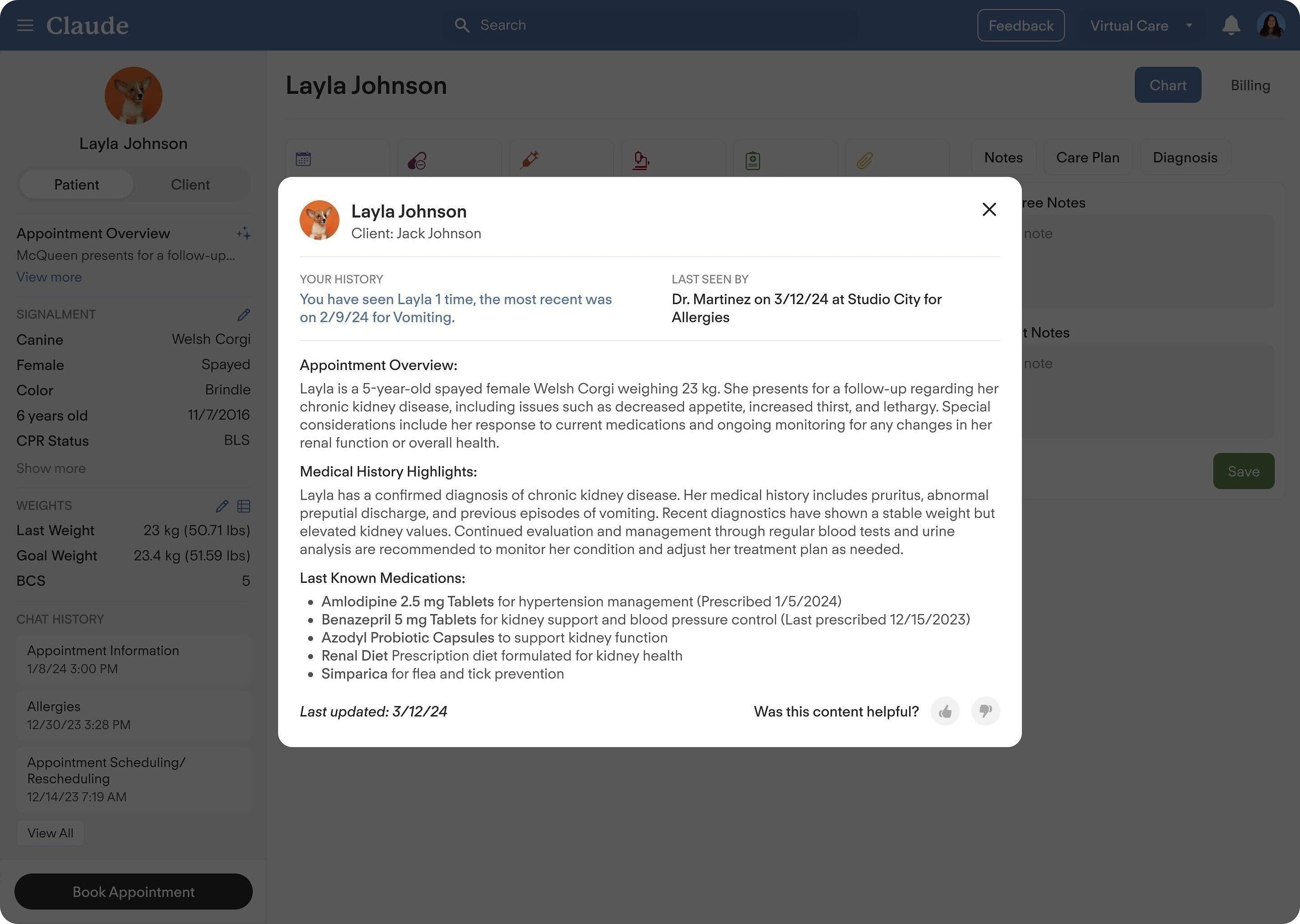
The recruiting pitch follows the same concern for the people doing the work. Modern Animal advertises mentorship, continuing education, mental-health resources and collaboration with its technology team. Those are employer commitments rather than proof of every employee’s experience. They do, however, show how central the practitioner is to the company’s proposed customer experience.
A $400 million vote on the whole system
Building the network required substantial capital. Publicly announced rounds included $75.5 million across Series A and B, another $75 million in Series C and $46 million in 2025. In September 2025, Modern Animal reported a $100 million annual revenue run rate. That measures the pace of business, rather than a completed year’s revenue.
Chewy completed its $400 million purchase on May 21, 2026. At the April announcement, the buyer counted 29 Modern Animal clinics and more than 100,000 member families. The acquisition connects veterinary relationships to Chewy’s pharmacy and commerce operations. An October rollout began bringing Chewy-powered prescription fulfillment into the Modern Animal app in selected regions.
The businesses are still distinct in ways customers should understand. Modern Animal says its memberships apply at its own clinics; records do not automatically transfer to Chewy clinics. Virtual care also has boundaries: the company requires an in-person relationship before virtual diagnosis or prescribing. Emergency treatment requires an appropriate facility.
The lesson worth copying is practical. Publish the prices. Watch the work before designing the tool. Give customers a clear route from a question to an examination. The same model depends on enough clinicians, reachable clinics and owners able to pay for treatment. Removing hesitation is useful. Having the capacity to answer it is the harder business.
Follow the conversation
PROFILE UPDATED 24 OCT 2026 · PRICES VARY BY REGION